Pages

Showing posts with label Fraser. Show all posts

24 October 2018

Fatigue


It's not blogging fatigue. It's more like research fatigue. With other interests taking precedence. Make that other preoccupations.

Then Scotland's People informed me that my credits were about to expire. Stir yourself, I said. Where did those Frasers and McIntyres and McKenzies and Dougalls come from?

Some time ago I hit my personal brick wall with the wild explosion and correlation of DNA evidence. I watch proceedings of the MacFadyen DNA Project and the Isle of Coll DNA studies. Thanks be to those who understand chromosome segments (and all that) and diligently report to the few of us pathetic fogeys. Could be that my Neanderthal cells have surged, overpowering what's left of my unfocused brain.

My to-do pile grew into three foot-high stacks. For variety, the genealogy notes are mingled with scarcely decipherable travel journals, medication printouts from the pharmacy, photographs to scan, sketches for furniture rearranging, memos about meetings, and physiotherapy sheets of stick figures demonstrating painful positions. Momentary thoughts of de-cluttering the filing cabinet cross my cluttered mind.


Searching for the origins of one Fraser line have narrowed to two parishes in western Inverness-shire: Kiltarlity and Kirkhill. I'm sure the reason for this decision will become clear when I spend more time upright instead of performing all those supine exercises. And pursuing trial courses of painkillers.

I don't expect my John Fraser's daddy had enough worldly goods or estate to leave a testament in Inverness Commissary Court that would mention his son in the colonies but it should be fun trying to correlate a few wills with the transcribed burial stones.

Hold on, Scotland's People ... don't give up on me yet. Pass the codeine, please. It's been a Lousy Year.

© 2018 Brenda Dougall Merriman


10 July 2015

DONE: Independent Small Print Publishing

... As "done" as any modest family history ever is. The dead ends and brick walls are obvious points for pulling together what you have and starting to write. In my case, that began about seven years ago. More sub-title: John Fraser from Inverness-shire, Scotland and John Fraser from Perthshire, Scotland.
Then, as so often happens in the evolving access to sources, more information surfaced as I applied myself to the narrative task. The research continued irresistibly as I wrote.

It's difficult for the genealogist to call a research halt; it's difficult for the writer to stop editing the manuscript. But the moral is you have to start writing sometime, and you have to stop somewhere.

The print-on-demand publisher I'd used before ‒ Belgium-based ShopMyBooks, formerly known as UniBook ‒ decided to go all "new and improved" and oh by the way, we are deleting your previous books with us unless you re-format them from scratch, imposing a fast-looming deadline. Following our three easy steps. Trust me, the steps were not easy and SMB was not responding to email. One friend complied, with difficulty, and had dreadfully frustrating delivery problems.

Originally the SMB process was easy for the technology-challenged. The search for something similar yielded websites like Lulu, CreateSpace, and Blurb. My manuscript was created long ago in 8.5 x 11 size to match my earlier family histories. Not every company would accept that size with the options I wanted and I was not going through 110 pages to re-format to say 8 x 10 with the headaches of re-sizing photos, placement of 243 footnotes, odd-page alignment for new chapters, etc. I chose CreateSpace (CS). So check out finished-size availability before you start formatting your manuscript in a certain size!

Uploading with CS is the easy part. And they will assign you an ISBN number if you wish. Because it's an American company, they want tax information which amounts to nothing if you are a non-US citizen, but still, some pertinent forms to go through. Also, because CS is an Amazon company they pay a lot of attention to marketing, sales, and distribution. You can set your own price, including a royalty if that turns you on. Since my only "market" is my extended family, I am not going into high gear over those aspects.

Cover design is important and has technical specifications that were over my beleaguered head. They would not be beyond your average, clear-thinking genealogist. I believe the three-mentioned companies have similar requirements, some providing a template to follow ~ but if I see the word bleed again in the next ten years it will be too soon ~ Instead I sought a knowledgeable colleague, for whom I am extremely grateful, to manage that feature. (CS does provide helpful services for a fee.)

I am pleased with the finished product and even more pleased with the discounted cost for my own purchases. Once I reviewed and approved the proof copy they provided, and sent in my own order, the delivery from South Carolina to Toronto was made in an astonishing forty-eight hours. Oopsy, did I mention? - customs duty on the shipment, not onerous.

Now I feel I can update the former family histories with some faith and familiarity in the procedure.

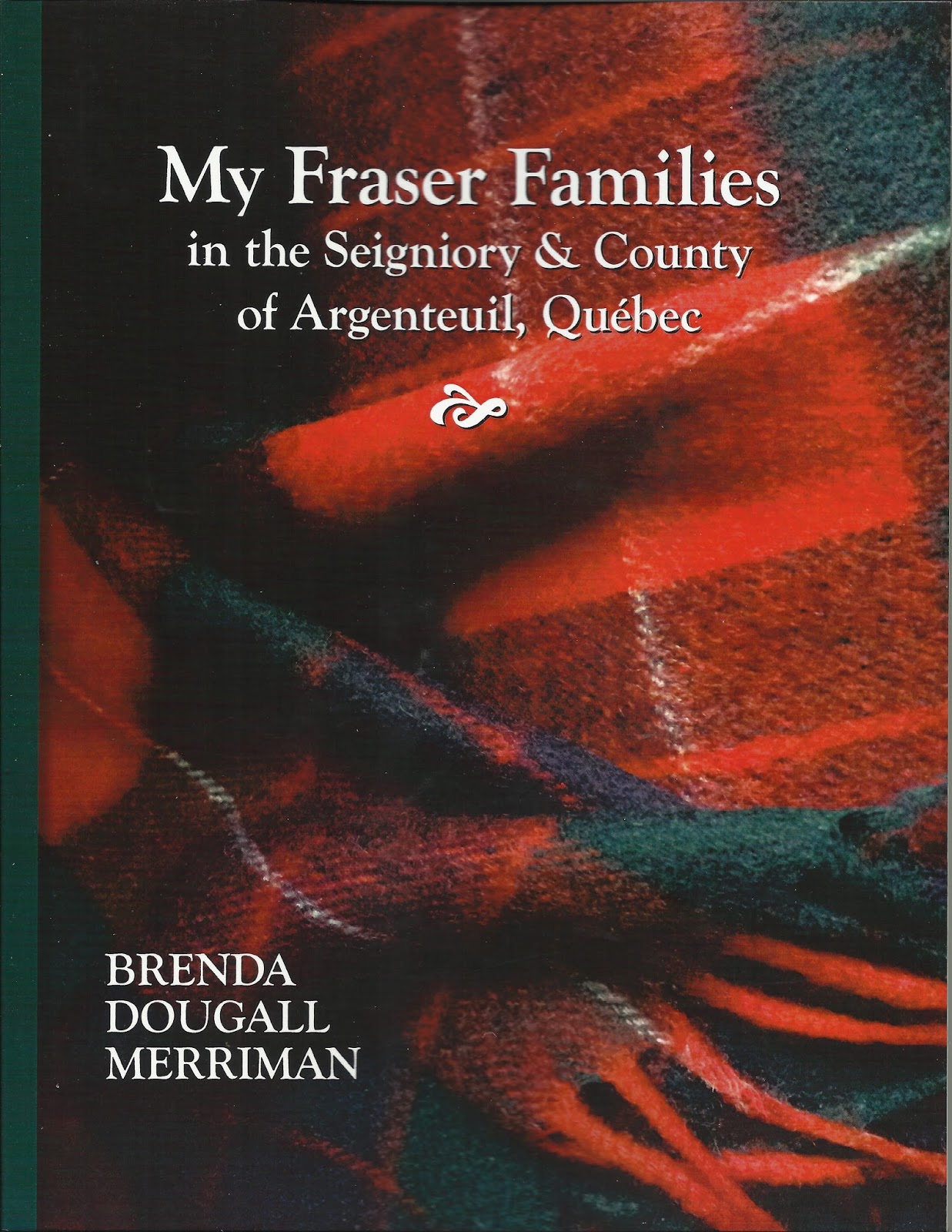
Without a doubt, further relevant genealogical sources and information and evidence will appear, with or without me. Let's hope My Fraser Families will inspire the millennial generation to carry on.

© 2015 Brenda Dougall Merriman

20 March 2015

Blogivvvversary

Rumours of my dropout, disappearance, or death have probably been gravely overestimated. After all, the blog name is right there in your face should you actually look for it. The name was hastily chosen with no forethought whatsoever when a techno-terrific offspring created it for me upon departure for the airport never to be seen again. And ~ woe ~ leaving moi to my own meagre devices.

Just think, if I'd had more techno-smarts I wouldn't be stuck with boring eponymous blogger me. I could have called it DyingfromBirth.com© (... It's taken. By me). Or changed it to BalticandCelticConnections. So many bloggers have created clever blog titles. After eight years, it's a little late to change, I'm thinking. Eight years of scribbling, hard to believe because it seems like forever. Didn't blogging always exist? So why does everything takes twice as long to do now.

A blogiversary is a customary time for review. The past year, blog-wise, was interesting, as always. I persevered with The Book of Me until me felt boringly over-exposed ― absolutely no reflection on Julie's series and all who stayed the course into a new year. My blog is primarily a record of research tales. If my experience in researching, methodology, problem analysis, or the occasional whimsy benefits anyone in the broad genealogical community, all the better.

Ongoing problems encountered in my FRASER family history were painfully articulated and aired, only to spawn further problems, similar to the way fruit flies breed. Not only that, I lack a firm grip on autosomal DNA (why does it have to have all those SNP numbers - stop snickering) never mind the forthcoming Y-DNA results about to scare the pants off me.

End of blog review, especially since I've used the word boring twice already. Otherwise:

Leaving comments on a blog post has become pretty well passé (therefore all the more appreciated). The trend is to notify a thousand friends on social media when a new post is up to collect likes and Internet-generated statistics. Numbers again, eh? The process reminds me of how many of my old real friends have the gall discipline to avoid Facebook and Google+ altogether.

On a different tack, disaster of sorts struck in the late fall. The print-on-demand outfit I used for several family history books had a kind of mid-life crisis, reverting to its Belgian origins as best as I and my equally-impacted friend Elayne can figure. It's complicated; but bottom line, we have to take time from the writing and editing to shop around (trying not to despair over complex formatting issues.)

This genealogy blog is not the only one I write, as some know. I've reviewed countless books for three years, mainly crime novels but also notable new fiction, on an inappropriately-named blog (one senses rightly I have a blog-naming disorder.) My personal Famdamily failed to produce the expected fodder for satire, although luckily other surroundings did.

But my favourite pet is CamelDabbleTravelBabble, a title I managed to nail. It consumes pleasant time when I am in this country reminding me of other parts of the world. I know ~ it's hit and miss sometimes ~ but more fun than (and relief from) genealogical proof arguments. It is my sincere hope that I never run out of topics there.

© 2015 Brenda Dougall Merriman

28 February 2015

McIntyre Hunt / Study, an inch of progress

Still beating my McIntyre drum in the former St. Andrews East parish (Saint-André d'Argenteuil), Seigneurie and County of Argenteuil, Quebec. Research findings show that three men in a close community were all married to McIntyre women of unknown origin in Scotland: 
John Cameron (before 1803); 
John Fraser (in 1808); and 
Walter Graham (in 1818).
River Rouge, 1889
(1) John Fraser, my Argenteuil, Quebec, farmer from Inverness-shire, was a widower when he married spinster Margery McIntyre age twenty-two on 17 August 1808 at St. Gabriel Street Presbyterian Church in Montreal.[1] John was described as “farmer of Rivière Rouge” and Margery was “of the same place.” John signed the register and Margery made her mark. The witnesses were Robert McNabb and William Cameron. Margery was therefore born about 1786. John Fraser arrived in Canada with his first wife after the birth of his second child James in Scotland ca.1804 and before his next child Elizabeth in 1806.

Finding a family for Margery is the ongoing goal.

(2) Catherine McIntyre was married to a John Cameron as per the 1851 census.[2] Her age was then said to be seventy-five, making a birth year of ca.1777 (census taken mainly in January 1852: age at next birthday). Catherine is further identified as his wife in numerous baptismal entries for their children and in John's will.[3] We don't know when he (or the couple?) arrived in Canada, but he purchased his original property on the Rivière Rouge Road in 1802.[4] I believe he died in 1853 but his actual burial place has not been found.[5]

John Cameron and John Fraser were witnessing for each other at some baptismal events. John Cameron was illiterate (“ ... the said Testator having persisted therein had made his mark having declared that he could not write his name ...”) as also evidenced in land and church records[6] ― clearly distinguishing him from an older John Cameron ("l'âiné") whose homestead was at Cote du Midi very close by. We don't know the age difference between the two John Camerons or if or how they were related.

(3) Walter Graham, gentleman of Montreal, married Jane McIntyre of the same place 26 September 1818; witnesses were Allan Cameron and Hugh McMillan.[7] This is a third early McIntyre marriage ― is Jane possibly related to our Margery and also Catherine McIntyre? Despite Walter's residence in 1818, he was living at Cote du Midi in 1825 and apparently remained there.[8] In 1842 he is among a cluster of Camerons and related families; Walter said he had been in the province for twenty-five years.[9] An emigration date of about 1817 means he arrived in Quebec only shortly before his 1818 marriage.

The couple were still living at Cote du Midi in 1851.[10] Jane's age was shown as fifty. A birth year of ca.1800 in Scotland makes her approximately a generation younger than the other two McIntyre women. The census ages all may well be approximate; "rounding off" was suspected at times. Walter Graham is another name frequently appearing in conjunction with Fraser church witnessing.

Is there another McIntyre in or near St. Andrews in the first decades of the nineteenth century? In other words, as potential family or relatives of Margery? In a survey of the few available early sources, the most likely name in the specific area is a James McIntire who witnessed a Robertson baptism in 1818 (some ten years after Margery's marriage).[11]

While I am not reproducing here a list of all McIntyre occurrences in early days, the information that stands out is:
▪ The (unnamed) widow of James McIntire in 1825 is a chef de famille located on west side Rivière Rouge, across the river from my Frasers.[12] The minimal information required on this enumeration reveals a total of five people in the home. No other McIntyre appears in St. Andrews parish.

▪ Ann Mcintyre was a household head in 1842 in “part of Argenteuil”; she was in the “single female 45 and upwards” age category.[13] The enumerator did not specify the "part" of Argenteuil but it appears to be St. Andrews. Ann's number of years living in Canada was not filled in. Her home also contained two single males between 21 and 30 and a single female aged 14-45. Of the total, two were natives of Canada, two of Scotland. She does not appear again in 1851.

A female household head is often a widow but if so, it’s uncertain whether her surname is her husband’s or that of her birth family. If the three young members are her children and everyone was accurate with their information and recording, then likely the oldest of them was born in Scotland ― always a clue to the family's emigration date. Possibly even older children had left home by then. Perhaps Jane (McIntyre) Graham was one of them.

Was James McIntire Ann's husband? Were James and Ann old enough to be Margery's parents? My sense is James would more likely have been her contemporary, possibly a brother. Could be, this is as close as I can get to potential kin although autosomal DNA results show my connection to a descendant of Catherine (McIntyre) Cameron. When I figure that one out, happy day. 


The difference in census citations indicates whether I was viewing them on microfilm or online. 

[1] St. Gabriel Street Presbyterian Church (Montreal, Quebec), 1808 register, p. 47, Fraser-McIntyre marriage; Archives of Ontario (AO) microfilm MS 351 reel 1. Also, “Quebec Vital and Church Records (Drouin Collection), 1621-1967,” digital image, Ancestry.ca (www.ancestry.ca/ : accessed 19 April 2008) where he is indexed as John Francer.
[2] John Cameron household, 1851 Census Canada East, District 33, Deux Montagnes, enumeration district 11, parish of St. Andrews, sheet 21, stamped p. 41, line 28; Library and Archives Canada (LAC) microfilm C-1147.
[3] Cour supérieure, District judiciaire de Terrebonne, Répertoire du notaire Michel-Gaspard Thibaudière de LaRonde (1825-1882), (Saint-André Avellin, Québec), document no. 3211, 20 September 1836 and codicil 13 August 1840, will of John Cameron; Bibliothèque et Archives nationales du Quebec (BAnQ) at Montreal, CN606, S5.
[4] Terrebonne Actes notariés compiled by Marney MacDonald, email Brian Anderson to Brenda Merriman 10 October 2014; Répertoire du notaire Peter Lukin [Sr.] no. 2629, 12 November 1802, John Cameron, farmer residing at Argenteuil, bought lot 29 south side Rivière Rouge from Elon Lee; signed X his mark; Notary Peter Lukin [Sr.] no. 2625, 12 November 1802, John Cameron l’ainé [Senior] habitant living at Argenteuil bought lots 19 and 20 Cote du Midi from Seigneur Patrick Murray; signature included. Citing Actes notariés, BAnQ Montreal, microfilm M620.1214.
[5] "Quebec, Non-Catholic Parish Registers, 1763-1967," digital image, FamilySearch (www.familysearch.org : accessed 5 March 2012), burial John Cameron, 8 March 1853; citing St. Andrews Presbyterian Church (St-André Est, Quebec).
[6] “Quebec Vital and Church Records, 1621-1967 (Drouin Collection), digital image, Ancestry.ca (www.ancestry.ca : accessed 5 March 2012), baptism Allan Cameron, 30 October 1807, “parents don't write”; citing St. Gabriel Street Presbyterian Church (Montreal, Quebec).
[7] “Quebec Vital and Church Records (Drouin Collection) 1621-1967,” digital image, Ancestry.ca (www.ancestry.ca : accessed 28 May 2012), Graham-McIntyre marriage, 1818 register; citing St. Gabriel Street Church (Montreal). Jane's surname was misspelled as McTeer by the minister then corrected on her signature line.
[8] "Canada, Lower Canada Census 1825," digital image, FamilySearch (www.familysearch.org : accessed 21 February 2015), York County, Argenteuil, Cote du Midi, sheet 4, stamped p. 1277, 3rd line, Walter Graham; citing LAC microfilm C-718.
[9] Walter Graham, 1842 Census Lower Canada, County Deux-Montagnes, Argenteuil seigneurie, Cote du Midi, sheet 22, stamped p. 1225, line 6; LAC microfilm C-728.
[10] “1851 Census Canada East,” digital image, Ancestry.ca (www.ancestry.ca : accessed 12 August 2012), District 33, Deux-Montagnes, ED 11, parish of St. Andrews, sheet 2, stamped p. 3, line 1, Walter Graham; citing LAC microfilm C-1147.
[11] “Quebec, Non-Catholic Parish Registers, 1763-1967,” digital image, Family Search (www.familysearch.org : accessed 28 May 2012), baptism George Robertson, 23 August 1818; citing St. Andrews Presbyterian Church register (Saint-André-Est , Quebec).
[12] "Canada, Lower Canada Census 1825," digital image, FamilySearch (www.familysearch.org : accessed 21 February 2015), District York, Argenteuil ..., sheet 6, stamped p. 1279, 5th line, Widow James McIntire; citing LAC microfilm C-718.
[13] "Canada, Lower Canada Census 1842," digital image, FamilySearch (www.familysearch.org : accessed 21 February 2015), County Deux-Montagnes, Argenteuil seigneurie, sheet 15, stamped p. 1218, line 15, Ann Mcintire; LAC microfilm C-728.

© 2015 Brenda Dougall Merriman. All rights reserved.

06 December 2014

Boleskine and Stratherrick Frasers: One Study

Herewith a study that demonstrates the underlying shortcomings of Scottish highland research. It's John Fraser again, my Argenteuil, Quebec, farmer. The long-term research goal has had multiple parts:
▪ find John's first marriage in Scotland to Ann (possibly Nancy) Fraser;
▪ find the baptisms of his two oldest children (Alexander, James) born to such a couple;
▪ find John's own baptism (range 1768-1776) and the names of his parents.

Research parameters included assumptions (assumptions can be dangerous, we know; but sometimes they are the only potential clues we have):
▪ that the local history saying John was a native of Inverness-shire is fairly accurate;
▪ that he was born ca.1776 (age at second marriage) OR ca.1768 (age on 1851/2 census);
▪ that his father was called Alexander or James (name of John's first and second sons);
▪ that his mother was called Elisabeth, Ann, or Mary (names of his daughters).

From Scotland's parish registers (OPRs): utter fail in anything resembling solid information, mainly because ― sad excuse ― Scottish OPRs for so many highland parishes are missing erratic years of baptisms and marriages. Great periodic chunks of nothing. The serving minister in the 1790s parish account of Boleskine and Abertarf, states:
 “For what reason we cannot assign, but we do not find that there has been any regular baptismal register, kept in this parish, for many years past.”[1]

Also, kirk session minutes often only survive from the nineteenth century when we need eighteenth century and earlier! Potentially helpful are monumental inscriptions (MIs) and the Old Statistical Accounts and sometimes local histories, but other sources such as estate papers, sheriff courts, tax lists, militia rolls, and so on, are usually available only in distant regional or private collections.
Boleskine Burial Ground; photo: WJ Millar, geograph,org.uk
Enter an unsourced reference to Boleskine, shire of Inverness, from an online "tree" (that unfortunately conflated three or four JohnFrasers of Quebec into one man). It was worth deeper investigation.

Combing the published Inverness-shire MIs produced any number of family possibilities that may ultimately be irrelevant. Parts of the surviving old stones are frequently illegible. In my case, each mention of an Alexander or a James on a stone had to be examined to see if my John Fraser would fit in their families. Example from Boleskine burial ground:
Flat Stone, erected by James Fraser, tacksman, Glindomore, died _[illegible]_, wife Elisabeth Fraser died 12 September 1789 age 67 years, son Hugh Fraser died 18 June 1797 age 22 years [2]

What analysis can I make of this, as applying to my John the farmer?

▪ Names: The forenames are relevant although imperfect Highland custom, since James was the name of my John's second son, and Elizabeth was the name of his first daughter. Hugh is a compatible name as a possible brother for our John who used that name for his fifth son. All three names recur in John's descendants. If this was my John's family, the loss of parents and a brother may have influenced his decision to emigrate.

▪ Place: Glindomore or Glendomore, sometimes Glendomere, has all but disappeared as a place name, but would have been a farm within the Lovat Fraser estates (one of which comprised the entire parish of Boleskine/Abertarff). The geographic location along the southeast area of Loch Ness is also known as Stratherrick.
From A Country Called Stratherrick
▪ Status: In general, tacksman meant James was in charge of Glendomore land, beholden to Lord Lovat, with very likely an intermediary principal tacksman or wadsetter to whom he paid rent. In turn, a tacksman would have sub-tenants renting smaller holdings. Rent in former days largely involved agricultural produce and loyalty as a clan soldier. The complaisant system deteriorated when the English enforced draconian tax and proscription measures after “the ’45.”

James was the tacksman at Glendomore when he had the stone made ― one would guess when his wife was buried. We don’t know the year he died; there would have been a succession of tacksmen after him. The significance of "erected by" does not necessarily imply James was living when his son Hugh died in 1797. Perhaps his death shortly followed that of his wife and someone else added the inscription for Hugh. I can’t glean anything useful from neighbouring stones (the SGS publications provide a diagram of each burial ground).

▪ Dates: Since his wife was born ca.1722, James’ birth year would be similar or earlier. He could easily have had a son born in 1768 or in 1776, but what about wife Elisabeth? At the age of forty-six (1768, the earlier suggested date for my John's birth) she would definitely be nearing the end of the conventionally accepted fertility span. Bearing a child at the age of fifty-four (1776) is not impossible but unlikely. Which brings us to the dates for their son Hugh, ca.1775–1797. The same questions apply regarding mother Elisabeth. Were dates on the stone carving deciphered accurately? Was Hugh actually a grandson? Birthing two children within two years is not in dispute; it's a matter of the mother's age.

Without access to particular regional or local sources, default to the Internet produced a great find regarding Glendomore: a horse tax list in 1797 for Boleskine/Abertarf parish.[3] It shows four Fraser men at Glendomore in two separate clusters: John and Hugh Fraser (taxed for one horse and two horses respectively); Malcolm and James Fraser (two horses and one horse). Because the two groups are separated by some MacDonalds, they appear to be two different households. We don't know if the groupings are fathers and sons, or brothers, or some other family configuration. Malcolm is a problematic name, not occurring in my family.
1797 Horse Tax List, Boleskine; NAS, E326/10/9/213
 "Date of assessment" is September 1797 which seems to eliminate this Hugh from being the man in the cemetery information unless the list had been compiled over many months. "Masters and Mistresses" seems to imply heads of, or adults, in households. One of these Fraser men would be the Glendomore tacksman because the right generally descended in one family line.[4] It would be merely a guess that John here fills that role simply because he is the first Fraser listed at the location. Could James in the second group be the erstwhile tacksman of the burial ground? Doubtful? — He would be eighty-five years old or more in 1797.

Back to the OPRs. Is there evidence of a James Fraser marriage to an Elisabeth in or near Boleskine parish between 1740 and 1775? ― “No matches” on ScotlandsPeople. A son Hugh born ca.1775 to such a couple? ― Not in the available baptisms. A son John born/baptized to such a couple 1767 to 1779? ― No. I can't even find a Malcolm born in Boleskine 1725-1782.

All I can say is it's possible that John in September 1797 was my ancestor who emigrated ca.1805 or that he belonged to the family of tacksman James. I can't support either hypothesis but I can't reject them altogether. There's simply not enough information or evidence for meaningful correlation. Is it a worthwhile exercise? Yes, but I am no farther ahead. Guesses, possibilities, probabilities; the spreadsheet is growing.

That's just one stone of dozens being examined. Why ever did I say my draft was ready for the big edit??

[1] Sir John Sinclair, digital images, The Statistical Accounts of Scotland (http://stat-acc-scot.edina.ac.uk/link/1791-99/Inverness/Boleskine%20and%20Abertarff/ : accessed 3 October 2014), Vol. 20, County of Inverness (1791-99), Boleskine and Abertarf, p. 37.
[2] Alastair G. Beattie and Margaret H. Beattie, eds., Inverness District East, Monumental Inscriptions pre-1855 (Edinburgh: Scottish Genealogy Society, 1996; "Boleskine Old Churchyard," Boleskine parish, County of Inverness, no. 48, James Fraser et al.
[3] “Historical Tax Rolls,” digital images, ScotlandsPeople (http://www.scotlandsplaces.gov.uk/digital-volumes/historical-tax-rolls/ : accessed 2 October 2014), Farm horse tax rolls 1797-1798, Volume 09 [includes Inverness-shire], sheet 213, September 1797; citing National Records of Scotland, E326/10/9/213.
[4] Sir John Sinclair, Statistical Accounts of Scotland ... Boleskine and Abertarf, pp. 21-22.

© 2014 Brenda Dougall Merriman. All rights reserved. 

23 September 2014

Seeking GORDONs

It's worth a try. Conventional genealogical wisdom (or plain general family wisdom?) says women are usually the "keepers" of family tradition, stories, souvenirs, photographs, heirlooms, and whatnot. Convention has proven true in many instances of my own families.

I've posted several times about my missing John Fraser the blacksmith; my lack of cousins has been a yawning black hole. The blacksmith had just four children. Aside from my direct ancestor, probably only one other has descendants who could hold potential keys. Maybe among them is the keeper of my missing stories.

The younger sister of my great-grandmother Catherine, Elizabeth (Eliza) Fraser married Alexander Gordon in Renfrew, Ontario on 30 October 1860.[1] Alexander was a lumber merchant in Pakenham Township, Lanark County, where the family lived in the 1861 and 1871 censuses. By 1881 they had moved slightly north to the town of Pembroke in Renfrew County and there they spent the rest of their days. Eliza died in 1891[2] but Alexander outlived her by many years. Both are buried in Calvin United Church and First Presbyterian Church Cemetery in Pembroke.[3]

From Pembroke Observer 1 November 1916:

Gleaned from Alexander's obituary, the cemetery stones, census returns, and some superficial marriage searches, their children were:

i. ISABELLA M. GORDON born ca.1862, married at Pembroke 22 September 1886 Robert Booth, lumber merchant of Ottawa.[4]
ii. ANNIE FRASER GORDON born 1863, “at home” in 1916, died in 1933.
iii. ELIZABETH GORDON born ca.1864, “at home” in 1916.
iv. GEORGE GORDON born ca.1865 was a Canadian Senator from 1912 to 1942.[5] He married Alice Emma Parry in Dunnville, Ontario on 30 August 1894.[6] His North Bay home is heritage-designated; after being sold in 1985, his grandson Gordon Taylor donated many artifacts to the North Bay Museum.  
v. ROBERT W. GORDON born 19 April 1868, died 30 September 1911, buried in Pembroke;[7] married Jane R. Sparling 19 June 1895 in Pembroke.[8]
vi. ALEXANDER GORDON born May 1870 (1871 census).
vii. PETER GORDON born ca.1873; John Peter Gordon, civil engineer of Le Pas, married Mary Agnes Barr at Pembroke on 12 November 1913.[9]
viii. JAMES GORDON born ca.1875, perhaps the “ J.B.” of Toronto, overseas in 1916.
ix. KATE LILLIAN GORDON born ca.1879, married Douglas W. Gray, a physician in Kingston, on 20 April 1905.[10]

Now, wouldn't you think there would be a family historian among that crew?

If you recognize any of these families please run, don't walk, to your nearest computer and email me, brendadougallmerriman at gmail.com.

[1] “Ontario, Canada Marriages, 1801-1928,” database, Ancestry.ca (www.ancestry.ca : accessed 17 September 2011), Gordon-Fraser marriage (1860); citing Archives of Ontario microfilm MS 248 reel 14.
[2] “Ontario, Canada Deaths 1869-1938,” digital image, Ancestry.ca (www.ancestry.ca : accessed 17 September 2011), Elizabeth Gordon, no. 014427 (1891); Archives of Ontario, MS 935.
[3] Canadian Gravemarker Gallery, digital image (www.rootsweb.ancestry.com/~cangmg/ : accessed 30 September 2011), Eastern Ontario, Renfrew County, Pembroke and Satellite Communities, Calvin United Church and First Presbyterian Church Cemetery, Alexander Gordon family gravestones.
[4] “Ontario, Canada, Marriages, 1801-1928,” digital image, Ancestry (www.ancestry.com : accessed 21 August 2014), Booth-Gordon, no. 010363 (1886); citing AO, MS 932.
[5] “Historical Buildings,” North Bay (http://www.cityofnorthbay.ca/living/history/buildings : accessed 21 August 2014).
[6] “Ontario, Canada, Marriages, 1801-1928,” digital image, Ancestry.com (www.ancestry.com : accessed 22 August 2014), Gordon-Parry, no. 001697 (1894); citing AO, MS 932.
[7] Canadian Gravemarker Gallery, digital image (www.rootsweb.ancestry.com/~cangmg/ : accessed 30 September 2011), Eastern Ontario, Renfrew County, Pembroke and Satellite Communities, Calvin United Church and First Presbyterian Church Cemetery, Robert W. Gordon gravestone.
[8] “Ontario, Canada, Marriages, 1801-1928,” digital image, Ancestry (www.ancestry.com : accessed 22 September 2014), Gordon-Sparling, no. 010817 (1895); citing AO, MS 932.
[9] “Ontario, Canada, Marriages, 1801-1928,” digital image, Ancestry (www.ancestry.com : accessed 21 August 2014), Gordon-Barr, no. 013289 (1913); citing AO, MS 932.
[10] “Ontario, Canada, Marriages, 1801-1928,” digital image, Ancestry (www.ancestry.com : accessed 21 August 2014), Gray-Gordon, no. n/a (1905); citing AO, MS 932. The registrations at this time stretched across two pages; the second page of the folio was not filmed.

© 2014 Brenda Dougall Merriman

18 September 2014

Je suis [presque] prest

First draft of my FRASER family history is almost ready for an editing round ... that semi-satisfied feeling when you've drawn a line and said no more flailing around on the unsolved bits and write down what you know. We are not talking opus magnum here: a modest couple hundred pages max. Editing can be a pleasurable experience as you try to stand back and examine whether you actually said what you meant to say.  

But editing is an onerous procedure when you work with a "camera ready" manuscript for print on demand. Adding a paragraph or a new sentence (sometimes even a word!) can throw the whole works out of kilter. Ditto for changing or reducing text. Each photograph or an illustration could need minor or major adjusting to keep its placement relevant to what it describes.

Now I find I must add a paragraph of specific caution about something we in the genealogy world know, but my family very likely does not. A paragraph to acknowledge and warn that "family trees" online ― that I rarely search ― can have serious flaws. And there you have the reason that I seldom search them. The corollary is that my family and descendants may not trust what a batty old lady has to say, preferring the graphic ease of online offerings.

As luck would have it, this week in an idle moment I threw care to the winds and entered a search engine. Lo and behold. Two contributors have conflated three or four Quebec JOHN FRASERs into one man. It's quite a stupendous achievement, especially with regard to the man born in 1776 who had a granddaughter born the same year. Two of the men are recognizably my John Frasers and one is likely a downriver (Saint Lawrence) stray from the 78th (Fraser) Highlanders. They have sourced a valid marriage, no question, but then turned the Argenteuil farmer into his son-in-law the blacksmith, awarded him three wives, and gave him a mega-passel of French-Canadian grandchildren. Both have given my female ancestor the spurious middle name of Marie.

I can't tell which, but one contributor probably followed the other's lead. Fellow bloggers and other genealogists regularly locate similar misappropriations and misattributions. It could be a full time job to keep up. Perhaps the biggest surprise was that the errors haven't been compounded in even more trees.

However. Deep breath. One of the "trees" has given me two pieces of new (but let's say third-hand) information. First is the name of a birthplace for this hybrid John Fraser. The other is the alleged marriage of a John Fraser to an Ann McDonell; while it's very much out of place, if the record exists, it could be useful in eliminating other John Frasers.
Clan Fraser of Lovat hangouts, from the 16th century; Wikipedia.org
Learning the parish of Scottish origin for my Inverness-shire farmer John Fraser has been the canyon wall I beat my head on. While I've been slightly favouring Kiltarlity as the birthplace, I'm willing to give this "new" parish information a shot ― a foothold in the rock? ― once again hauling out the dog-eared OPR sheets from ScotlandsPeople and the equally tattered copies of Inverness-shire Monumental Inscriptions (Scottish Genealogy Society) for the parent-who-ought-to-be-named Alexander or James.

Meanwhile, peer wisdom calls for contacting the contributors with a thoughtfully composed message. Will the source of the parish info be revealed? Will it have creds? Hopefully we will exchange pleasantries and further information on all sides. Corrections will ensue and possibly mutual discoveries will unfold. Right?

Almost ready, mais oui. Another line to be drawn.

© 2014 Brenda Dougall Merriman


14 July 2013

John Fraser: Still Missing

By far the most popular post I ever made was “John Fraser, Missing in Action.” It was Part 5 in an ongoing (apparently endless) series about my various Fraser families.

That was over four years ago.

Let me point out, my John Fraser is STILL missing in action.
wikipedia.org
You would not know from the two comments on site that the post probably has more hits than all my posts combined. The attraction mystifies me. It must be the phrase missing in action that does it. Are people searching for a contemporary family member? Do they expect it’s about a military man? Identifying a missing soldier/sailor/airman? A combatant lost in the jungles of Vietnam, the deserts of the Gulf War, the mountains of Afghanistan?  

How disappointed are those people when they find it’s about genealogy? A man born two hundred years ago. Not only that, I sure as heck didn’t know much about John Fraser the blacksmith four years ago and still don’t!  

I fear I have let a lot of folks down. On the other hand, who is to say the odd person who landed here (with other expectations) went away to Ancestry.com or FamilySearch or another vast database, to become smitten with the family history love bug?

Possibly MY John Fraser is hidden among thousands of faceless John Frasers featured there (or not) but none of them will tell me why he disappeared from wife and family in Quebec ca.1840.
~ Being a subtle reflection on the limitations of online name indexes and databases: the mere surface of a sea that runs deep and unpredictable without the proper navigation skills ~  
What I have done in the interim is satisfactorily find two of his four children (apart from his daughter Catherine, my direct ancestor), Duncan and Eliza. More on Eliza here. The third and last is a son called—wouldn’t you know it—John Fraser (born 1835). Another no-show.

Not to mention the father-in-law of the desaparecido John Fraser: being another John Fraser, farmer at Rivière Rouge, Argenteuil, Quebec. Suspicions are that a family farm burial ground became overgrown and forgotten. Suspicions are not evidence.  

At times I feel doomed to wander the centuries, crying for the spectres of John Fraser(s). 

© 2013 Brenda Dougall Merriman

08 July 2013

Frasers Part 21: Eliza(beth) born 1839

The instincts were right ... that the missing younger siblings of my ancestor Catherine (Fraser) Dougall (1833-1914) might have followed her from Argenteuil County, Quebec to Renfrew County, Ontario is working out. It's not just instincts, of course. One develops a theory, hypothesis, when ancestors disappear from one place. It takes a combination of geography, history, and social contexts to recreate a cold trail, if there is a trail at all.
Not that easy to find a map that extends from Montreal all the way west; this one from Champlain Local Heath Information Network almost does the job.
Although Catherine married her husband Peter Dougall in the same St. Andrews East (St André Est, Quebec) Presbyterian Church where she'd been baptized, his blacksmithing occupation soon took them across the Ottawa River to Vankleek Hill, Ontario. From there, they had moved to the town of Renfrew by 1861 and were well-documented all the way to their twentieth-century retirement and deaths in Winnipeg, Manitoba.

But for years Catherine's siblings rested in limbo (where were all my potential Fraser cousins?!) The sister and brothers were John born 25 January 1835; Duncan born 10 November 1836; and Eliza(beth) born 4 February1839.[1] Their parents were John Fraser and Nancy (Ann) Fraser ... both were Frasers.

Recent developments have been the discovery of a Duncan Fraser who died in May 1861 in Beckwith Township, Lanark County.[2] His age on the gravestone was spot on. The location more or less jibes with an Ottawa River Valley migration pattern. He was in the Beckwith census in 1861 with a wife and no children;[3] his marriage record has not yet been found.

Even more interesting was an Elizabeth Fraser who married Alexander Gordon of Pakenham Township, Lanark County, 30 October 1860.[4] But wouldn't you know it: census information about the Gordons had conflicting information about Elizabeth's age and place of birth. It was questionable if the "John and Ann" parents on her marriage record were MY John and Ann/Nancy Fraser.

NOW I can feel confident that Elizabeth (Fraser) Gordon is the missing sister. After searching for her death registration and a potential newspaper notice, the best find was this:[5]
 Sister of Mrs. P. Dougall of this place. Hallelujah! ... with one small niggle that the notice is not from the newspaper in her place of residence—the town of Pembroke. Despite the fine search service of the Pembroke Public Library, the Pembroke Observer did not (oddly?) contain a death notice or obituary. But the family had previously lived in Pakenham Township for between twenty and thirty years till the move upriver to Pembroke in Renfrew County.[6]

Elizabeth's age in the newspaper and her death registration is a few years shy of her actual birth year.[7] The cemetery stone says the same thing.[8] But the February part is right ... I'm willing to give the rather common feminine mystique (age reduction) its due. Elizabeth Fraser Gordon and her husband are buried in Calvin United Church Cemetery, Pembroke. Many thanks to The Canadian Gravemarker Gallery for its awesome website and intrepid volunteers.

Identifying Elizabeth, of longtime Pakenham residence, somewhat bolsters the argument that the Duncan of nearby Beckwith was also her (and my Catherine's) brother―hard to say what level of probability this reaches. Alas, vital stats abstracts from Perth Courier, premier newspaper of Lanark County, were silent about both their deaths.[9]

The remaining sibling, brother John Fraser, is still missing in action like his father John Fraser: two needles in a haystack. Still, the pool of research prospects has not dried up yet.

[1] St Andrews East, Quebec, Presbyterian Church baptisms; correspondence from incumbent W. Harold Reid to author, 23 September 1970.
[2] St Fillan's Cemetery (Beckwith Township, Lanark County), digital photograph, The Canadian Gravemarker Gallery (www.rootsweb.ancestry.com/~cangmg/ : accessed 10 September 2011); Duncan Fraser stone.
[3] "1861 Census of Canada," Canada West, Lanark County, ED 24, Beckwith Township, p. 16, stamped p. 45, Duncan Fraser; digital image, Ancestry.ca (www.ancestry.ca : accessed 10 September 2011), citing Library and Archives Canada (LAC) microfilm C-1042.
[4] Marriage Registers of Ontario, 1858-1869, Renfrew County, p. 26, Gordon-Fraser marriage; Archives of Ontario microfilm MS 248 reel 14.
[5] Renfrew Mercury (Town of Renfrew, Ontario), 9 October 1891.
[6] Alexander Gordon household, digital images, Ancestry.ca (www.ancestry.ca : accessed September 2012-March 2013):
"1861 Census of Canada," Canada West, Lanark County, ED 21, Pakenham Township, p.7; citing LAC microfilm C-1042.
"1871 Census of Canada," Ontario, District 80, North Lanark, subdivision 2, Pakenham, division 2, pp. 13-14; citing LAC microfilm C-10019.
"1881 Census of Canada," Ontario, District 114, North Renfrew, Town of Pembroke, p. 78; citing LAC microfilm C-13234.
"1891 Census of Canada," Ontario, District 113, Renfrew North, subdivision D, Town of Pembroke, p. 121; citing LAC microfilm T-6365.
[7] "Ontario, Canada, Deaths, 1869-1938 ...," digital image, Ancestry.ca (www.ancestry.ca : accessed 23 March 2013), Elizabeth Gordon, registration no. 014427 (Renfrew County, 1891).
[8] Calvin United Church Cemetery (Pembroke, Renfrew County), digital photograph, The Canadian Gravemarker Gallery (www.rootsweb.ancestry.com/~cangmg/ : accessed 19 September 2012); Alexander Gordon stone.
[9] "Newspaper Clippings, Spencer - Perth Courier Obituaries," Lanark County GenWeb (http://www.rootsweb.ancestry.com/~onlanark/ : accessed 23 March 2013).

© 2013 Brenda Dougall Merriman

02 December 2012

December Ancestors


For the sake of brief entries, I am not footnoting the facts in this ongoing memorial. Sources have been noted either in other blog posts or in my family history books.

8 December 1871 Jessie Isabella McFadyen was born in Provincetown, Massachusetts, the daughter of John McFadyen and Isabella Campbell; she was their second child and first daughter. Her parents were Cape Breton natives who sailed to "the Boston states" as an interim step toward their final destination: the Canadian prairies. Her father worked in Provincetown for a few years to finance the remainder of the trip. And indeed young Jessie Isabella (known as Belle) and her brother Hector would find themselves in Oakbank, Manitoba, three years later. Belle later married William Charles Dougall on her father's farm in 1894. She was my grandmother.

24 December 1814 On Christmas Eve, Donald McFadyen, a native of Coll, Scotland, was discharged from the 2nd Battalion, 91st Argyllshire Regiment of Foot, in southern England. Donald would have had a long journey to his island home in the Inner Hebrides where he spent another thirteen years, eking out a scant living for his family from the land. It is still not clear to me whether he chose to leave for Nova Scotia or was forced to go in 1828. His battalion was disbanded the following year as the Peninsular War ended. Not much is known about the old second battalion, even by current regimental historians. The Argyllshire and Sutherland Highlanders Museum is situated in Stirling Castle.

26 December 1914 Catherine Fraser Dougall died on this date in Winnipeg, Manitoba, three days shy of her 81st birthday. She was the mother-in-law of Belle, above. Catherine became the wife of Scottish-born Peter Dougall, outliving her husband only by six months. Both are buried in Elmwood Cemetery, Winnipeg. Catherine was my great-grandmother.
Catherine Fraser Dougall, 1833-1914
29 December 1833 Catherine Fraser (as above) was born in St Andrews, Quebec, the daughter of John Fraser from Killin, Perthshire, Scotland, and his wife Nancy Fraser of Inverness-shire, Scotland, lineage. Catherine's marriage to Peter Dougall incurred residential moves to Vankleek Hill and Renfrew, Ontario, then finally Winnipeg. She became the mother of nine children who, as adults, scattered between Renfrew and Winnipeg to California, Minnesota, and New York.   

05 September 2012

McIntyre + Cameron + Graham

Exhaustive searches have a way of shrinking thanks to a small pool of sources. Therefore the FAN principle expands. Let's not say I'm desperate (I am) in pushing Friends, Associates, and Neighbours to the max for Margery McIntyre, one of those ancestors who dropped in from outer space. First the Camerons; now, this.

Some Cameron researchers say Preacher John Cameron had a Graham son-in-law, an unresolved side issue, but still of potential benefit for a Scottish place of origin. John Cameron, likely the Preacher, named his wife Catherine McIntyre in his will, and eight children. None of those daughters married a Graham. He probably had some older children by a first marriage. It's known that a John Graham, married to a Mary Cameron (born ca.1799 in Scotland), lived in Roxborough Township, Upper Canada.[1] I want to leave that aside because of the different migration history to that area: not exactly FAN club candidates in my mind.

Nevertheless, a person of interest is a man called Walter Graham who settled at Cote du Midi in the St. Andrews East area of Argenteuil, Quebec. Men, actually. I've counted at least three. The name was also closely associated with my John Fraser. And probably the phantom McIntyres, object of my angst. There's far too much math calculation for my liking in what follows.

Walter Graham of Montreal, gentleman, married Jane McIntyre of the same place on 26 September 1818 by licence.[2] ... another McIntyre connection. Both were of the age of majority. Hugh McMillan and Allan Cameron were the witnesses. I have no idea who Jane is or where she came from.

Good questions: What does gentleman imply? A man of “means”? ... he became a farmer. What does licence imply? ... one or both were not members of that congregation. Who the heck is Allan Cameron? ... not Preacher John's son who was born in 1807.

In the 1842 census Walter Graham appears a few lines above Hugh Cameron (another dangling thread in himself). Walter had been in the province for twenty-five years.[3]  An emigration date of about 1817 means he arrived in Quebec only shortly before his 1818 marriage. Walter Graham and Jane McIntyre are both shown as age 50 in the 1851 census.[4] They have a son Walter aged 25.

Four months after the 1818 marriage, the couple had a daughter Joan born; her baptism was witnessed by John Fraser and Hugh Cameron.[5] This girl could be “Joanne” Graham who married a John Cameron in September 1836 at Chatham, Quebec, both “residing at Cote du Midi.”[6] Witnesses were Archibald McCallum and Alexander Cameron. The groom is thought to be the son (1803-1893) of John Cameron and Catherine McIntyre;[7] the bride would have been 17 and the groom 33. The witness Alexander could possibly be her brother born in 1809.

On the other hand, a Joanna Graham married a John Cameron in 1845, recorded in the same church register.[8] On this occasion the witnesses were A. Cameron and H____ Nor[ton?]. Residence/s were not noted, but the clergyman’s reference to duly published banns suggests the couple lived in or near Chatham.

Which Graham-Cameron marriage involves Walter’s daughter and the Preacher’s son, if either? The 1851 census shows John Cameron age 30 and wife “Jane” Graham age 31 in a Graham-Cameron cluster.[9] (Most nineteenth-century Quebec censuses show a wife's birth surname.) If the census ages are fairly reliable, this man is not John and Catherine's son born in 1803; he was born more or less about the same time as his wife. The age of their oldest child–14–infers a marriage at least by 1838, fitting with the known 1836 marriage and Jane’s young age at the time.

A third marriage entry is that of Jane Graham to Duncan McCallum in 1847, which took place at Cote du Midi but recorded in the same register as the first two mentioned.[10] Zachariah McCallum and Donald McSorly were witnesses.

John Cameron, son of John and Catherine, likely found his bride elsewhere. Walter Graham and Jane McIntyre of Cote du Midi may have had two daughters with similar names (Jane, Jean, Joan, Joanna, etc. were variables of one name) but it’s equally likely that several women with the same name and different fathers (oh yes, no lack of candidates) lived at the same time ... illustrating common same-name problems in Highland family research.

So John Fraser (born ca.1776) and John Cameron (ca.1764) and Walter Graham ((ca.1801) all married McIntyre women of unknown origin. Where am I going with this? To Scotland, I hope, somewhere, somehow.

Just to prove I am having fun (?) ... another Walter Graham perhaps worth mentioning was the man buried 8 January 1852 in the Berthier County parish of Lanoraie.[11] He was described as “formerly servant to the seigneur of this parish.” Lanoraie is located on the north shore of the St. Lawrence between Montreal and Trois-Rivières, quite distant from Argenteuil but still in the District of Montreal. The seigniory was the domain of one Ross Cuthbert during the period. Walter was aged about 80 at the time of his death, making his year of birth ca.1772. Thus he was old enough to have fathered a son called Walter who could have been in Montreal in 1818 to marry a McIntyre.

Could have, would have, possibly. It's difficult to decide how far to extend the searches without a few small rewards. Depends how exhausted or desperate you are.

[1] “1851 Census Canada West,” digital image, Automated Genealogy (www.automatedgenealogy.com : accessed 31 August 2012), Stormont County, Roxborough Township, district 4, sheet 20, stamped p. 39 and sheet 21, stamped p. 41, John Cameron household; citing Library and Archives Canada (LAC) microfilm C-11752.
[2] “Quebec Vital and Church Records (Drouin Collection) 1621-1967,” digital image, Ancestry.ca (www.ancestry.ca : accessed 25 August 2012), Graham-McIntyre marriage, 26 September 1818; citing St. Gabriel Street Presbyterian Church (Montreal, Quebec).
[3] Walter Graham, 1842 Census Lower Canada, Deux-Montagnes, Argenteuil seigneurie, Cote du Midi, p.1225, line 6; LAC microfilm C-728.
[4] “1851 Census Canada East,” digital image, Ancestry.ca (www.ancestry.ca : accessed 12 August 2012), Deux-Montagnes, ED 11, Argenteuil, Parish of St. Andrews, sheet 2, stamped p. 3, Walter Graham household; citing LAC microfilm C-1147.
[5] St. Andrews Presbyterian Church (St. Andrews East, Quebec) register 1818-1827, p. 13, baptism Joan, 24 February 1819 (born 29 January 1819), daughter of Walter Graham, farmer Cote du Midi, and wife “Jean”; LAC microfilm C-2904.
[6] “Quebec Vital and Church Records (Drouin Collection), 1621-1967,” digital image, Ancestry.ca (www.ancestry.ca : accessed 26 August 2012), St. Phillipe d’Argenteuil Presbyterian Church (Grenville-Chatham), Cameron-Graham marriage, 28 September 1836.
[7] Cameron researchers often refer to her as “Johanna.”
[8] “Quebec Vital and Church Records (Drouin Collection), 1621-1967,” digital image, Ancestry.ca (www.ancestry.ca : accessed 26 August 2012), St. Phillipe d’Argenteuil Presbyterian Church (Grenville-Chatham), Cameron-Graham marriage, 29 December 1845.
[9] “1851 Census Canada East,” digital image, Ancestry.ca (www.ancestry.ca : accessed 12 August 2012), Deux-Montagnes, ED 11, Argenteuil, Parish of St. Andrews, sheet 2, stamped p. 3, John Cameron household; citing LAC microfilm C-1147.
[10] “Quebec Vital and Church Records (Drouin Collection), 1621-1967,” digital image, Ancestry.ca (www.ancestry.ca : accessed 26 August 2012), St. Phillipe d’Argenteuil Presbyterian Church (Grenville-Chatham), McCallum-Graham marriage, 19 January 1847.
[11] “Quebec Vital and Church Records (Drouin Collection), 1621-1967,” digital image, Ancestry.ca (www.ancestry.ca : accessed 25 August 2012), St. Joseph parish (Lanoraie, Berthier County), 8 January 1852, enterrement Walter Graham.

labels: Graham, Fraser, Cameron, McIntyre, Argenteuil