Pages

29 October 2013

Dia de los Muertos


Do you know where your ancestors are? 
Are you ready for All Saints' Day and All Souls' Day?

27 October 2013

Silent Sundays

Pioneer Memorial on local pink marble, River Denys, Nova Scotia; photo BDM July 2006 

10 October 2013

The Book of Me (3)

More catchup. Really, I am taking this seriously. Hats off to those who are diligently keeping up! Julie's prompts are making me realize where photographs of yore are regrettably missing.

Prompt Four: Seasons. 
SUMMER. No contest. No ambivalence, no waffling, hands down the winner.  
If you lived in Thunder Bay at the head of Lake Superior, you annually waited ten months for the magic of summertime (about six weeks long, although some like to say it lasts only two). People decamp from the city for their summer camps, meaning "cottages" or "cabins" in other cultures. Liberation! Kids go wild, barefoot, sunburnt (olden days, obviously), blissfully running their own agendas. There's just the lake, our boats, our bikes, the baseball teams, and sleeping in tents if we feel like it. Parents are also chilling out with few responsibilities other than hauling their refrigeration needs from the ice house at the tiny nearby store and ensuring the honeyman comes by the outhouse regularly.


Then you move to a new camp that has indoor plumbing! You get to be a teenager, play spin-the-bottle at wiener roasts, have romances with young pups who are learning to drive cars, what more could anyone possibly want. Then you get your own kids and one hundred years of tradition at Amethyst Harbour go on ...

SUMMER also included, from time to time, Banff, Alberta. The Banff School of Fine Arts, as it was known then, was a vibrant summer community of young musicians, singers, dancers, actors, and theatre students. Lots of socializing, despite curfews; introduction to the pastry called butterhorn, riding the Hoodoo Trail, sunrise on a mountain (was it Sulfur Mountain?). But we worked our butts off: in a six week period, each part of the program mounted a full production.

On to Prompt Five, Your Childhood Home.
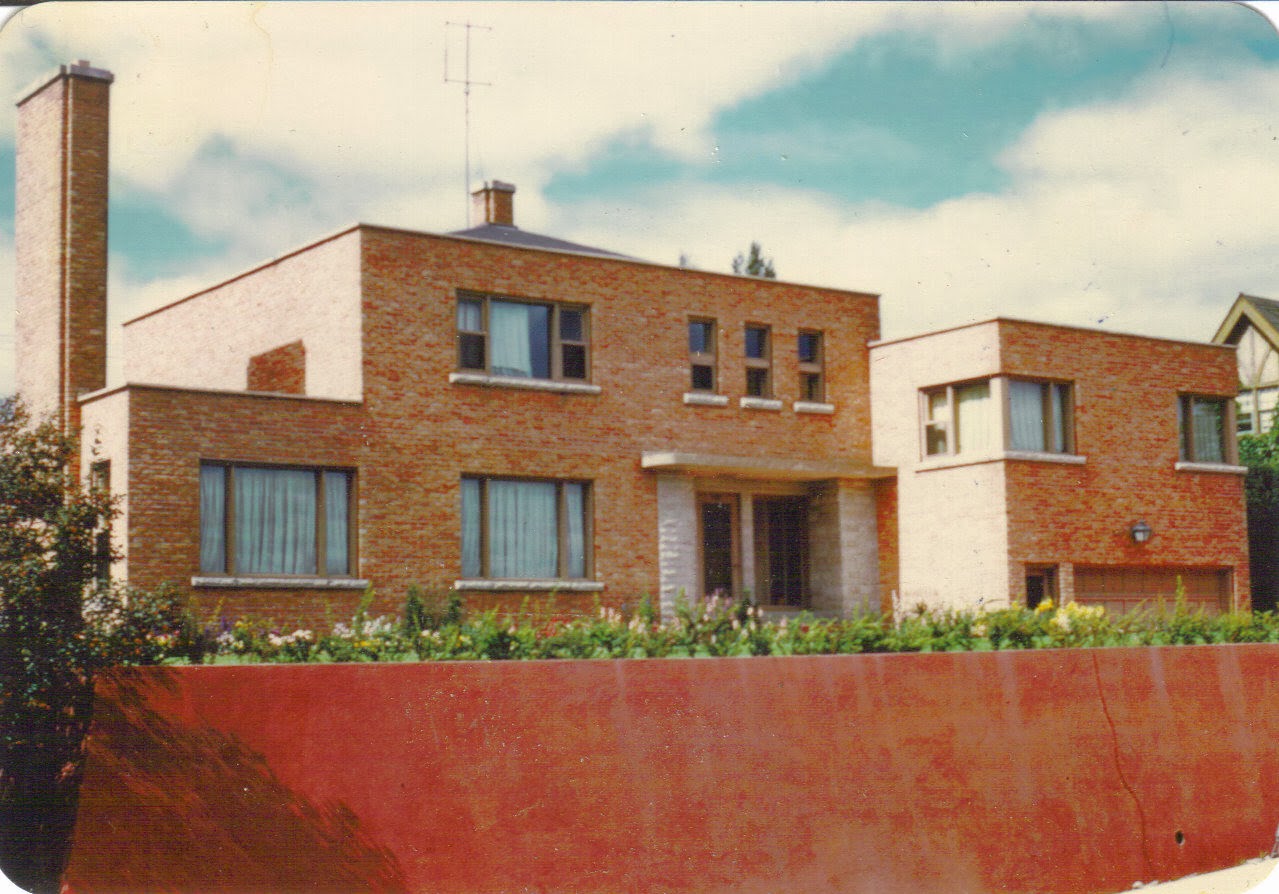
My first home was at the top of a hill on North Court Street in Port Arthur, an awesome hill for the winter toboggan. Mysterious photo from unknown source. It's exactly the shape and design of our house which was red brick; possibly the house next door? My Dad built a playhouse in the backyard and my Mom painted murals on it. Sadly, no picture of my house itself. Some time later the homes along the ridge were torn down to allow an extension of River Street and the building of a medical clinic. 

An old family photo of my best buddy and little brother proves the red brick. Did someone add siding after we left?

My second home was our farm on Oliver Road, a one-plus year sojourn while our new city house was being built. Again, no photo! Whatever happened to the one of me on Mickey the pony ... I recall he was faintly terrifying. A Yorkshireman called Arthur was the livestock handler (mainly egg-laying hens and some dimly recollected horses and pigs). Horrendous amounts of snow in winter. Commuting by car five miles to Pine Street School in town. Mom hitting a moose in her Chev and for months thereafter driving white-knuckled after dark like five miles an hour, an impatient procession of cars behind us.

Third home on High Street, Port Arthur, was sort of po-mo and very roomy but had a few inexplicable things. The pink retaining wall clashed with the brick colour. The always-frigid upstairs bathroom. The unfinished bomb shelter in the basement (hey, this was the Cold War 50s). My Dad built the entire basement "rec room" basement area himself. 

Fourth home (when does childhood end ... ?) was Balmoral Hall, my home away from home, secondary education years. In effect, the school then partly functioned as a residence for Royal Winnipeg Ballet students. I loved my time there, but after four years I was ready to move on.

The "homes" all pale in comparison with SUMMER on the greatest lake in the world and the greatest place to be on that lake.

© 2013 Brenda Dougall Merriman


03 October 2013

Resuscitating George Porter

It's time to update an item about my nemesis George Porter (thanking my stars he's not MY ancestor). For an essential backgrounder, see my post several years ago about "Berkeley Castle."

George certainly didn't know it, and no-one else seems to know it, but archaeologists are calling his Town of York cabin "Toronto's first house"!!

In a CBC TV news item aired 24 September 2013 archaeologist Keith Powers referred to the site with its evidence of an underlying log structure as the first house in Toronto (meaning York, Upper Canada). Yup, not one of, but the first house. Archaeologists were excited to reveal their findings last month at a construction site on King Street East at Berkeley. Online news outlet BlogTO followed with the story a week later. The property under construction is for the new offices of The Globe and Mail.
Photograph at BlogTO

The site is heavily barricaded at street level but BlogTO gives us a peek at the stone foundations of Berkeley House, home of John Small (1746-1831), clerk of Governor Simcoe's executive council. Archaeologist Powers says Small purchased the site in 1795 with a log cabin already on it. "A fishing cabin." ... Not exactly!

But yes, indeed, the purchase was 31 August 1795 for a sum of $50.(1) But no-one mentions that it was George Porter's log house (for that sale price he had also agreed to shingle it for Small). George was a productive, in-demand carpenter from the earliest days of building York; I doubt he considered his house a fishing cabin. George was in York for such a relatively short time, his name has been almost lost; whereas John Small was a firmly planted member of the establishment, a top ranking civil servant. So the log house likely predated 1795, possibly back to York's founding in the summer of 1792: after all, the busy carpenter had to have a place to live for three years while while employed in town construction.
See Note 2.
The transfer from Porter to Small is outlined in minutes of the executive council's land committee, in Small's petitions submitted after the fact.(2) Awaiting government delays in confirming his location, Small lived in the log structure adding improvements; his plan was to use it as a stable when his new residence was finished. By 1795 the parliament buildings aka Government House, Small's place of work, were located diagonally south across Palace/Front Street, only a few steps from his residence.
Berkeley House pastel attributed to Owen Staples ca.1912, said to be based on a drawing ca.1888, based on a sketch by Mrs CC Small in 1830; image Toronto Public Library, Baldwin Room, JRR 693 Cab.

In the 1840s, son Charles Coxwell Small added more wings to the house. For reasons unknown, he incorporated the old log dwelling:(3)
"When reconstructed at a subsequent period, Mr. Charles Small preserved, in the enlarged and elevated building now known as Berkeley House, the shape and even a portion of the inner substance of the original structure.”
Charles and family lived for many years there in one of Toronto's showcase homes; his wife made what is probably the earliest sketch. Berkeley House became derelict in the next century and was demolished in 1925.

Let's ensure we keep the history straight. Even if he is a most annoying man (as my previous posts demonstrate), George Porter's name should be attached to "Toronto's first house" !

(1) Edith Firth, The Town of York 1793-1815 (Toronto: Champlain Society/University of Toronto Press, 1962), 223; citing Ridout Papers at Archives of Ontario.
(2) Upper Canada Land Book F, pp. 359-361 (1805); Library and Archives Canada microfilm C-102. The entry includes copies of Small’s petitions dated 12 June 1800 and 28 August 1801.
(3) Henry Scadding, Chapter 6, "King Street: George Street to the Bridge and Across It," Toronto of Old (1873; reprint Toronto: Dundurn Press, 1987), 138.

© 2013 Brenda Dougall Merriman

29 September 2013

The Book of Me (2)

Julie Goucher's Book of Me has its taxing moments in the memory and feelings departments. Now, to be truthful here ― and that's what we're aiming for, right ― I am not putting myself out in public naked and cringing because I told three lies in my lifetime or peed my pants in Mrs. Jacobs' grade one class. On the other hand, mustn't cater to some kind of ancestor popularity contest among descendants not-yet-born. Attempting a balance, I have to do Julie's challenge my way.© Paul Anka

And I'd like to say at this point that when you have genealogy fatigue or family-history-writer's-block, Book of Me is a great way to distract and/or refresh yourself. It also reminds you to scan some of those fuzzy old photos before they fade entirely, so the whole exercise is mucho win-win.

My thoughts on Prompt Three: Physical Self (15 September) began and almost ended with:
Once a dancer, always a dancer. That says everything about my physical self. Except for forty years my hair was unmistakeably, vividly, Celtic RED and of course that says everything else.
Not exactly as pictured

That's my story and I'm sticking to it.

But I noticed in the Prompt 3 responses a lot of autobiographers got hung up with one of Julie's suggestions: size. Struggling with weight is only one kind of lifelong pain. Lest you think I'm cheating I will say I was always the tallest. Tallest often makes you the shyest. Tallest makes you stand out ~yerm~ as an easy target of fun from creepy little grade seven boys. Tallest makes you ineligible for the ballet company because you can't partner with short creepy men. Tallest makes creepy people call you big even if you're skinny. Combine that with red hair and don't think it was easy growing up. My teenage friend from Stuttgart confidently told me that Europeans innately, consistently regard redheads as evolutionary defectives.

Nevertheless, I successfully portrayed a (tall) mouse in the skating carnival and moved on to dance recital levels to be a butterfly and a singin'-in-the-rain hoofer and a thunderbird and years of fabulous costumes our mothers made, when mothers used to sew, reaching solo status as Snowflake, assistant to George the Porter who was a quasi-Santa fixture (a Thunder Bay thing, don't ask) in the annual Christmas extravaganza.

Then it morphed into serious classes in days when we had to darn our fragile pointe shoes so they'd last more than one performance and our examination tutus were made by the company's wardrobe mistress who was so kind to me because surprisingly she was a good friend of my ancient "aunt" Agnes B. Dougall in touch with my father who was terrified I'd become a theatre person (well, I did for a while; the musical stage is where the tall girls go unless you get a Vegas showgirl contract like my friend Ginny — thankfully she survived that and a bad marriage) so had to keep up the piano lessons that somehow pacified him even though Mrs. Bancroft (about grade ten that was) was so sick of listening to the same opening bars of the same Rachmaninoff concerto every week for a year coming from incredibly clumsy fingers for someone who could dance. Bless your patience, Mrs. B.

So. Not limiting myself to classical training, fast forward a bit to a life of domesticity and child-raising. Luckily some of it coincided with a trend in balls (but not enough of them) entailing long dresses and social dancing. BTW a man who knows how to waltz is worth his weight in gold; I only ever met two and unfortunately did not have affairs with either one, more's the pity (honestly, I would tell you if I had). The occasional military ball spiced it up with what I call Scottish cross-country dancing.

Now that I've taken up all this space which seems awfully self-indulgent to me, you may well ask — if you are not snoring by now — isn't that all ancient history, how dare I imply the dance, or more to the point, the dancer goes on? Self-delusion?
 
Well, the fact is most do. Right into the golden years when we need to keep creaky limbs from rusting up like a junked car, no matter how the body has changed ... hiding middle-aged spread under flowing tops; giving up the awesome three-inch heels and beloved (non-orthotic) boots; pretending the arthritic joints or dimming vision or hip replacements are temporary blips to overcome. Try shuffling with the latest offerings like zumba, clogging, salsa, belly dancing, meringue, you name it (it's okay to draw the line at break-dancing or whatever they call it now). Hey, even karaoke invites creative moves.

It's all of a piece. An overheard phrase of music only has to start and the body's twitching in recall. You know what I'm talking about. Betcha some of you never thought of yourselves as dancers.

Things have a way of evening out somehow. I'm no longer the tallest kid in the chorus line and the hair has faded. Meanwhile, as Sonny and Cher said, the beat goes on.

Now I'm thinking, should I start Prompt Three all over again? ... 
... Once a writer, always a writer ...

© 2013 Brenda Dougall Merriman

22 September 2013

Silent Sundays


Mom just rising from a curtsey to HM (his back to us); wish I'd been there!
It was a brief whistle stop on their cross-country train route.
The King and Queen are standing on the Dougall living room carpet.


15 September 2013

The Book of Pathetic Me

"The Book of Me Written by You" is a project I first saw on Geneabloggers, devised by the inspired Julie Goucher of Anglers Rest. It's a natural for genealogists who dwell mainly in the past. We should thank Julie: Shame on us if we forget our own biographies, neglect attention to our own lives because who knows us better than us? How could a third party possibly get it right??

This is important work. The assumption is that the scribblings will satisfy an intensely curious future someone (not happening now, is it). Not that we are compelled to make just every old thing public.

Image by Thomas MacEntee at Geneabloggers
Regarding the serial prompts, this writer has already fallen behind Julie's schedule. Regarding the personal history, I began it long ago and then skittered sideways when it became problematic. Problematic means how confessional are you going to be. You know, in case your kids get their hands on it before you actually die. Besides, other projects hopscotch the order of precedence with distractions always leading from one thing to another.

Take now for example, multi-tasking Book of Me along with breakfast preparation, no, it's more like lunch time, thinking calcium and fibre, where are the radishes, and attending to the laundry upstairs but on my way out the door CBC radio plays "Jerusalem!" so needs must halt and joyously deliver word for word (it's a Pavlovian thing: wherever I am when the opening chords sound, a thousand days of morning hymns at boarding school kick in) which then reminds me I wanted to look up William Blake designs for another project, write that down in the daytimer, why is that plant on my shelf looking brown, reach the laundry room only to catch an unavoidably socially-interactive moment with the local hypochondriac, then to quickly fold some of that same laundry so it doesn't get horridly wrinkled, making the bed at the same time somehow goes with it, better vacuum up those popcorn bits, discard yesterday's scattered reading material, ...

Good lord. Is that who I am? Where were we?

I had to scroll down AnglersRest for Prompt One, Who Am I? (posted 31 August). OK, tick off everything on that list. No: correction. Delete tea drinker, chocolate lover, and Alfie whoever he is. On second thought, that must be who Julie is. Let's add camel chaser. Is that good enough? Maybe the defining of oneself should begin with a blank page (like my head goes when I run across anything that smacks of mathematics numbers). I can see Prompt Four will appear before I properly get over this one.

Next. Prompt Two, My Birth (posted 7 September). My birth. That's a good one. Truthfully, I don't remember a thing. Everything from birth to ca. two years and ten months old is a blur, deeply hidden in the neurological recesses. Julie did a terrific job on hers. This must be the hardest part. No baby book courtesy of Mom. Besides, can we trust mothers to tell the truth? Sure, she was an original source with primary information but was she conscious the entire time? How much credibility do we give the Arthur Janov school of thought?

This is quite tiring so far. Definitely more work to do. Good thing it's a long way till we get to my problematic parts. Up the flag and carry on, Julie.

© 2013 Brenda Dougall Merriman

31 August 2013

Dougall Part 12, Manitoba Peter

Peter3 Dougall (George2, John1, ThomasA, JohnB) was born 5 December 1855 in Montreal and baptized 13 January 1856 at Erskine Presbyterian Church, son of George and Agnes (Moffat) Dougall.[1] He died 27 December 1939 at Pembina, Manitoba.[2] He is buried at St Lukes Church cemetery, Pembina.[3] On 9 March 1882 in Montreal, Peter married Helen Anderson, daughter of the late George Anderson and his widow Agnes;[4] Helen predeceased Peter on 16 October 1935.[5]

See Note 7.
Peter was said to be a naval engineer with the Merchant Marine for some years[6] and then migrated to Manitoba in 1880 to farm. His location on both east quarters of Section 22, township 2, range 9 west was nearby that of his older brother James Joseph.[7] Peter returned to Montreal to marry, as did his brother, between filing his land claim and receiving the 1886 patent for it. In 1881, Peter was enumerated with brother James, both single farming men.[8] Ten years later, he is with his wife and son, next to the Lea relatives of my correspondent Felix Kuehn.[9]

Pembina Manitou Archive
Peter's father George likely also assisted his youngest son in building a new frame home of Peter's own design. The tall narrow section featured interior window seats for a fine view over the valley and his property known as Kirkland Farm. Although not clearly discernible, I would say the Dougalls posed for the photograph, with Helen in the garden she was planning and Lorne on the porch, assuming the man in front is Peter. Helen was probably well-educated; she was one of the founders of the Pembina Crossing Literary Society. She brought expensive wedding gifts with her from Montreal, possibly also inheriting resources from her father. Their home was furnished with many framed oil paintings, fine china, and a grand piano. Yet the couple led unpretentious, hardworking lives, generally acknowledged as exemplary and hospitable Christians―"incorruptibly faithful in their attendance at church."[10]

Peel's Prairie Provinces
(University of Alberta)
 The year 1902, about the time Peter was completing his new house, saw a solid step toward a momentous religious transition in Canada. Some would call it disruption. Formal talks were begun to unite three different faiths: Presbyterians, Methodists, and Congregationalists (it was not until 1925 that the United Church of Canada was officially formed). Many Presbyterians were against the idea of merging with Methodists, including our western Dougalls. Their early church building was shared with a Methodist congregation on alternate Sundays. Then a large new Presbyterian church was built at Manitou just after the turn of the twentieth century; Peter Dougall became an elder.
 
The incumbent of the new church spoke in favour of union, quickly falling out of favour with some parishioners who resisted. Dr. Matthew Young, friend of the Dougalls and great-grandfather of Felix Kuehn, was one who made his objections plain. Eventually each church congregation in the nation voted whether to join the United Church merger or not. When his church voted to join, Peter Dougall switched his worship to St Luke's Anglican Church at Pembina Crossing. He went so far as to stipulate he would not be buried at the Manitou church, therefore he and his family lie in St. Luke's churchyard.[11] This is indicative of how strong the feelings ran; although solid numbers of Presbyterians overall embraced the merger, it was difficult for many members to accept the change, especially if they felt bereft of the local church they loved. Nonetheless, the Presbyterian Church in Canada still remains a stalwart, separate entity.

 Only child of Peter3 Dougall and Helen Anderson:
i. GEORGE LORNE4 DOUGALL was born at Manitou, Manitoba on 30 June 1883.[12] He died, unmarried, before 1971 in LaRivière, Manitoba.[13] Lorne maintained the family farm throughout his lifetime except for draft service in the Canadian army from July 1918 until his discharge in November 1919.[14] His parents commissioned an oil portrait of teenaged Lorne in Highland dress, by a Montreal artist.[15] He befriended local natives, having a great interest in Indian lore, collecting artifacts unearthed while ploughing. Much of his collection later went to friends and neighbours; his cousin Agnes believed the Manitoba Museum acquired some pieces--this last has not yet been verified or not. .

My thanks to Felix Kuehn who considerably enlightened me on a corner of Manitoba history!

[1] "Quebec, Vital and Church Records (Drouin Collection), 1621-1967," digital image, Ancestry.ca (www.ancestry.ca : accessed 20 August 2013); Peter Dougall baptism, Erskine Presbyterian Church (Montreal, Quebec), 1856, folio 2.
[2] Peter Dougall, Manitoba death registration no. 39-06-048423 (1939), Manitoba Department of Health, Pembina division. Further information in undated newspaper clipping kept by Agnes B. Dougall.
[3] Felix Kuehn to Brenda Merriman, email, 2 February 2013.
[4] "Quebec, Vital and Church Records (Drouin Collection), 1627-1967," digital image, Ancestry.ca (www.ancestry.ca : accessed 8 August 2013); Dougall-Anderson marriage, Erskine Presbyterian Church (Montreal, Quebec), 1882, folio 7.
[5] "Deaths," database, Manitoba Vital Statistics Agency (vitalstats.gov.mb.ca : accessed 20 August 2013), Helen Anderson Dougall, death registration no. 040416 (1935).
[6] Family story.
[7] "Western Land Grants (1870-1930)," database, Library and Archives Canada (www.collectionscanada.gc.ca : accessed 15 August 2013), citing microfilm C-5958; Peter Dougall, SE part section 22, township 2, range 9W, 12 January 1886. A separate patent was issued for the NE quarter.
[8] 1881 Census of Canada, Manitoba, district 186, Marquette, subdistrict 3, Mountain, p. 6, Peter Dougall; digital image, Ancestry.ca (www.ancestry.ca : accessed 19 August 2013), from Library and Archives Canada (LAC) microfilm C-13283.
[9] 1891 Census of Canada, Manitoba, Selkirk District, subdistrict Louise, division 2, p. 16. Peter Dougall; digital image, Ancestry.ca (www.ancestry.ca : accessed 19 August 2013), from LAC microfilm T-6295.
[10] Felix Kuehn, Departed Leaving Footprints in the Sands of Time, Chaper XI, "Our Noble Neighbours," p. 9.
[11] Kuehn, op. cit., p. 9 note 27.
[12] George Lorne Dougall, Manitoba birth registration no. 003913 (1883); database, Consumer & Corporate Affairs, Vital Statistics (http://web2.gov.mb.ca/cca/vital accessed : 10 April 2007). Note the more recent change of the database title as per Note 5.
[13] Family information. Manitoba death registrations are available only when seventy years have passed.
[14] “Particulars of Recruit,” service no. 528576 JO, 30 June 1916, digital image, Canadian Genealogy Centre (http://www.collectionscanada.gc.ca/genealogy/index-e.html : accessed January 2007).
[15] Kuehn, op. cit., p 11. The portrait devolved into the possession of Felix's family but was destroyed in a house fire in 1976.

© 2013 Brenda Dougall Merriman

18 August 2013

Dougall Part 11, Manitoba Jim

Dougalls: it's been a while, I know. Updating the Dougall family history as per my 2011 publication means, for me, drafting the new information as a blog entry. It's preparation for tackling the manuscript as a whole. Thanks to Felix Kuehn and his great-grandfather, Dr. Matthew Young, I can do this for two branches. Felix is unrelated to me but a marvellous chronicler of pioneer families in the McKenzie District of southern Manitoba. Felix willingly shares, and we have had many pleasant mutual exchanges. My new material is heavily indebted to him.

Many Dougalls went west from their birthplaces in Quebec. They shared the same emigrant Scottish grandparents as my own ancestor, William Charles Dougall (1854-1934) who also moved west to Winnipeg. Thus, cousins all, and the first generations to be born in Canada. Here I dwell on two of them—one couple as they were. Some of the source citations dating from years-ago cooperative family research have not been updated yet.

To my great surprise and delight, Felix brought to my attention a diary written by one Dougall, of his journey into the "Great Northwest." In his memoirs, Dr. Young quotes entries from April 22nd when the adventurers headed north from the border town of Emerson, Manitoba, up to May 28th. It's not yet clear if more description exists before that date, for example, details of the travel between Montreal and Emerson.

James Joseph3 Dougall (George2, John1, ThomasA, JohnB). Probably born in 1847, he was baptized 12 September 1847 in Montreal, son of George Dougall and Agnes (Moffat) Dougall.[1] He died in West Kildonan, Winnipeg, Manitoba, on 17 May 1940.[2] James J. of Pembina Crossing, Manitoba, married 28 February1883 in Montreal his first cousin Ellen Dougall of Farnham Centre, Quebec, the sixth daughter of his uncle James and Agnes (Fenton) Dougall.[3] Ellen was born at Cowansville, Quebec, 8 February 1856[4] and died in Winnipeg in 1949.[5] Both are buried in the Manitou Cemetery, Manitou, Manitoba, along with their two daughters.
St Andrews Presbyterian Church; Pembina Manitou Archive (http://www.pembinamanitouarchive.ca/)
James J. Dougall was occupied as a carpenter in the 1871 census, in his father's household.[6] It was another eight years before he and a group of like-minded friends decided to head for the Pembina River Valley of Manitoba. Jim, as he was known, wrote a diary about the 1879 journey and obtaining his land claim.[7]

The diary records the obstacles these hardy men faced as they explored almost virgin territory; even reaching the land office at Nelsonville was hard work. So much distance to cover and so few habitations. Fertile as it is, Manitoba mud is legendary for its impediments to man, beast, and vehicle. Jim mentions the hardships of reaching each point of reference, sometimes "to the knees in mud and water―a dreadful experience," broken carts, having enough supplies for rough camping, swimming oxen across a river, getting lost, how some discouraged men bowed out. It snowed on April 26th! Returning to Nelsonville, on 7 May 1879 he filed for part of section 16, township 2, range 9, on the west bank of the Pembina River.[8]

It was May 28th, the last available diary entry, when Jim reached his homestead property again with the necessary goods and livestock. A log house would be the first priority, a location chosen on the crest of an imposing hill with a splendid view of the valley, a home to be named "Hillside." Four years later at the age of thirty-six, having accomplished his main goals, he returned to Quebec to marry his cousin.

We wonder: being city-born and -bred, did Jim have any experience at farming? The suspicion is that as a teenager/young man, he spent summers at his grandfather's farm at Beech Ridge near St. Andrews East, Quebec―he speaks knowledgeably about soil in the diary. Whatever, this was a versatile family. His father George—a tailor in Montreal—was definitely involved to some extent with his parents' farm. In fact, after his wife died and beginning in 1888, George travelled west many summers to assist his son in preparations for a fine stone house. Felix worked with the memoirs of Dr. Young―also a pioneer, and good friend and neighbour of Jim Dougall―and other neighbours' recollections to bring a voice to early Pembina Crossing days.
The James Dougall home, Hillside Farm; Pembina Manitou Archive

Regarding the James J. Dougall home, great credit goes to his father George Dougall ... "a tailor who in his retirement takes up the art and craft of a stone mason. Although he was eighty-two years of age when he undertook to assist his son in the building of a new home, he was still perfectly capable of spending a day swinging a three-pound stone mallet."[9]

In Felix's words again:
A man of amazingly good health and possessing a constitution which allowed him take undertake any line of work that a man half his age could manage, I must especially write of his labours during the summer of 1900, vacation months which he spent almost entirely breaking rocks.
... With the assistance of his hired man, Jim Dougall dug out and hauled to his house yard several hundred tons of stone. These were carefully inspected by his father, who selected those displaying the best graining and finest colour. These he set out to split into pieces of appropriate size for the construction of his son's new home. In consideration of the fact that he had passed the biblical span by more than a decade, the elder Mr. Dougall was persuaded to make a single concession. When possible to do so, instead of straddling the stone he was drilling, he settled himself in his son's favourite rocking chair, an arrangement which allowed him to spend his normal eight-hour day without undue strain or unnecessary fatigue. Of course, I would not like anyone to think that breaking rocks for his son's home occupied him for the entire summer, for that was not the case. He also dug a drain for the sinks in the house from the kitchen to the top of the hill, a distance I should think of about thirty feet, two feet wide and six feet deep. Of course, this also occupied him for a number of days.[10]
The photo of George (1818-1904) is from the Peter Smith family. Alas, no photo of James Joseph "Jim" Dougall.

Another quote following the above:
The Jim Dougalls were well-known for their gracious hospitality and Mrs. Dougall for her excellent cuisine [and] exquisite desserts which graced the table. The Dougall home was one of the first places in our district where one could enjoy an apple pie made with apples grown in the family's own orchard. An old paper from the summer of 1898 notes that a single apple tree in his orchard had produced two hundred and eighty fine apples! 
The couple had two spinster daughters, who became school teachers. Eventually they rented their farm out and moved to 125 St. Anthony Avenue, Winnipeg. Agnes cared for her elderly parents in their final home and loved to keep in touch with her extended family by letter-writing. When Agnes died in 1967 it was the end of this Dougall branch. Agnes was a going concern and deserves her own biography.

Children of James Joseph3 Dougall and Ellen3 Dougall:
79. i. AGNES BENNING4 DOUGALL, 1884-1967.
80. ii. ELIZABETH JANE DOUGALL, ca.1885-1945.

One of Jim's younger brothers, Peter, followed him to Pembina Crossing, and will be my next Dougall subject.

[1] Erskine Presbyterian Church (Montreal, Quebec), baptisms. Originally researched by Salli Dyson, the church registers are now available (and the baptism confirmed) in Ancestry.ca's "Quebec, Vital and Church Records, (Drouin Collection)."
[2] Manitoba death registration no. 020420 (1940), Manitoba Department of Health, West Kildonan division. Also “Mrs. James J. Dougall,” unattributed newspaper clipping, undated, referring to husband James J’s death in 1940.
[3] "Quebec, Vital and Church Records, (Drouin Collection), 1621-1967," digital image, Ancestry.ca (www.ancestry.ca : accessed 2 August 2013); Dougall-Dougall marriage, East End Methodist Church (Montreal, Quebec), 1883, folio 5.
[4] Ellen's baptism eludes me in the Drouin Collection, although Salli Dyson apparently saw the church record.
[5] Felix Kuehn to Brenda Merriman, email, 5 February 2013; Manitoba death records are not available until 70+ years have passed.
[6] 1871 Census of Canada, Quebec, District 106, Montreal, St. Antoine Ward, subdistrict B, division 2, p. 83. George Dougall household; digital image, Ancestry.ca (www.ancestry.ca : accessed 9 October 2010), citing Library and Archives Canada microfilm C-10046-10047.
[7] The diary is quoted in Felix Kuehn's work in progress, Departed Leaving Footprints in the Sands of Time, Chapter XI, "Our Noble Neighbours," pp. 2-5. Felix grew up in the neighbourhood, collecting tales of ancestors and their friends. Diary excerpts have also been previously quoted in some  histories of Manitoba.
[8] "Western Land Grants (1870-1930)," database, Library and Archives Canada (www.collectionscanada.gc.ca : accessed 15 August 2013), citing microfilm C-5942; James Joseph Dougall, NE part section 16, township 2, range 9, W1; no image or date.
[9] "Our Noble Neighbours," p. 6.
[10] "Our Noble Neighbours," pp. 6-7.

© 2013 Brenda Dougall Merriman


11 August 2013

Silent Sundays

Photo BDM November 2012
What is it, you ask? It's part of a Tunisian marriage contract for a nineteenth century Ottoman family. Displayed in Dar Essid, Sousse, Tunisia. No transcription available! The once-luxurious home is stuffed with sadly decaying historical artifacts.

29 July 2013

Girl With Cat

A recent visit to Saskatoon revealed a delightful family story. A sculpture by Arthur Price has pride of place in the entrance to the conservatory of the Mendel Art Gallery and Civic Conservatory.
Girl With Cat has been fascinating children for almost fifty years; (not the best) photo, BDM July 2013.  
Here's a better one:
prairieartsters.blogspot.com

Opened in 1964, the Mendel borrowed the sculpture for display the next year and it became very popular. Children especially were charmed with its life-size presence and hands-on appeal. But the cost to buy it was beyond the means of the young gallery. That's when my little cousin Caroline got involved. Even as a nine-year-old, she was quite familiar with visiting the new cultural centre. Girl With Cat enthralled her, reflecting a large portion of public opinion. With no fund-raising underway, she wrote a letter to the director, sending money she and her brother had saved toward the sculpture's purchase.

One dollar and nineteen cents.

Saskatoon's StarPhoenix recently did a story on this, "Childhood Gift Keeps on Giving." [Sorry, the printing is in blue pencil.]


Caroline's letter sparked a campaign in the city, mostly among children's organizations and activities. Thus the sculpture became a proud permanent acquisition in 1970. No telling what a determined little redhead can accomplish! Visitors are encouraged to stroke the cat and the girl's hair; little ones will even join her in the rocking chair.


Very sadly, Caroline died before her time in 2010. She was in the happiest years of her life, a career in elementary school counselling her great joy. Her husband dedicated a nearby bench in the conservatory to her.


It chokes me up every time I see this lovely photo of brother and sister in later life.


© 2013 Brenda Dougall Merriman

20 July 2013

Cemeteries Part 17: Silent Work

To the enlightened, cemeteries are heritage parks. Quiet places of beauty, a solitary enjoyment, or even a picnic en famille. We in North America have begun to appreciate their significance, the need for maintenance, and the uncovering of small, forgotten ones. Walking tours of older cemeteries are introducing the general public to historical treasures. Genealogists and family historians have an abiding interest, it goes without saying, in transcribing memorials. But time and weather (sometimes theft!) wreak havoc on granite, marble, and other materials. And so groups of disparate people, not necessarily genealogy-oriented, have been formed for physical preservation efforts. This post is solely to herald their efforts and not the associated projects dealing with advocacy and legalities.

One related project that impresses me is a venture that could be a community model. The CK Cemeteries Preservation Project is an independent project that grew from concern over conditions in Chatham (Ontario) cemeteries, a concern echoed everywhere in this province. Cemetery owners, often municipal entities, can only allot so much time and funds (not enough, heritage-minded folk would agree) for maintenance.
CKC volunteers hard at work; photograph courtesy of Trish Nigh
The CKC group not only unearths dozens of sunken or buried grave markers, they are repairing vandalized stones, photographing their work, and learning history at the same time. A ground penetrating radar machine assists with locating fallen, covered stones. Armed with their “little shovels,” a great deal of back-breaking work is involved, digging and lifting, to re-position fallen or broken stones. One stone and monument at a time. With a great deal of respect for the interred and the families they represent. The volunteers find quiet satisfaction in the learning process, both physical and historical.

Owner of the Chatham-Kent Cemeteries website and also one of the first original volunteers, John Skakel notes the difference between the terms preservation and restoration, concluding firmly, " ... we truly are doing work that brings the grounds as a whole closer to what they looked like originally and not just the stones." Since their program has been carefully refined over a long period, he adds they are more than willing to share advice when contacted. The Chatham-Kent Council has recognized their quietly heroic work. Occasional donations assist with necessary materials and tools.
Similar undertakings happen in many corners of the world, some obscure and some well-known. Friends of Highgate Cemetery Trust in London, UK, is a charity that rescued from neglect and vandalism one of those iconic places where famous figures are memorialized. Well-organized volunteers give training on different facets of maintenance; working parties extend to landscape cleanup and gardening. 

Then there are unsung loners. One man in the Ottawa Valley on his own tackled a small burial ground all but obliterated by thick overgrowth, poison ivy, and trees with stubborn roots; biting insects are another obstacle. It only takes a generation or two of family leaving the area for a cemetery plot or small burial ground to succumb to nature. He didn't stop at the restoration; he researched the deceased to bring their lives to light. There are more of these stories of search and rescue than you might think; one can find unexpected examples, probably not far from your own home.

Here, from South Carolina, is but one of a multitude of sources that feature workshops on doing it right. How about that lengthy list of items required for an inclusive understanding?! It's also necessary to know the laws on several levels that can affect proposed projects. Some groups focus on particular perspectives, such as The Association for GravestoneStudies that concentrates on historical artistry and symbology. 

These small armies represent people from every walk of life who band together in hard work and frequent bonhomie. Seems like unconditional love to me. I salute volunteers everywhere who serve their communities and, in so doing, benefit family historians.

© 2013 Brenda Dougall Merriman