Pages

08 August 2012

McFadyens Part 15: Coll to Cape Breton?

Following on Part 14:
In the newly translated/published “Account of Donald Mackinnon,” the scribe said:
Part of the [Crossopol McLean] family spent part of the year living in Totamore House ... There were cottars – [one being] the family of Lachlan son of John son of Charles who were servants to the farmer. [Of Lachlan’s sons] Donald was a shoemaker, Alexander a tailor, John a labourer. They had no sister; their mother was Catherine daughter of Donald son of Alexander.”[1]

Paraphrasing the attached Note 25 by Nicholas Maclean-Bristol (NMB):
In the 1776 List of Coll Inhabitants, Lachlan was the underage son of John McPhaiden & Catherine Macdonald of Totamore. To which NMB added that Lachlan himself married a Catherine McDonald on 29 October 1789 and had the following children (specific baptismal dates were given; I merely cite the years here):
John 1791; Alexander 1795; John 1802; Roderick 1804, “died Inverness, Cape Breton 1877”; unnamed 1807; Neil 1810; Ann 1812; Donald 1814; Donald 1819.

Mackinnon continues:
Donald and Alexander, the sons of Lachlan [McPhaiden] son of John son of Charles, went to America along with that Lachlan Macphee and his family and many others from Coll, Rum and Muck in the year 1822. I believe they arrived safely.”
NMB adds in Note 33: Colin S. MacDonald thinks they sailed on Commerce of Greenock from Tobermory to Plaster Rock Nova Scotia with settlers from Muck (“Early Highland Emigration to Nova Scotia and Prince Edward Island,” Nova Scotia Historical Society Vol. 28, 45). My colleague Terry Punch has corrected the reference to MacDonald's article in Collections of the NSHS, Vol. 23 (1936).
Photograph CDM, July 2010
The emigration information was new to me, and relevant to my erstwhile reconstruction of early McFadyen families in Cape Breton. I'm particularly interested in attempting to uncover their places of origin. But I find some of the statements bothersome, asking:
Did Commerce of Greenock sail to Cape Breton in 1822?
Were Lachlan McPhaiden's two sons on it?
Are the two men in evidence as Cape Breton settlers?

Point One. There are no “complete” lists of ship crossings from the Scottish Highlands to Cape Breton for the 18th and 19th centuries; but Lucille Campey's Appendix II in After the Hector and Punch's own Some Early Scots in Maritime Canada, Vol. III, make headway at cataloguing them from a variety of sources. Commerce of Greenock, like many ships, made a number of crossings. MacDonald seems to have been the first to assert its arrival in 1822, and repeated by historians since, but his source is unclear.

Point Two. With few well-documented exceptions, extant lists of passenger names in that time period are simply not available. In 1822, Lachlan's oldest son Alexander would have been about age twenty-seven, a reasonable age to emigrate. His brother Donald (whether both Donalds survived or not) would have been about eight, or a baby. The two names as brothers do not synchronize with Mackinnon's emigration scenario. 

Points Two and Three. We know that two men had arrived in Cape Breton at least a year sooner. An Alexander McPhaden age twenty-two was in Cape Breton in 1821.[2] He is described as a tailor early on.[3] MacDougall says Alexander was the brother of Donald McFaden[4] age twenty-eight in 1825.[5] Clearly their ages do not match with the baptismal years of Lachlan McPhaiden's sons, Alexander being younger and Donald being considerably older. Nevertheless, when this Donald died at Malagawatch, his parents were said to be Lachlan and Catherine (specific place of birth in Scotland not recorded).[6] Scotland's People is no help in this regard for a baptism!

Donald married Mary Ann Calder and settled at Militia Point near Malagawatch; Alexander married Margaret McQuarrie and settled at Lexington near Port Hastings. Both men named their eldest sons Lachlan; both had daughters Catherine. I can follow at least the first generation of their descendants.

Of the putative companion Lachlan Macphee, there is no sign in Nova Scotia land petitions.

A Lachlan McPhaden also applied for Cape Breton Crown land in 1821, having arrived that year, age twenty-four and married.[7] Further records show that this Lachlan and his wife Mary McLean had a son Archibald baptized in 1829 by a visiting cleric at Malagawatch.[8] It's unknown if this was their first son. A marriage has not been found in Scottish parish registers 1795-1822 and I have no later information about him.

Finally, a Roderick MacFadyen settled, date unknown, in the River Denys area. His death record in 1877 shows him as a native of Coll and his parents as Lauchlan and Catherine.[9] His age at death and the 1871 census infer a birth year of 1804-05. In that census, his occupation was farmer. Roderick/Rory also married a Mary McLean and did not apply for Crown land. Describing him as a tailor, MacDougall says, “So far as we know, he had no relatives in this country.”[10] And yet, his location was a mere two lots away from my own ancestor Donald “the soldier,” a generation older.

However, while Roderick seems to be the son overlooked by Mackinnon, it was mandatory to consult my photocopies of the original Coll kirk sessions containing baptisms and marriages.[11] The parents of the child Roderick baptized on Coll on 15 August 1804 were Lachlan McPhaiden and Catherine McKinnon (not Macdonald) at Cnocleathan. Lachlan McPhaiden at Grimsary had married Catherine McKinnon in 1801.The same couple had another son Roderick baptized on 25 May 1807. No further children were recorded after 1795 for mother Catherine Macdonald. The timing might suggest a second marriage for Lachlan McPhaiden although I can't say whether a switch in locale from Totamore to Grimsary between 1795 and 1801 is plausible. We may have two different Lachlans.
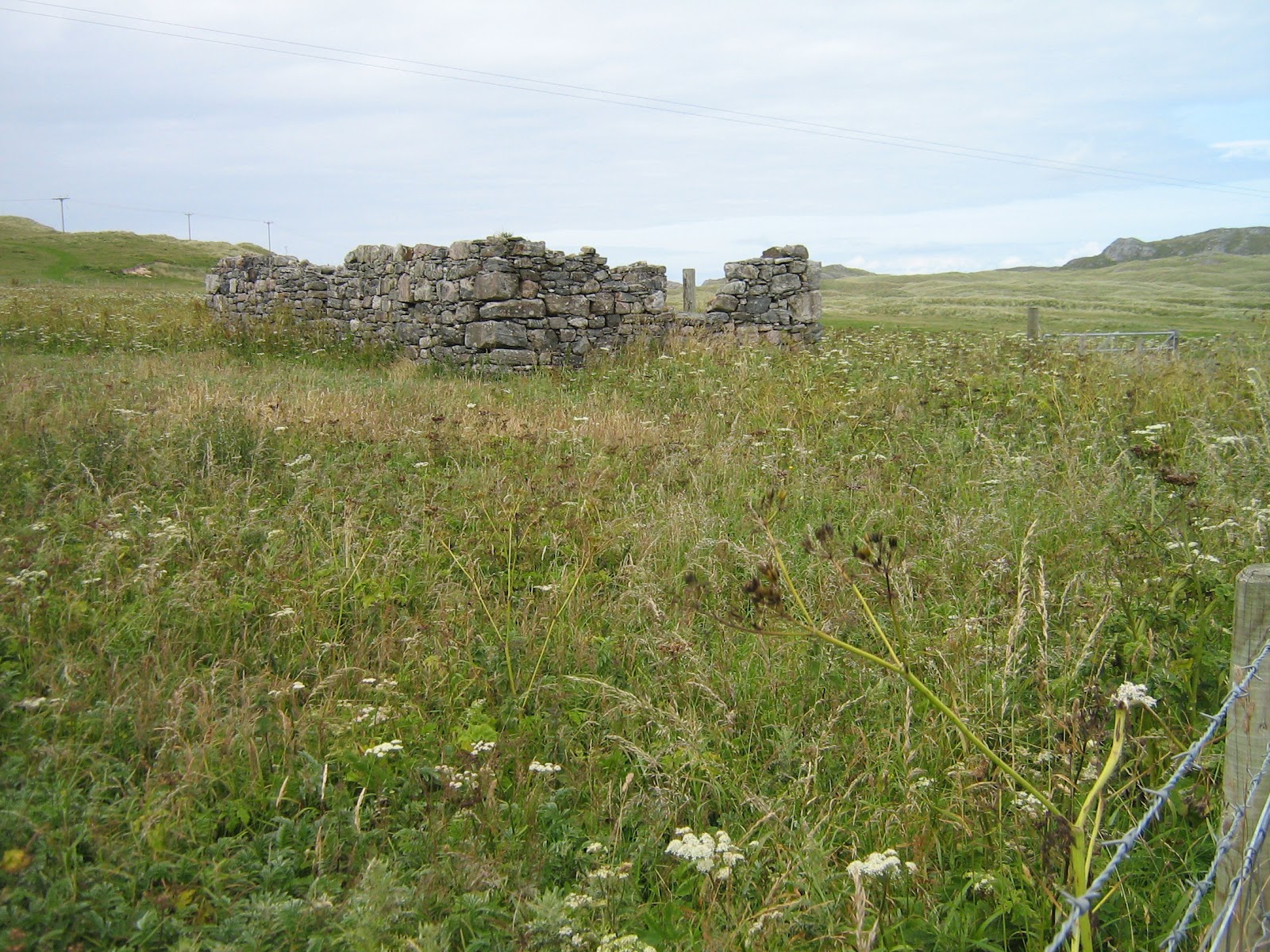
Photograph BDM, July 2010
Initially I set out to ask if Mackinnon was simply out by one year in his recall of the emigration date. And to compare Lachlan McPhaiden's sons with the known early Cape Breton men. But Alexander and Donald as brothers don't match either Lachlan-and-Catherine couple from what we know of their children. Roderick might. All the analysis must allow for variables:
baptisms potentially missing from the parish register;
the fact that not all Cape Breton arrivals petitioned for Crown land;
perhaps a loose attitude about one's age;
the accuracy of secondary information in a local history;
the possibility that “the sons” landed in Cape Breton at whatever date and shortly went elsewhere;
the possibility that Alexander, Donald, and/or Lachlan originated in Rum, Muck, or even Mull.

I want so much to believe that the oral tradition is a fairly reliable source in the absence of original documentation. But I may be sinking my own ship.

[1] Nicholas Maclean-Bristol, “Donald Mackinnon, 'An Account of the Island of Coll and Its People' (2),” West Highland Notes and Queries, Series 3, No. 19 (May 2012).
[2] “Land Petitions - Cape Breton Island Petitions 1787-1843,” database, Nova Scotia Archives (http://www.gov.ns.ca/nsarm/virtual/land/ : accessed May 2008), Alexander McPhaden, no. 2754; citing NSA microfilm 15798.
[3] Nova Scotia census 1838, Inverness County, Canso Township, unpaginated; Library and Archives Canada (LAC) microfilm M-5220.
[4] J.L. MacDougall, History of Inverness County, Nova Scotia (1922; reprint Belleville, ON: Mika Publishing, 1972), 177.
[5] “Land ... Cape Breton Island Petitions,” database, Nova Scotia Archives, Donald McFaden, no. 3053; citing NSA microfilm 15799.
[6] “Nova Scotia Historical Vital Statistics, Deaths 1864-1877,” digital image, Nova Scotia Archives (https://www.novascotiagenealogy.com/ : accessed May 2008); Donald McFadyen, 10 June 1869, Inverness County, register no. 1810, p. 36, no. 132.
[7] “Land ... Cape Breton Island Petitions,” database, Nova Scotia Archives, Laughlin McPhaden, no. 2755; citing NSA microfilm 15798.
[8] St. John's Presbyterian (Belfast, Prince Edward Island) baptisms, 1823-1849, Archibald, son of Laughlan McFadden and Mary McLean “basin of River Denny,” born 13 February 1829, baptized 3 September 1829; LAC microfilm C-3028.
[9] “Nova Scotia ... Deaths 1864-1877,” digital image, Nova Scotia Archives (https://www.novascotiagenealogy.com/ : accessed May 2008); Roderick McFadyen, 28 February 1877, Inverness County, register no. 1810, p. 142, no. 44
[10] MacDougall, History of Inverness County, 496.
[11] Coll Kirk Sessions, National Archives of Scotland, CH2/70/1/.

© Brenda Dougall Merriman


06 August 2012

Summer

Not that many horses around any more.
St. James Park; photograph BDM May 2011

31 July 2012

August Ancestors


For the sake of brief entries, I am not footnoting the facts in this ongoing memorial. Sources have been noted either in other blog posts or in my family history books.

17 August 1808 John Fraser age 32, a farmer at Rivière Rouge, married Margery McIntyre age 22 of the same place, at St. Gabriel Street Presbyterian Church in Montreal. John was a widower whose first wife, Ann Fraser, died sometime after 16 November 1806; he had been left with three small children. Rivière Rouge was a settlement on the outskirts of St. Andrews East (St-André Est) in the seigniory of Argenteuil, about 40 miles northwest of Montreal. St. Andrews did not have a resident Presbyterian clergyman until 1818. Dates of birth (in Scotland) and death for this couple have not been ascertained. John had another eight children with Margery from 1811 to about 1827. Alas, I have no photos of this couple or any of their children. They are my triple-great-grandparents.
HFD by Nicholas de Grandmaison, 1963


23 August 1896 Hector Fraser Dougall was born in Winnipeg, Manitoba, second child and only son of William Charles Dougall and Jessie Isabella McFadyen. He grew up in Winnipeg with two sisters. During the First World War Hector enlisted with the Winnipeg Rifles but then became a pilot in the Royal Flying Corps, later spending nine months as a German POW before the Armistice. See also www.facesofholzminden.com. In 1931 after a move to Fort William, Ontario, he founded what would become a family media conglomerate. The Second World War saw him as manager of Canada's No. 2 Elementary Flight Training School for new Commonwealth pilots. Hector was my father.


22 July 2012

July Ancestors (2)

For the sake of brief entries, I am not footnoting the facts in this ongoing memorial. Sources have been noted either in other blog posts or in my family history books.
Killin parish church, Perthshire; photo BDM, July 2010
24 July 1783 Duncan Frazer was baptized in Killin parish church, Perthshire, Scotland, son of John Frazer and Janet Buchanan of Ballechuish. The apparent place name puzzled me until Cousin Lizzie came to my rescue. Ballechroisk was one of the small settlements adjacent to the village of Killin. We are sure this is our ancestor although his mother’s surname differs in a later source that I won’t go into here. In 2010 I visited the church, built in 1744, not the expected classic stone building. Nevertheless, a thrill to be in a place my ancestors frequented so long ago—it is “listed” as a Scottish ancient and historical building. The baptismal font was rescued from the older, preceding church structure “and is reckoned to be 600 years old” according to an interior plaque. Of great interest was the memorial out front to Rev. James Stewart (1700-1789) who served at Killin for 52 years, more renowned as the first translator of the New Testament into Gaelic. The consequences of that spread far and wide across the Highlands. He was likely the man who baptized my triple-great-grandfather Duncan.

29 July 1878 Marion Hastie, widow of John Dougall, died in Montreal at the home of her youngest daughter Helen (Dougall) McCunn. As a youngster in 1804, Marion embroidered a sampler with the names of her parents and their six sons and six daughters. The sampler has disappeared, likely into a family of McCunn descendants—women often being the keepers of family memorabilia. Marion was 88 years old when she died. She was my great-great-grandmother.
McFadyen stone, Sunnyside Cemnetery, Manitoba; photo BDM, ca.1972


31 July 1915 John McFadyen died, probably at his farm in Springfield, Manitoba, at the age of 78. Of his five sons, none produced McFadyen heirs. My McFadyen branch “daughtered out” as we genealogists like to say. John and his wife Isabella Campbell (Cape Breton natives) are buried in the local Springfield cemetery sometimes known as Sunnyside or Moose Nose Cemetery. “In my father’s house are many mansions; I go to prepare a place for you.” At the time I paid my respects, many years ago, deer were also visiting but moose were not in evidence. John was my great-grandfather.

14 July 2012

McFadyens Part 14: A Welcome New Source

Historian and author Nicholas Maclean-Bristol (NMB) is now publishing the translation of Donald Mackinnon’s important manuscript about the Isle of Coll, written after the schoolmaster left for Australia in 1859.[1] He includes a transcript of the original Gaelic version. The second installment in West Highland Notes and Queries, Series 3, No. 19 (May 2012), newsletter of the West Highland and Island Society of Historical Research, had me chewing my brain for days.
My thanks to NMB for providing a copy of this map.
The second installment of Mackinnon’s account concerns Crossapol and Totamore, and presents two interesting implications for McFadyen descendants:[2]
▪ Mackinnon seems to have revealed a hitherto unknown son of the Charles Roy [McPhaiden] at Ardnish as per the 1716 disarmament list.
▪ By naming grandchildren of the hitherto unknown son, he gives clues which may lead to identifying origins of some of the earliest McFadyens petitioning for land grants in Cape Breton. 

For now, I air my thoughts on the first point above. Comments on the second will follow later. I air my thoughts in full recognition of my limitations as a scholar and fervently hope that others more knowledgeable will respond. Genealogical research for Highland ancestors who pre-date parish registers usually depends on manuscript material in difficult to access collections, often obscured by the primary nature (cataloguing) of such a collection, and/or on the traditional oral family memory. Thus early genealogical linkages frequently rest on sporadic sources, secondary information (memory), and inevitable assumptions.

Born in 1800, Mackinnon was an educated native of Coll representing “insider” knowledge of both local history and the ancestry of the inhabitants. He wrote of what he knew and absorbed since childhood, with the gift of recalling the patronymics for many, many residents. Here is a welcome new source of island life for historians and genealogists.     
 
Previously, NMB ascribed two children to the above Charles Roy, shown at Ardnish on the 1716 disarmament list for Coll: Margaret Ann with certainty, and Angus with uncertainty.[3] Franklin and Lamont adopt the same.[4] In his account, Mackinnon names a family of servants to the Maclean farmer at Totamore House, headed by “Lachlan son of John son of Charles.”[5] This Lachlan can be pinpointed in the 1776 list of Coll parishioners, son of John McPhaiden and Catherine McDonald, under the age of seven years.[6] Thus the existence of his grandfather Charles reaches back to the early eighteenth century.

The 1716 list, prepared for the Sheriff of Argyll, “gives the impression that it is a list of the whole male population over the age of sixteen.”[7] Therefore it seems likely that there was no other adult Charles in contemporary McFadyen families. Without conflicting evidence, one works on the theory that grandfather Charles and Charles Roy were one and the same person. Good news for descendants of Lachlan and Catherine—of Totamore when they married in 1789—if they can link (especially their emigrant ancestors) to Lachlan’s children whose names and baptismal dates are provided by NMB in a note. An expanded ancestry to Charles Roy and beyond also carries exciting potential.

Unfortunately for me, the news seems to have no direct impact on my Donald-the-pensioned-soldier who came to Cape Breton in 1828.

Mackinnon goes further to name two sons of Lachlan and Catherine who “went to America.” On that point, I have issues with the attendant note that Cape Breton was their destination in 1822. My next post on the subject will compare his statement with some known early settlers in Cape Breton.
For serious researchers in mediaeval and subsequent times of the Inner Hebrides, I recommend West Highland Notes and Queries by subscription to the Society of West Highland and Island Historical  Research, Breacachadh Castle, Isle of Coll, Argyll, Scotland PA78 6TB. Current annual fees from January 1st each year are CDN$44, US$34.


[1] The first part appeared in West Highland Notes and Queries, Series 3, No. 17 (November 2011). The next appeared in Series 3, No. 19 (May 2012). Four more parts are planned for future issues.
[2] I customarily use the spelling McFadyen in generic mentions but apply the original version used when citing the work of others.   
[3] “The MacFadyens in Ballyhough” chart in West Highland Notes and Queries, Series 3, No. 5 (November 2002), “Special MacFadyen Issue.”
[4] See Glenda McPhadden Franklin and Gene Donald Lamont, “Genealogical Records – The MacFadyen-McPhadden Family in Coll and Tiree” at Coll Genealogy (www.collgenealogy.com/).
[5] West Highland Notes and Queries, Series 3, No. 19, p. 11.
[6] “List of the Inhabitants in the Island of Coll Decr 2nd1776” in Kirk Session Minutes [Coll] 1733-1813, National Archives of Scotland, CH2/70/1.
[7] Nicholas Maclean-Bristol, ed., “Inhabitants of the Inner Isles Morvern and Ardnamurchan,” Scottish Record Society, New Series, Vol. 21 (1998).


© Brenda Dougall Merriman, 2012

13 July 2012

Summer Hiatus

Nothing like some family visits to remember why it’s important to know the past. Genes, characteristics, attributes, favourite sayings—all surface in the present. In my mind, that is.

The generation gaps are sometimes astounding. And educational gaps a bit alarming.
“What lake is this?” she asked.

04 July 2012

July Ancestors (1)

For the sake of brief entries, I am not footnoting the facts in this ongoing memorial. Sources have been noted either in other blog posts or in my family history books.

12 July 1828 Donald McFadyen, retired soldier from the 91st Foot Regiment (later to be known as the Argyll and Sutherland Highlanders), his wife Flory McLean, and five children set sail from Tobermory, Isle of Mull, bound for Ship Harbour [Port Hawkesbury], Cape Breton, Nova Scotia.

15 July 1978 Victor Carl Freiberg died in Port Arthur, Ontario, at the age of 93. Victor was a tall man, fair-haired and blue-eyed. After his wife Marija died, he lived on his own for over 15 years with the assistance of the Latvian community and his grandson Fraser’s family. Ultimately he developed pancreatic cancer and was hospitalized. Victor was my grandfather.

18 July 1755 Thomas Dougall was baptized, son of John Dougall and Jean Weir, at West Calder, West Lothian, Scotland. His humble farming parents lived on the farm estate called Parkhead on the north side of Linlithgow Loch across the lake from the palace. Parkhead was in the parish of Linlithgow. Later Thomas married Marion Pollons—before 1781, no marriage record found—and he too lived and worked at Parkhead. What I still don’t understand is why both generations ignored the local church to travel several parishes away for children’s baptisms in West Calder, in what was then Edinburghshire. A genealogist would suspect deep family roots or ties there. Thomas became the father of my emigrant ancestor John, so he was my triple great-grandfather.
The "Old Smiddy" at Killin, Perthshire; photograph BDM, July 2010

18 July 1807 Duncan Fraser married Katharine Robertson at Killin parish church in Perthshire, Scotland. Killin is situated smack in the lovely Highland region known as the Trossachs. The couple produced eight children, probably born at Smithy ("Smiddy") Cottage, Monemore, Killin. Duncan was a master blacksmith and his trade was carried on by two sons and a son-in-law. One of the greatest things about blogging and the internet was my 4th cousin Elizabeth (Lizzie, love that name) finding me. A gravestone for Duncan and wife is not visible in the unkempt Killin churchyard. Lizzie and I share Duncan as our triple great-grandfather.

19 June 2012

June Ancestors (2)

For the sake of brief entries, I am not footnoting the facts in this ongoing memorial. Sources have been noted either in other blog posts or in my family history books.

12 July 1828 Donald McFadyen, retired soldier from the 91st Foot Regiment (later to be known as the Argyll & Sutherland Highlanders), his wife Flory McLean, and five children set sail from Tobermory, Isle of Mull, bound for Ship Harbour [Port Hawkesbury], Cape Breton, Nova Scotia.

15 July 1978 Victor Carl Freiberg died in Port Arthur, Ontario, at the age of 93. Victor was a tall man, fair-haired and blue-eyed. After his wife Marija died, he lived on his own for over 15 years with the assistance of the Latvian community and his grandson Fraser’s family. Ultimately he developed pancreatic cancer and was hospitalized. Victor was my grandfather.

18 July 1755 Thomas Dougall was baptized, son of John Dougall and Jean Weir, at West Calder, West Lothian, Scotland. His humble farming parents lived on the farm estate called Parkhead on the north side of Linlithgow Loch across the lake from the palace. Parkhead was in the parish of Linlithgow. Later Thomas married Marion Pollons—before 1781, no marriage record found—and he too lived and worked at Parkhead. What I still don’t understand is why both generations ignored the local church to travel several parishes away for children’s baptisms in West Calder, in what was then Edinburghshire. A genealogist would suspect deep family roots or ties there. Thomas became the father of my emigrant ancestor John, so he was my triple great-grandfather.
The Old Smiddy at Killin, all tarted up today; photo BDM July 2010.
18 July 1807 Duncan Fraser married Katharine Robertson at Killin parish church in Perthshire. The couple produced eight children, probably born at Smithy Cottage, Monemore, Killin. Duncan was a master blacksmith and his trade was carried on by two sons and a son-in-law. One of the greatest things about blogging and the internet was my 4th cousin Elizabeth (Lizzie, I love that name) finding me. A gravestone for Duncan and wife is not visible in the unkempt Killin churchyard. Duncan was my triple great-grandfather. 

17 June 2012

Silent Sundays

War of 1812 Commemoration, St James Park, 17 June 2012; photo BDM

10 June 2012

The Power of the Record


Ian Wilson, former Archivist of Canada, illustrated the Power of the Record, that is, when we HAVE “the record” and have ACCESS to it. He spoke to the opening plenary of the Ontario Genealogical Society’s annual conference in Kingston, Ontario.

At issue are the astonishing, decimating cutbacks underway for Library and Archives Canada (LAC) in Ottawa. LAC is THE centre of our national documentary heritage. Genealogists and family historians are probably the largest user-group at that institution, whether we visit in person or view their materials via interlibrary loan.
 
Few genealogical societies are showing public support for the protests on their websites. Why is that? It seems individual Geneabloggers and comments on social media pages are doing the work to promote petitions and write letters.

James Moore, Minister of Canadian Heritage and Official Languages, determined that the 21st century requires the slashing of jobs, country-wide programs, interlibrary loan of microfilm, and access in general to the institution itself. Why? Because digitization is the way to go and/or everything is already digitized; it’s not clear on which the Minister bases his shocking decisions. As Ian Wilson put it calmly in a nutshell, “The Minister has been misinformed.”

We have already lost acquisitions of historical Canadian material. We are losing knowledgeable custodians for preservation, conservation, reference services, and ironically, digitization. A Guelph Mercury headline said, “The federal government is systematically depriving Canadians access to our own history.”
Funeral at LAC; photograph by Jeffers Lennox


Everyone suffers! — archivists, librarians, journalists, researchers and students of all ages and interests — and ordinary Canadians looking for information they deserve to have. I cannot find words eloquent enough to express the damaging precedent we are facing. Others are expressing it:

■ One of the best, most informative articles is by archivist Myron Groover at http://thetyee.ca/Opinion/2012/06/07/LibraryCuts/.
■ Canadian Association of University Teachers, http://www.savelibraryarchives.ca/
■ Canadian Library Association, http://www.cla.ca/AM/Template.cfm?Section=Home&TEMPLATE=/CM/ContentDisplay.cfm&CONTENTID=12946
■ Jewish Public Library Archives http://www.jewishpubliclibrary.org/blog/?p=1738
■ Canadian Council of Archives Call to Action http://www.cdncouncilarchives.ca/action2012.html
■ National Archival Development Program http://www.change.org/petitions/make-it-better-write-a-letter-help-save-canada-s-national-archival-development-program
■ Mnemosyne’s Magic Mirror: http://www.mnemosynesmagicmirror.blogspot.ca/2012/05/archives-who-needs-all-that-old-stuff.html
■ And the ongoing posts from John D. Reid at http://anglo-celtic-connections.blogspot.com.

We need more headlines like:
Federal cutbacks to impact local libraries .. Ottawa East EMC
Nanaimo Archives in crisis after feds cut grants .. Nanaimo News Bulletin
Cuts to archives threaten our ability to preserve our precious heritage .. Montreal Gazette
Archivists protest in Ottawa .. CBC
Canada’s National Archives being dismantled and scattered .. Boing Boing
Cuts to Canadian archives suit the Harper Tories .. rabble.ca

I can only urge you and everyone you know to write letters immediately to James Moore, Stephen Harper, and your own Member of Parliament. Petitions are good, but a personal letter is better—the Power of the (written) Record!

© Brenda Dougall Merriman, 2012

31 May 2012

June Ancestors (1)


For the sake of brief entries, I am not footnoting (most of) the facts in this ongoing memorial. Sources have been noted either in other blog posts or in my family history books.


3 June 1963 Happy wedding anniversary to a very special brother, Hector Fraser Dougall, and his multi-talented bride, Elizabeth Burton! 

6 June 1916 On this day in Belgium, William Lauchlin McFadyen “died in War, unknown cause.” Born in 1891, he was my Dad's uncle but with four years' age difference they were more like brothers. Willie joined the 1st Canadian Mounted Rifles (Saskatchewan Regiment) as a private in September 1915 and was in the deadly German bombing and overwhelming assault east of Ypres on 2 June 1916. Military historian Granatstein says “Nine-tenths of the Canadian forward reconnaissance battalion became casualties during the bombardment.”*[emphasis added] Willie is buried in the Commonwealth War Graves Commission's Bedford House Cemetery at Ieper (Ypres), Belgium. On the family stone in Sunnyside Cemetery, Manitoba, is written for him: “I go to prepare a place for you.”
* Jack Granatstein, Hell's Corner: An Illustrated History of Canada's Great War, 1914-1918 (Toronto: Douglas & McIntyre, 2004), 81.

 
13 June 1914 Peter Dougall died at 234 River Avenue, Winnipeg, Manitoba, a few months shy of his 90th birthday. He'd had a long and fulfilling life between his birthplace just west of Edinburgh, Scotland, and his final days in the city where some of his nine children settled. A devoted Presbyterian, he spent “many years of faithful service” in his long-time Renfrew, Ontario congregation. In his will he said, “I recommend that my family shall live harmoniously and good and useful lives and assist one another if needs be.” Peter's wife of more than 60 years, Catherine Fraser, survived him by only six months. Peter was my paternal great-grandfather.

19 May 2012

McIntyre Road, Cameron Detour

The power of blogging: Originally dated 10 May 2012, this post has been extensively re-worked. A perceptive cousin pointed out an egregious error on my part about John Cameron’s age, and then provided more information from what I think of as the Cameron Collaborative. See how writing a blog post can draw out unexpected rewards?

Wheels within wheels, to confuse the metaphor. Sometimes the research road forks in several directions. Exploring all of them, tangential though they may be, can add or eliminate extra indirect evidence to a troublesome problem. 

Following Frasers Parts 19 and 20 ... the main goal is testing the hypothesis that these two women are sisters. So far we have no clues from the women, although like-minded Scottish and French customs identified married women by their birth surnames. Neither woman has been found in the 1861 census.

Catherine McIntyre was born ca.1777 in Scotland; she married John Cameron before about 1803.
Margery McIntyre was born ca.1785 in Scotland; she married John Fraser 17 August 1808.[1]

Margery is my ancestor. Her year of birth is consistent with her stated age at marriage, the 1851 census, and her burial record. She came to St Andrews East some time before her marriage. Her husband came to St Andrews East “from Inverness-shire” between about 1804 and 1806[2]—the years of birth in Scotland and Quebec, respectively, for the last two children of his first marriage.

Catherine is more of a challenge. Her age is available only in the 1851 census. If she and Margery are sisters, the gap in their ages could imply intermediate siblings. Catherine's husband in 1851 (and father of her children from 1803 to 1814) was John Cameron who may or may not be the man known as Preacher John Cameron, said to have come to St Andrews in 1802 “from Fort William, Scotland.”[3] 

We first turn to their husbands in case there are common denominators (records of their adult children could also be useful, but that is still in progress with no relevant results to date). The place names attached to Preacher John Cameron “from Fort William” and  John Fraser “of Inverness-shire” are compatible; Fort William was in Kilmallie parish, Inverness-shire. Those place names are secondary information from a derivative source.

Yet we know only that Catherine McIntyre was married to a John Cameron[4] ... the tangent! That John is definitely the man who fathered Catherine's children as per numerous baptismal entries and his will. That John was illiterate—clearly stated in his will (“ ... the said Testator having persisted therein had made his mark having declared that he could not write his name ...”)[5], in his land transactions, and at the baptism of a son in 1807 (“parents don't write”).[6]

So Cameron researchers are in as much a quandary as I: Is it possible to be a preacher without being able to read the Bible? Still ... the evidence does not preclude rhetorical ability in a pious pioneer to witness the faith and inspire others, based on his own aural learning. So I am told by colleagues with knowledge of similar situations.

The identity of Preacher John Cameron has been extremely difficult to pin down, aside from a few anecdotal statements in Thomas' local history compilation. There it was said:
■ he lived in Lachine for about a year after arrival from Scotland;
■ he came in 1802 to the St. Andrews area (Cote du Midi to be precise—the lots of which were slightly east of the River Rouge lots);
■ he preached in Gaelic;
■ he was a Volunteer serving six weeks at Lachine during the War of 1812;
■ he had sheep on his farm;
■ his eldest son Hugh later lived on the homestead;
■ a son also bore “the same cognomen,” i.e. Preacher;
■ grandson John owns the original land (when the book was published);
■ he had seven sons and six daughters;
■ he died about 1867.[7]
(The last two statements immediately above are not entirely clear if referring to John or son Hugh.)
       
After relaying the above information, Thomas refers us to another section of his book for more about the same man, where the Presbyterian incumbent of 1896 wrote:
“The district was much in need of Gospel ordinances, no minister having ever been settled in it. Mr. Easton of Montreal occasionally came to attend to the Presbyterians. An Episcopal minister preached once a fortnight to the people of that body, while a good man, Hugh Cameron of Cote du Midi, was wont to exhort the people, and even, it is said, sometime to baptize children. He was usually spoken of as 'Hughy the Minister,' and his descendants are still distinguished by the cognomen of 'the minister.'”[8]

Woops! John or Hugh? Here is an example where the often-valuable clues provided by a local history (derivative source) run amok. Stories about the same individual fail to coincide. I have not heard John Cameron descendants mention a son also known as a preacher or 'minister,' or of the appellation lingering in the next generations. Who had the better memory—the local historian giving the tale to the clergyman (who arrived in Quebec more than fifty years after the fact) or the informant for the Cote du Midi section of the book? Alas. 

What I know from the historical record (original sources) is that not only was a John Cameron in the parish of St. Andrews interacting occasionally with my John Fraser, but a Hugh Cameron was even more visible at Fraser church sacraments. A network of Cameron researchers has done extensive work to find relationships. My thanks to them for sharing with me even though my main McIntyre interest skirts the edge of their large project.

The will of John Cameron (naming his wife Catherine McIntyre) does not mention a son Hugh. He does refer to his eldest son Donald! Now it's not unusual for older children to have been provided for, before a man executes his will, but generally they are acknowledged. In fact, he mentions eight children by name, although researchers still wrestle with the possibility of some from a previous marriage. Therein lies the crux for descendants of an early Hugh Cameron, who is present in various records of the period. Was he a son unacknowledged in the will?

John Cameron executed his 1836 will “in the dwelling house of said Testator at the place [???] Riviere? rouge” [as transcribed by a descendant]. He later deeded River Rouge land to younger sons Alexander and Angus in 1845.[9] The document refers to “where the donor currently lives,” specifically lot 28 in the River Rouge settlement.

The 1851 census enumerates elderly John and wife Catherine between married daughter Catherine (Cameron) Lavigne and son Angus, the lot 28 recipient. The next folio indicates the Lavigne family was the sole family in one residence, whereas Angus Cameron has two families occupying his home (the column for type of residence and number of families “belongs” to Angus, not his parents in the two lines above him in the personal schedule). Even if most of his lifetime the Preacher was known to be “of” Cote du Midi, he may have moved in his old age to one of his children for care. At this point I conclude John and Catherine Cameron were living with son Angus, probably since 1836 at the least.

I should not lose sight of the possibility that “my” John Cameron could have owned property in both River Rouge and Cote du Midi and could indeed be one and the same as the Preacher. More work can be done in earlier census returns (household heads only: 1825, 1831, 1842) to compare and correlate John Cameron occurrences. Do we have two “senior” men living in the same general area at the same time? Four names appear in the 1842 census for Argenteuil, but two can probably be eliminated because of occupation or single person status. Perhaps we will be able to analyze enough evidence to say John Cameron—age 88 and the husband of Catherine McIntyre in the 1851 census—is also the father of Hugh and thus the Preacher. Camerons are discussing DNA testing of known descendants of both Catherine’s husband and Hugh, the Preacher’s alleged son.

The previous version of this post concluded that Catherine's husband seemed to have three strikes against his being the Preacher—which doesn’t directly affect the sister hypothesis. Now my mind is open again.

Recently I learned the Preacher John Cameron homestead location at Cote du Midi is known to his descendants. Most surprising to me was the discovery (uncovery might be a better word) this month of a burial ground on that farm. Its existence had been long suspected but was apparently heavily obscured by bush and undergrowth. Descendants have second- or third-hand information that ten people are buried there. Hopefully another expedition can ascertain, with the appropriate tools, if there are sunken stones or markers of any type. In an ideal world, we’d find that it’s the resting place of Preacher John Cameron and identifiable members of his family.

Besides the potential of DNA testing, another big challenge is access to more Quebec-based documentation, i.e. off-line, on-site materials, especially land transfer records and wills. The fact remains that if my John Cameron was not the Preacher, I can forget the assumptive Fort William origin—once a weak point in my rationale, but a fascinating byway on my McIntyre road journey. It’s safe to say this is not the end of my detour, by any means.

[1] St. Gabriel Street (Montreal, Quebec) Presbyterian register of baptisms, marriage, and burials, 1808, Fraser-McIntyre marriage, p. 47; Archives of Ontario (AO) microfilm MS 351 reel 1. Also, “Quebec Vital and Church Records, Drouin Collection,” digital image, Ancestry.ca (www.ancestry.ca/ : accessed 19 April 2008) where he is indexed as John Francer.
[2] Cyrus Thomas, History of the Counties Argenteuil, Quebec and Prescott, Ontario (1896; reprint Belleville, ON: Mika Publishing, 1981), 149.
[3] Thomas, 144.
[4] John Cameron household, 1851 Census Canada East, County Deux Montagnes, enumeration district 11, parish of St. Andrews, sheet 21, stamped p. 41; Library and Archives Canada (LAC) microfilm C-1147.
[5] Cour supérieure, District judiciaire de Terrebonne, Répertoire du notaire Michel-Gaspard Thibaudière de LaRonde (1825-1882), (Saint-André Avellin, Québec), document no. 3211, 20 September 1836 and codicil 13 August 1840, will of John Cameron; Bibliothèque et Archives nationales du Quebec (BAnQ) at Montreal, CN606, S5.
[6] “Quebec Vital and Church Records, 1621-1967 (Drouin Collection), digital image, Ancestry.ca (www.ancestry.ca : accessed 5 March 2012), baptism Allan Cameron, 30 October 1807, “parents don't write”; citing St. Gabriel Street Presbyterian Church (Montreal, Quebec).
[7] Thomas, 144.
[8] Thomas, 106.
[9] A transcription of the John Cameron notarial document was provided by third-party Cameron researchers; the citation is incomplete until details can be provided or unless I can see the original documents: District of Montreal, County of Two Mountains, notaries J.Geo. Lebel and F.H. Leclair of St. Hermas, document no. 944 (20 January 1845), John Cameron to Alexander and Angus Cameron.


© Brenda Dougall Merriman 2012

04 May 2012

May Ancestors


For the sake of brief entries, I am not footnoting the facts in 
this ongoing memorial. Sources have been noted either in other blog posts or in my family history books. 

4 May 1934 William Charles Dougall died in Vancouver at the home of his daughter Mabel (Dougall) Jaeger. Will apparently trained in his father's blacksmithing trade which later became a carriage-building business in Renfrew, Ontario. He followed his older brother John Fraser west to Winnipeg where they established their own carriage making business; perhaps brother Thomas was also initially involved. It is said the tragic death of his brother John Fraser in 1916, and business irregularities, affected him deeply for the rest of his life. He may have been prone to depression from then on. One of Will’s hobbies was making rustic furniture. He and his wife Jessie Isabella (Belle) McFadyen moved to the west coast in 1920. After Belle died in 1927, Will lived on a small farm in Whonnock, British Columbia. He is buried in Ocean View Burial Park, Burnaby, BC. Will was the grandfather I never knew.

13 May 1810 John Dougall (“Dougald”) of West Calder, Edinburghshire (later Midlothian), Scotland, son of Thomas Dougall and Marion Pollons, married Marion Hastie of Whitburn, Linlithgowshire (later West Lothian), daughter of John Hastie and Margaret Brown, at Whitburn parish. There is an apocryphal family story that Marion, daughter of a landed tenant, was engaged to be married to a young man of suitable means. The man broke the engagement to marry someone else and Marion rebounded to marry John Dougall, “a humble but god-fearing” man. We often hear variations of stories like this, where one party married (or eloped) beneath their class. After their oldest son Thomas sent encouraging words of life in Canada, and their second son John died of injuries from a horse, the couple emigrated to Quebec. They were my great-great-grandparents (photograph at this blog post).

16 May 1869 Margery (McIntyre) Fraser died on this date at St. Andrews East, Quebec (aka St-André Est). Her death is recorded in St. Andrews Presbyterian church register, although no marker exists in the cemetery (nor for her husband John Fraser). I have not been able to determine her whereabouts in the 1861 Canadian census. I know she was born in Scotland ca.1786, but her family and origins are still a mystery. A working hypothesis is that she came to Canada with a married, older sister, Catherine (McIntyre) Cameron. Margery was my great-great-great-grandmother.

27 April 2012

Historical Toronto: Ships in Drydock

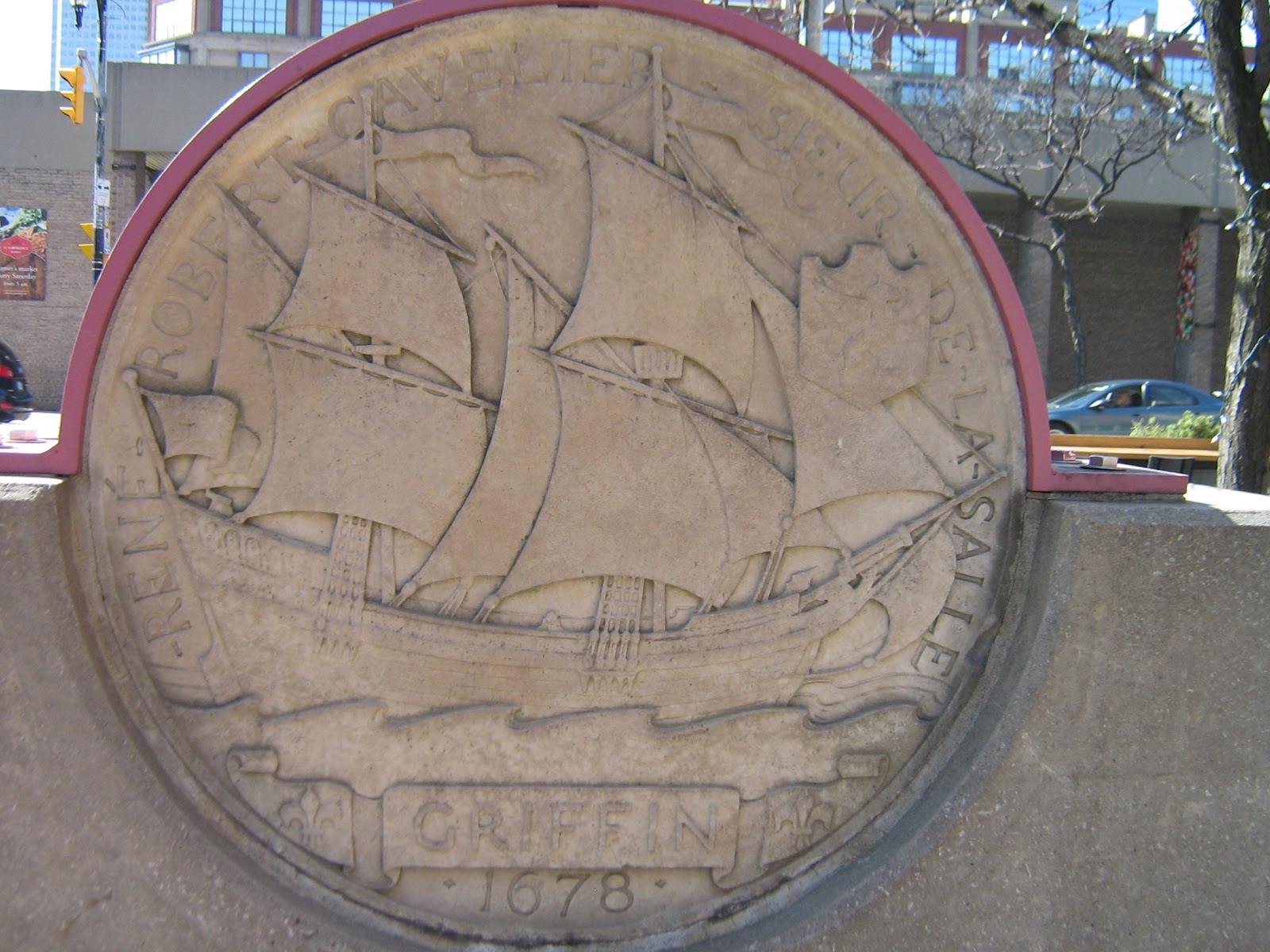
Ships in drydock: that’s how I think of them ... on the cryptic monument occupying quiet space at Front and Jarvis Streets. I’m certain it’s meaningless to 98% of the passers-by. It was to me. It has a bench on each side. People like to sit there, especially when the sun is out. It’s a prime spot for a moment’s restoration amid the St. Lawrence Market bustle ... the elderly, the incapacitated, the bored, can wait for their shopper-companions; a street person will take a break from wheeling her cart of worldly goods. 
Rene Robert Cavalier Sieur de La Salle "Griffin" 1678


Commodore Sir James Yeo Flagship 1814 "St. Lawrence" 1812-15

 The captions above show the circumferential wording on each of the two medallions. Toronto Historical Board plaques at either side tell us the medallions were created by noted sculptor Emanuel Hahn and carved by Louis Temporale for installation on the Clifton Gate Memorial Arch at Niagara Falls. We are told the original intent was to commemorate “early pioneers,” including a passing mention of William Lyon Mackenzie (not to denigrate the man and his contributions to Upper Canada) but oddly, what has all this to do with iconic ships?

A little more investigation revealed an embarrassing history (i.e. what the plaques omit; then again, there’s only so much room on a plaque). The said Memorial Arch was duly built and dedicated in 1938; it was demolished in 1967. Some time later these two rescued art works were reinstalled on what was once our town of York waterfront. Ah-ha, ... waterfront ... ships. The tenuous connection? Not exactly.

The concept of the Memorial Arch, under the supervision of an Ontario government cabinet minister, had two purposes: to celebrate one hundred years of responsible government in Canada, and to welcome visitors entering our country across the Niagara River. The phrase responsible government inevitably conjured unhappy shades of the 1837 Rebellion, provoking some still-tender sensitivities a century later. Criticism arose over some of the monument’s historical allusions. Prime Minister Mackenzie King, despite having been consulted about the design, deplored the inclusion of some American names associated with the Hunters’ Lodges raiders—one gets the impression that the design changed a few times betwixt paper and actual construction!

Clifton Gate Memorial Arch, date unknown, Looking at History
The Memorial Arch was doomed to a lifespan of less than thirty years. Impeding the widening of the Niagara Parkway was a big excuse for removing it. As far as I can ascertain—accounts vary—nearly all the carvings disappeared except for what’s now displayed on Front Street and at William Lyon Mackenzie House. Anyone of historical bent can pursue the details at many websites such as “The Offending Arch” at Historical Narratives of Early Canada:   
http://www.uppercanadahistory.ca/tt/tt14.html,
and Looking at History: https://sites.google.com/site/lookingathistory/the-rebellion-trilogy/three-rebellions/remembering-rebellion-the-infernal-arch.

What I find incomprehensible and disgraceful is much loss of the art. There were four panels of tributes: explorers; Loyalists; the War of 1812 and Tecumseh; and reformer William Lyon Mackenzie (grandfather of the then-PM). The Front Street plaques do not mention that renowned illustrator C.W. Jefferys designed the four large panels. Neither Jefferys nor the equally renowned Hahn lived to see the dismantling.

Let’s have a closer wee look at the subjects on our lonely medallions, which seem to be almost forgotten in the panoply of official heritage plaques.


La Salle (1643-1687) was a very early explorer, the first European to travel the length of the Mississippi River. On a subsequent exploration trip, La Salle became stranded in Texas and was killed there. Le Griffon was a 45-ton barque he had built on the Niagara River above the falls, in order to sail the upper Great Lakes. The ship disappeared on a return voyage from Lake Michigan to New France with a load of furs. Finding Le Griffon is sometimes called the “holy grail” of Great Lakes shipwreck hunters. Indeed, one underwater exploration group believes it recently located the site, but the discovery is in limbo under a tsunami of international litigation. Clearly La Salle and Le Griffon were part of the tribute to explorers.

Yeo (1782-1818) was a naval officer appointed commodore and commander-in-chief on the lakes of Canada in March 1813. He arrived in Upper Canada just after the invasion of York, knowing it was crucial to protect the Kingston shipyards and the lake lifeline to troops in Niagara. In practice, Yeo’s position was subordinate to Sir George Prevost, the army general and British North America governor-in-chief. Prevost and his army officials caused no small problems for the naval commander, not to mention the general’s blunders at Lake Champlain. The great warship St. Lawrence was launched for Yeo in early fall of 1814, a newly effective threat to the American navy—only long enough to serve for a few months before winter came. Word of the war’s end followed soon after. So we know where Yeo and his flagship belonged on the ill-fated Arch.
James Lucas Yeo was a brilliant officer whose selfless devotion to duty contributed in large measure to his early death. He deserved well of his country, and he has justly earned an honoured place among the heroes of the War of 1812.[1]

I love surprises in my neighbourhood.

In memory of the invasion 199 years ago on April 27th.


[1] John W. Spurr, “YEO, Sir James Lucas,” Dictionary of Canadian Biography Online (http://www.biographi.ca/009004-119.01-e.php?&id_nbr=2722 : accessed 30 March 2012).

© Brenda Dougall Merriman, 2012


17 April 2012

The Tolstoy Connection


A morsel of validation! A family emigration story from Latvia gets a helping hand from local history.

The Family Story:
Janis (John) Jurikas (1880-1954) was originally given passage money by a member of the Tolstoy family in London, in order to reach Canada.

My Earlier Thoughts:
The intriguing story may have some truth although Count Leo Tolstoy, the renowned author, was apparently never in England (he died in Russia in 1910). Count Tolstoy was known for his generous sponsorship of group emigration for Russian Doukhobors. Some of those groups came to western Canada in 1898 and 1899.(1) I could not ascertain that any of Leo Tolstoy’s children or descendants happened to be in London at an appropriate time for Janis Jurikas. If the financial assistance took place, perhaps it was before he went to England.

What is certain is that John entered Canada at least twice. Iwan [sic] Jurikas, a general labourer age 26, came to Halifax 12 April 1907 on the ship Sicilian from Glasgow — also with a Johan Tukum (probably a cousin), age 28 and a carpenter.(2) Their destinations were Port Arthur and Fort William, Ontario, respectively. Then Iwan Jurikas, a “Lish” [sic: possibly a corruption of Lettish] native born in Russia, age 29, previous occupation painter, arrived in Montreal via Liverpool on the ship Cedric in April 1910.(3) John or brother Paul, or both, were in New York by 1912 when Victor Freibergs married their sister Marija.

Recently Found:
"It is interesting to note, that within the boundaries of the Russian Empire, Limbaži was considered a place of exile, to which the government sent unruly freethinkers-noblemen. And so in 1899 Lev Tolstoy's associate, lawyer Bodyansky, was sent to Limbaži. He had already sold his estates and bought land in Canada for those being persecuted by the Czarist regime. After Bodyansky's departure to Canada from the "Limbaži exile", his children remained on good terms and in contact with students in Limbaži. They sent to Limbaži a variety of Tolstoy's writings. The gendarmerie in town questioned and arrested a number of people. After that, some of the oldest students - Daugulis, Jurikas and Eglitis - were also exiled from Vidzeme province."(4) [emphasis added]

The reference to Bodyansky more than likely means the nobleman and “Tolstoyan activist,” Alexander Mikhailovich Bodyansky, later associated with Doukhobor settlements in Canada.(5) The movement espoused “communalism” and certainly begs for a bit more background in my Jurikas family history, especially regarding Tolstoy's social theories. Did his group help subsidize individual emigrants to spread his ideals? In 1899 Janis Jurikas was about eighteen-nineteen years old. It's not difficult to imagine the impression such free thinking would make on young men thoroughly unhappy with alien domination of their lives and culture.
Janis Jurikas ca.1948

Epilogue:
About a decade of John's life in Canada and the United States remains unaccounted for. Whether he worked to spread Tolstoyan ideals is not known. In 1921 he travelled from the U.S. to meet his brother Paul who was working in Vladivostock, where they prepared to visit a liberated Latvia. John dedicated himself to working the family farm near Limbaži until he and his family were removed in the infamous Soviet confiscations and deportations. His widow and daughters were allowed to return in the 1960s to occupy the sadly neglected old family home once again.


(1) Dave Obee, Destination Canada: A Genealogical Guide to Immigration Records (Victoria, British Columbia: Dave Obee, 2010), 11.
(2) “Canadian Passenger Lists, 1865-1935,” digital image, Ancestry.ca (http://www.ancestry.ca : accessed 26 March 2010), Sicilian (1907), entry for Iwan Jurikas.
(3) “Canadian Passenger Lists, 1865-1935,” digital image, Ancestry.ca (http://www.ancestry.ca : accessed 26 March 2010), Cedric (1910), entry for Iwan Jurikas.
(4) Vecie Limbaži [Old Limbaži], full reference to follow, kindly translated by Antra Celmins; email correspondence Celmins to Merriman, 18 March 2012.
(5) John McLaren, Despotic Dominion: Property Rights in British Settler Societies, 226, digital image, Google books (http://books.google.ca/ : accessed 17 April 2012).

© Brenda Dougall Merriman, 2012
 

11 April 2012

Frasers Part 20, A Property Puzzle


Catherine McIntyre was born ca.1777 in Scotland; married John Cameron before about 1803.[1]
Margery McIntyre was born ca.1785 in Scotland; married John Fraser 17 August 1808.[2]

Following on my previous Fraser post, I was assembling information on points of intersection between John Fraser and John Cameron. The hypothesis is that their two wives were sisters. The women provide almost no clues themselves; their husbands might tell us more. To be continued later, but one piece of information loomed larger than others: is it a stepping stone to brothers-in-law, or a roadblock? I haven't convinced myself of the overall importance of the point, but it needs addressing. Or maybe I should say it took me into a tangent on maps. What genealogist can resist maps?

From G.R. Rigby, A History of Lachute (Lachute, QC: Giles Publishing House Ltd, 1964).
The two men had contiguous properties on the River Rouge Road by St. Andrews, Seigniory of Argenteuil, according to the metes and bounds description in two land documents of 1845.[3] John Cameron was transferring properties to two sons—all lots then being measured in arpents. Lot 29 was three (frontage) by twenty-eight (depth) arpents, a shape typical of French river lots. The rear of lot 29 abutted the boundary line between the seigniories of Argenteuil and Deux Montagnes. Lot 28 was three by thirty arpents. The latter is the one of interest; John Fraser's land was named as one of the “bounds.” The date of Cameron's acquisition of the properties has not been determined yet, but it was obviously prior to 1845.

Bouchette's 1814 map is the classic post-conquest map of Lower Canada. The line from D to E on the right signifies the boundary between the old seigniories, later counties, of Argenteuil and Deux-Montagnes. It looks to me like there are no more than a dozen lots on the south side of the River Rouge.
 
Cameron's lot 28 was “ ... bounded in the front by the said River Rouge, in the rear by a certain Grignon, on one side by the land of John Fraser and on the other by the above designated land which is Number twenty-eight, where the donor currently lives, ...”.[4] [emphasis added] This seems to place John Fraser on lot 27. 

Probably Bouchette, 1814

The second map is not dated, nor is its source cited, on the website in question.[5] I believe it's a portion of the 1814 Bouchette map which Rigby adapted in a line drawing for his book.You can see the boundary line again. The roads and layout of lots along the Rouge look the same. I scarcely need to mention the lack of lot numbers!

So where would lot 28 be, according to this?!

Were lots numbered in one consecutive series along one side of the river and continued over to the other side? Or did the north and south (sometimes called east and west) sides have their own separate numbering? Did the numbering extend into the Deux-Montagnes seigniory (because the river did)?
Bouchette, 1831
Here is Bouchette again in 1831, a good generation after settlement.[6] Houses and buildings are shown! ... how accurate would they be? But again, no lot numbers. However, I know from the 1861 census and specific land records that John Fraser's land included lots 21 (acquired in 1824), 22 (1806), and 23 (1818). Therefore I'm having some trouble with contiguous!
Cadastre map St-Andre East parish, no date
 All Quebec properties were re-numbered in the cadastral reform of the second part of the nineteenth century. The cadastre map shows many more than a dozen lots each side of River Rouge, within the old seigniory and parish limits.[7] Did something change between 1831 and ca.1870? Or were Bouchette's smaller number of squarish-looking lots simply the surveyor's artistic licence? The cadastre numbering, continuing from the Côte du Midi section, ascends numerically from the village along the south range of the river and continues from east to west on the north range.

Then John Fraser's original property numbers became lot 592 (formerly lot 21), lot 593 (22 ), and 594 (23). The highlight shows his lot 594 (23). How do I know this? Because with time and patience, professional researchers in Quebec were able to access both the registered notarial documents and the seigniorial records. We need to go through the same exercise with John Cameron's seigniorial record(s).

Even if John Fraser and John Cameron were located on adjoining lots, am I putting too much weight on proximity to infer a relationship? After all, a man has many neighbours! It can be argued that Fraser and Cameron are no more or less “associates” than all the settlers along the river bank.

Still, how could lot 28 border with John Fraser's lots 21 to 23?

A thought almost too grim to contemplate: What if the John Fraser mentioned in Cameron's document was my other John Fraser? ... the blacksmith “of St. Andrews.” Instead of hammering happily away in the village, did he have a farm where he practised his trade? Not too likely, I think. Not only had he died or disappeared shortly before 1842, his widow could not be found in that census. She spent her later days living with a brother on one of her father's original properties. It wouldn't hurt to investigate all the lots from 20 to 29. Much easier said than done, in two sets of complicated records. It's either an extended visit to BAnQ in Montreal or hire a researcher again.

[1] 1851 Census Canada East, County of Two Mountains, District 11, parish of St. Andrews, stamped p. 41, John Cameron household; Library and Archives Canada (LAC) microfilm C-1147. “Quebec Vital and Church Records (Drouin Collection) 1621-1967,” digital images, Ancestry.ca (www.ancestry.ca : accessed March 2012), baptism of “Jean” Cameron, 18 July1803; citing St. Benoit Catholic register (Saint-Benoît, Quebec) 1799-1805.
[2] St Gabriel Street Presbyterian Church (Montreal, Quebec), 1808 register, p. 47, Fraser-McIntyre marriage; Archives of Ontario (AO) microfilm MS 351 reel 1.
[3] A transcription of the John Cameron notarial document was provided by third-party Cameron researchers; the citation is incomplete until they provide details or unless I can see the original documents: District of Montreal, County of Two Mountains, notaries J.Geo. Lebel and F.H. Leclair of St. Hermas, document no. 944 (20 January 1845).
[4] Ibid.
[5] “The Seigniory of Argenteuil,” Comte d'Argenteuil (www.comte-argenteuil.com/SA1.jpg : accessed 21 March 2008).
[6] Joseph Bouchette, Topographical Map of the District of Montreal (London: James Wyld, 1831); digital image, David Rumsey Historical Map Collection (www.davidrumsey.com/ : accessed 9 April 2012).
[7] “Collection numérique de cartes et plans – Impression,” Bibiothêque et Archives nationales de Québec (http://services.banq.qc.ca/ : accessed 2 August 2009).

08 April 2012

April Ancestors


For the sake of brief entries, I am not footnoting the facts in this ongoing memorial. Sources have been noted either in other blog posts or in my family history books.

11 Apr 1912 Victor Karl Freibergs, son of Otto Freibergs and Ilse Hendricksons, and Marija Jurikas, daughter of Janis Jurikas and Katrina Tukums, were married by Rev. Isaac Sturges, the Latvian rector at St. Cornelius Russian Orthodox Church In New York City. The wedding took place at 442 West 47th Street and was witnessed by John J. Kalnins, the Latvian Consular Agent in New York. An original marriage document signed by all parties is in my possession. St. Cornelius, located on Governors Island in Manhattan, was later called St. Cornelius the Centurion, a chapel of New York's Trinity Episcopal Church. Victor was then living in Port Arthur, Ontario (now Thunder Bay) where he and his bride took up residence for most of their lives. They were my maternal grandparents. 
 
12 April 1808 John Fraser, son of Duncan Fraser and Catharine Robertson, was baptized at Killin, Perthshire, Scotland. John came to St. Andrews East, Argenteuil, Quebec, about 1830-1831. Little is known of his life (and nothing about his death) except he practised as a blacksmith in the village and may have had family relations on either side of the Ottawa River. His brother William became a respected doctor in Montreal. John disappeared from the radar about 1839 after the conception of his last child. Further details were posted here. He was my great-great-grandfather.

22 April 1906 Victor Freibergs arrived in Canada at the port of Saint John, New Brunswick on the Lake Michigan. Within a very short time he was bound for Montreal by train, arriving there the next day. He found a boarding house to stay in while seeking employment. Like many immigrants, he had to deal with the Russian Consul in Montreal to sort out his status and prepare for Canadian citizenship, a process that went on for some years. Victor never returned to his native Latvia.