Couldn’t resist an entry for the 100th edition of Carnival of Genealogy. Congratulations to Jasia of Creative Gene on this milestone! One in Every Family is the theme. We are encouraged to write about special individuals, family heirlooms, or “interpret as you like.” I’ve interpreted the theme loosely as One in Every Generation (of the family).
Part of the family history fabric for me is to see a pleasing characteristic or skill appearing in one generation after another as a recurring sort of genetic inheritance. Sometimes the evidence is not so pleasing! Granted, none of us can expect to live long enough to witness such interesting developments more than say three-four generations. But we can record what we see now, so the present youngsters can make future additions ... extended family, are you listening (reading)?
Certainly there are recurrent threads (genes?) in branches of my family history. Shades of a Carnival of Genealogy theme about two and a half years ago! Some recurring characteristics are fairly easy to spot, such as noted then in my red hair monologue. Old photographs can be helpful to confirm physical attributes of ancestors we ourselves didn’t know. Mental and psychological traits in long-gone relatives probably depend only on rather unreliable anecdotes; nevertheless, a cousin and I did capture memories and observations of less perceptible but recurring characteristics ... another post, another time. Having turned this Carnival subject to my own ends, I address the stated theme!
Victor Carl Freiberg lived most of his life in Port Arthur, Ontario. He was a blue-collar working man who found a niche at the mighty Provincial Pulp and Paper Mill. That was after a few stints at rough railway building in Northwestern Ontario and unsettled years of moving back and forth to Blind River in the pulp and paper industry. And those years were after a harrowing flight from his native Latvia at the age of twenty-one.
Born Victor Karl Freibergs in 1884, he and his three siblings had a good life. His father had a prosperous farm with sub-tenants on the Marzingshof (Mārsnēni in today’s Latvian) estate in Riga District, province of Vidzeme, Latvia. His father was also an influential member of the local Kastrāne parish council. As a young man Victor was vigorous and strong, with a special pride in his horses (the experience served him well for handling horse teams during a Canadian winter of hauling logs for railway ties). Then the 1905 uprising in the Russian Empire changed his life forever (see this for his father’s story).
After his unhappy exile, Victor apparently never entertained a wish to return to his homeland. He was not pleased when his insistent wife left for a six-month visit during the euphoric 1920s days of Latvia’s freedom. A relatively uneventful life in Port Arthur suited him. Grandchildren were bounced on his knee as he recalled bits of old Latvian songs—the best part was when he imitated the musical instruments. He did not achieve total fluency in the English language but it didn’t hamper his self-expression.
He found his second nature—and at times would wax poetic about nature’s pantheon—in gardening. He turned the garden of his modest home into a summer showcase. Several times he won civic garden tour awards that gave him enormous satisfaction. Sadly, my inherited old photographs don’t do justice to his labours. My assisted research efforts with Latvian records and kin now show that Victor’s grandfather, Ansis Freibergs, also had dedicated horticultural interests. His descendants still take pride in the trees he planted over 150 years ago.
In retirement life Victor loved his strolls downtown, critically inspecting all the gardens along the way, to socialize with the other old men. The “regulars” would sit on park benches with their faces lifted to the sun, exchanging amiable words now and then.
The corollary to this quiet story is the gardening gene that pops up again. A grandson has it in spades (pun intended), nurturing a greenhouse with spectacular flowers and vegetables. A great-granddaughter has it—actually trained to maximize the interest—eventually making her own home a blooming delight.
Five generations along from Ansis Freibergs. And likely more I don’t know about. Egad. Something so very satisfying about seeing a gentle, creative family legacy unfolding before your very eyes!
19 November 2010
08 November 2010
Family History: Truth or Fiction?
Which is stranger, truth or fiction?
In family history, the real question is which survives longer or stronger?
That depends, bien sûr, on two things in every generation: the level of interest among assorted family individuals, and the abilities of a family historian.
One of my main blog goals has been to reach extended family members who feel the occasional curiosity regarding their antecedents, their cousin relationships, or perhaps their biological inheritance. Now I’m seriously questioning this goal. Not that I will stop my mission, because family history contributes a much wider significance to the grass roots of ALL history. The necessary mental gymnastics themselves are a singular challenge and satisfying reward.
My particular subject of the moment is Family Stories—a special source my fellow genealogists will recognize at once, rolling their eyes. We have other terms for the same concept: derivative sources, oral tradition, family legends, family lore, hearsay, word of mouth, and so on.
My personal favourite is mythinformation, a coinage oh-so-suitable for historical/genealogical permutations. A few generic stories seem to cross all ethnic and genetic boundaries in the New World ... e.g., the Indian Princess ancestor, or The Three Brothers who arrived to go their separate ways, just waiting for us to hook them up again. By the time you reach the bottom of this post you will get the connection between the aforementioned goal and mythinformation.
Stories of the olden days are often what capture us to first explore our unique piece of history. Some ancestors were more colourful than others. Their exploits and events—heroic or scandalous—tend to alter as the years go by. Parts of a story get embroidered or censored. Bits get added or omitted. Sometimes the years blur two ancestors into one person. By the time a few generations pass, we researchers understand that it takes a certain amount of the proverbial salt to digest the stories.
It’s like that old parlour game with a circle of people. The first person whispers a fairly simple statement into the ear of the next person. The second person whispers what she or he heard to the next person. The whispers continue around the circle. Last person compares what she/he heard with the original statement. Hilarity ensues. Point taken: how little the statements resemble each other.
Family stories can be vivid for “adding flesh to the ancestral bones” as we say. Lord knows, anecdotal evidence can be useful when trying to describe long-gone people in writing. But they are only stories, identified as such, until otherwise researched. We spend a lot of time trying to track down the truth behind stories-gossip-rumour handed down to us. And it sure ain’t ever easy, separating the wheat from the chaff.
Example: An articulate cousin, at every family gathering, takes centre stage with tales of Highland glory and our imaginative descent from Simon Fraser the explorer. The indulgent audience is always rapt. I gave up arguing privately with him because I finally understood his need to repeat the fond stories without factual spoilers from me.
Searching for the truth is an obligation that comes with the genealogy package—at the least, doing our best to verify the straight goods. Biographical writing of real, documented ancestors, even if it looks slim at times, is the result of intensive research. We pay tribute to the ancestors who contributed so much to make US who and what we are.
However, that presumes perhaps impossible interest from the very family members we try to reach: enough genuine curiosity, and some respect for the researcher who’s writing it down :-)
Notice the emphasis on old family stories, and the passage of generations. How can we tell if the morphing into mythinformation began in mere carelessness or if more deliberate motives were at play?
To my surprise and regret, I find bizarre family stories propagating in my lifetime about an ancestor whose life events I’ve researched in contemporary, original sources. I hear: rum-running during prohibition! Military honour awarded by the Queen in greatest secrecy! Murderous post-war hunting of Nazi criminals! Yowser. Sounds like an unwritten novel. Idle minds? Wishful thinking?
Readers and GeneaBloggers, I ask you: Any similar experiences? Is there a moment when we stop proselytizing, if that’s what we’re doing, and forget the “audience”? Just work on family history for the sheer joy and peer support?
If any family members are lurking along, remember you can comment anonymously! Or do I detect a movement to lock up the crazed genealogist in a computer-unfriendly environment?
In family history, the real question is which survives longer or stronger?
That depends, bien sûr, on two things in every generation: the level of interest among assorted family individuals, and the abilities of a family historian.
One of my main blog goals has been to reach extended family members who feel the occasional curiosity regarding their antecedents, their cousin relationships, or perhaps their biological inheritance. Now I’m seriously questioning this goal. Not that I will stop my mission, because family history contributes a much wider significance to the grass roots of ALL history. The necessary mental gymnastics themselves are a singular challenge and satisfying reward.
My particular subject of the moment is Family Stories—a special source my fellow genealogists will recognize at once, rolling their eyes. We have other terms for the same concept: derivative sources, oral tradition, family legends, family lore, hearsay, word of mouth, and so on.
My personal favourite is mythinformation, a coinage oh-so-suitable for historical/genealogical permutations. A few generic stories seem to cross all ethnic and genetic boundaries in the New World ... e.g., the Indian Princess ancestor, or The Three Brothers who arrived to go their separate ways, just waiting for us to hook them up again. By the time you reach the bottom of this post you will get the connection between the aforementioned goal and mythinformation.
Stories of the olden days are often what capture us to first explore our unique piece of history. Some ancestors were more colourful than others. Their exploits and events—heroic or scandalous—tend to alter as the years go by. Parts of a story get embroidered or censored. Bits get added or omitted. Sometimes the years blur two ancestors into one person. By the time a few generations pass, we researchers understand that it takes a certain amount of the proverbial salt to digest the stories.
It’s like that old parlour game with a circle of people. The first person whispers a fairly simple statement into the ear of the next person. The second person whispers what she or he heard to the next person. The whispers continue around the circle. Last person compares what she/he heard with the original statement. Hilarity ensues. Point taken: how little the statements resemble each other.
Family stories can be vivid for “adding flesh to the ancestral bones” as we say. Lord knows, anecdotal evidence can be useful when trying to describe long-gone people in writing. But they are only stories, identified as such, until otherwise researched. We spend a lot of time trying to track down the truth behind stories-gossip-rumour handed down to us. And it sure ain’t ever easy, separating the wheat from the chaff.
Example: An articulate cousin, at every family gathering, takes centre stage with tales of Highland glory and our imaginative descent from Simon Fraser the explorer. The indulgent audience is always rapt. I gave up arguing privately with him because I finally understood his need to repeat the fond stories without factual spoilers from me.
Searching for the truth is an obligation that comes with the genealogy package—at the least, doing our best to verify the straight goods. Biographical writing of real, documented ancestors, even if it looks slim at times, is the result of intensive research. We pay tribute to the ancestors who contributed so much to make US who and what we are.
However, that presumes perhaps impossible interest from the very family members we try to reach: enough genuine curiosity, and some respect for the researcher who’s writing it down :-)
Notice the emphasis on old family stories, and the passage of generations. How can we tell if the morphing into mythinformation began in mere carelessness or if more deliberate motives were at play?
To my surprise and regret, I find bizarre family stories propagating in my lifetime about an ancestor whose life events I’ve researched in contemporary, original sources. I hear: rum-running during prohibition! Military honour awarded by the Queen in greatest secrecy! Murderous post-war hunting of Nazi criminals! Yowser. Sounds like an unwritten novel. Idle minds? Wishful thinking?
Readers and GeneaBloggers, I ask you: Any similar experiences? Is there a moment when we stop proselytizing, if that’s what we’re doing, and forget the “audience”? Just work on family history for the sheer joy and peer support?
If any family members are lurking along, remember you can comment anonymously! Or do I detect a movement to lock up the crazed genealogist in a computer-unfriendly environment?
05 November 2010
Death Customs Stay With Us
13 October 2010
Frasers: Part 10 (Perthshire)
A post of agony about the Frasers of Perthshire, to be tolerated with kind empathy. Especially by those searching for equally frustrating families like Smith and Jones. I noticed that I’d been spelling Killin in Scotland as Killean half the time so changes were made for consistency. They sound the same to me. For a long time I lived in an Ontario township where communities were named after places in Perthshire ... Crieff, Badenoch, Aberfoyle, Killean [sic] ... some kind of pre-ordained Scottish omen, I suppose. So I say Killeeeeeeen however it’s spelled.
My post about the town of Killin lamented the surprisingly (to me) scant number of Frasers in South Perthshire burials recorded by the Scottish Genealogy Society (SGS). I said: Why am I getting this sinking feeling that gt-gt-gt-Duncan’s grandfather may have drifted into Killin from Inverness-shire where the Lovat Frasers were concentrated? He would have been the age to be young and healthy at the time of the Battle of Culloden.
We’ll have to scrap that romantic notion because not one Duncan Fraser appears in No Quarter Given, a work that took years of research by many scholars and may never be definitive.[1] There were plenty of Frasers who fought for Prince Charles Edward, most notably among Lord Lovat’s clansmen of Inverness-shire. Simon Fraser, 11th Lord Lovat, is the one who was executed after Culloden for his support of the controversial Young Pretender. Don’t get me started.
As for the “missing” gravestone of Janet Fraser and husband Alexander MacFarlane in South Perthshire Monumental Inscriptions, which I had viewed in person, cousin Lizzie rightly pointed out that the SGS was concentrating on pre-1855 inscriptions. (Self: I knew that, didn’t I?) Because from 1855 onward, Scotland has official registrations of deaths, along with births and marriages.
A research plan is needed. What do we know about our earliest ancestors?
➢Duncan Fraser was baptized 24 July 1783 at Killin. His marriage to Catherine Robertson took place at Killin on 18 July 1807. Duncan died 15 February 1867. His parents were:
➢John Fraser, baptized 17 June 1751 at Killin. His marriage to Janet Buchanan before 1783 has not been found; they had five children born after Duncan. John’s parents were:
➢Duncan Fraser and Margaret McKeracher. The couple had three other children later than John, but neither baptism nor marriage for Duncan has been found. A burial index at Stirling Archives indicates a Duncan Frazer of Luib (another nearby hamlet) was buried at Killin 7 January 1787. The date would fit this particular Duncan—if there had been a gravestone, it’s no longer visible.
Most of the above is based on parish register searches as indexed at FamilySearch.org. Parish extractions for all of Scotland have not produced a “likely” Duncan married before 1751. Here is where we lose our thread, stalled at 1751.
It’s not as if the information is there and Duncan has somehow failed us. The available records do not include marriages at Killin which are missing 1699-1708 and 1720-1782. Um, yes, have we not heard this problem before? ... in other parishes and other families. Does anyone tell us why they are missing, or does the answer really matter? The records have disappeared through some kind of neglect or misadventure or might never have been written at all. So we have to suck it up.
Genealogists and family historians call this a brickwall or a roadblock problem. One strategy then, perhaps the only strategy, is the attempt to reconstruct every contemporaneous Fraser family in the area (SIGH). Say from 1700 to 1800 in this case. Tracking theavailable (Self: SO regretting over-usage of this word!) existing Fraser baptisms, marriages, and gravestones in and around Killin is the main way to do this.
At the same time, adjacent parishes and place names need to be kept in mind while searching databases and records. Additional monumental inscriptions need studying (but can’t expect volunteers to have recorded every burial ground in the country). Contact with local family history societies is essential—they have members’ interests, query pages, or copies of compiled family histories. Someone out there, in Wazoo, Australia, or Bottomley-on-Sprye, England, could have a missing link for me. I haven’t given up on the notion that Killin Kirk Sessions might have references to pertinent Fraser individuals (especially if they were naughty) because they do exist from 1723-1762.
Why did Duncan’s descendant Dr William Fraser (1810-1872), brother of my gt-gt-grandfather John, name his third son William Lovat Fraser? Did the doctor know from oral family lore something we don’t know? Oh no. Am I ultimately facing the complicated parish records of Inverness-shire? Complicated, because in that region the name Fraser is the equivalent of the dreaded Smith everywhere else.
Lizzie, our work is cut out for us. The next batch of monumental inscriptions is on its way to me.
My post about the town of Killin lamented the surprisingly (to me) scant number of Frasers in South Perthshire burials recorded by the Scottish Genealogy Society (SGS). I said: Why am I getting this sinking feeling that gt-gt-gt-Duncan’s grandfather may have drifted into Killin from Inverness-shire where the Lovat Frasers were concentrated? He would have been the age to be young and healthy at the time of the Battle of Culloden.
We’ll have to scrap that romantic notion because not one Duncan Fraser appears in No Quarter Given, a work that took years of research by many scholars and may never be definitive.[1] There were plenty of Frasers who fought for Prince Charles Edward, most notably among Lord Lovat’s clansmen of Inverness-shire. Simon Fraser, 11th Lord Lovat, is the one who was executed after Culloden for his support of the controversial Young Pretender. Don’t get me started.
As for the “missing” gravestone of Janet Fraser and husband Alexander MacFarlane in South Perthshire Monumental Inscriptions, which I had viewed in person, cousin Lizzie rightly pointed out that the SGS was concentrating on pre-1855 inscriptions. (Self: I knew that, didn’t I?) Because from 1855 onward, Scotland has official registrations of deaths, along with births and marriages.
A research plan is needed. What do we know about our earliest ancestors?
➢Duncan Fraser was baptized 24 July 1783 at Killin. His marriage to Catherine Robertson took place at Killin on 18 July 1807. Duncan died 15 February 1867. His parents were:
➢John Fraser, baptized 17 June 1751 at Killin. His marriage to Janet Buchanan before 1783 has not been found; they had five children born after Duncan. John’s parents were:
➢Duncan Fraser and Margaret McKeracher. The couple had three other children later than John, but neither baptism nor marriage for Duncan has been found. A burial index at Stirling Archives indicates a Duncan Frazer of Luib (another nearby hamlet) was buried at Killin 7 January 1787. The date would fit this particular Duncan—if there had been a gravestone, it’s no longer visible.
Most of the above is based on parish register searches as indexed at FamilySearch.org. Parish extractions for all of Scotland have not produced a “likely” Duncan married before 1751. Here is where we lose our thread, stalled at 1751.
It’s not as if the information is there and Duncan has somehow failed us. The available records do not include marriages at Killin which are missing 1699-1708 and 1720-1782. Um, yes, have we not heard this problem before? ... in other parishes and other families. Does anyone tell us why they are missing, or does the answer really matter? The records have disappeared through some kind of neglect or misadventure or might never have been written at all. So we have to suck it up.
Genealogists and family historians call this a brickwall or a roadblock problem. One strategy then, perhaps the only strategy, is the attempt to reconstruct every contemporaneous Fraser family in the area (SIGH). Say from 1700 to 1800 in this case. Tracking the
At the same time, adjacent parishes and place names need to be kept in mind while searching databases and records. Additional monumental inscriptions need studying (but can’t expect volunteers to have recorded every burial ground in the country). Contact with local family history societies is essential—they have members’ interests, query pages, or copies of compiled family histories. Someone out there, in Wazoo, Australia, or Bottomley-on-Sprye, England, could have a missing link for me. I haven’t given up on the notion that Killin Kirk Sessions might have references to pertinent Fraser individuals (especially if they were naughty) because they do exist from 1723-1762.
Why did Duncan’s descendant Dr William Fraser (1810-1872), brother of my gt-gt-grandfather John, name his third son William Lovat Fraser? Did the doctor know from oral family lore something we don’t know? Oh no. Am I ultimately facing the complicated parish records of Inverness-shire? Complicated, because in that region the name Fraser is the equivalent of the dreaded Smith everywhere else.
Lizzie, our work is cut out for us. The next batch of monumental inscriptions is on its way to me.
Labels:
Dr William Fraser,
Duncan Fraser,
Fraser,
Inverness-shire,
Killin,
Perthshire
09 October 2010
05 October 2010
George Porter Part 4: The Surveyor(s)
... continuing a small series on less-than-exhaustive searches for two mysterious George Porters.
One George disappeared from Upper Canada about 1800; another George surfaced in 1814, outlined here. Family origins for both are unknown. Two previous “Persons of Interest”have already been introduced. The Rifleman was said to be from Pennsylvania; the Blacksmith apparently originated in New England.
Speaking of Porter families in New England, one branch produced some prominent figures in the Buffalo and Erie County area of New York ... which is where? ... across and upriver from our George Porter the Carpenter’s first appearance in Newark (long since renamed Niagara-on-the-Lake but often referred to as simply Niagara). The next Persons of Interest:
The Surveyor
Augustus Porter (1769-1849) was born in Connecticut, the son of Col. Joshua Porter (born 1730, son of Nathaniel) and Abigail Buell.[1] The six children of this couple, by various accounts, do not include a George. Augustus was a surveyor who arrived in western New York in 1789 and became well-acquainted with the region.[2] His brother Peter B. Porter (1773-1844) later joined him, both purchasing extensive lands along the Niagara River to become pioneer residents, developers, and wealthy businessmen of Black Rock (Buffalo) and Niagara Falls. Augustus eventually became a judge and Peter became a general in the military, which are huge (and shameful) over-simplifications of their respective lives.[3]
The Person of Interest Part:
Number one, George the Carpenter named his second son Augustus. Not your run-of-the-mill name (the first son was David). The name does not occur in his wife’s family. It seems to be rare among the New England Porters. No use asking about baptismal sponsors ... George quite successfully avoided all contact with church and clergy in Newark and York. Number two, a descendant recalls a family tidbit that George himself had been engaged “as a surveyor” at one time. Number three, the Niagara proximity features again—but that is a given with all persons of interest. Residents on each side of the Niagara River were well aware of each other’s activities and considerable traffic—economic and social—went back and forth. References to leading citizens were published in newspapers on both sides.
When George the Carpenter’s son Augustus was born about 1798, the family was in the town of York. But George still had some unresolved property claims in Newark. Did he pull the name Augustus out of a hat? Or did it come from his own unknown, now forgotten, ancestral line? Or could it be he deeply admired a well-known entrepreneur across the river? A man, coincidentally, with the same surname ...
The Surveyor’s year of birth makes him a contemporary of the Carpenter. Augustus from Connecticut was unlikely to be the captured Rifleman in 1794, if we are to trust the report of the Rifleman being a “native of Pennsylvania.”
The Other Surveyor
Admittedly, I am hung up on the name Augustus. So hung up I might suspend credibility with this one. In 1788 Augustus Jones (c1757-1836) was sworn in as a Crown surveyor near Newark.[4] From 1791 to 1800 he served as chief surveyor for the old Nassau District of Upper Canada which encompassed the Niagara peninsula and well beyond. Augustus came from a family settled in Newburgh, in the Hudson River Valley, and had trained as a surveyor in New York City.
Does it defy possibility that, when George the Carpenter first came to Upper Canada, he worked on Jones’ survey crew for a year or so? If Augustus Jones actually recorded the names of his axe men, chain bearers, and so on (few surveyors seemed to do this in their working diaries), it might give us a reason for the naming of George’s son ... assuming he had great respect for Jones.
The earliest surviving survey diary of Augustus Jones is from the winter of 1793 with no names of the men he hired.[5] His 1797 diary, at work on the Grand River, illustrates the occasional reference to the largely nameless employees: “one of the hands” was bitten by a rattlesnake, and applying some roots to the wound “made the man easy.”[6]
Both scenarios for naming a child Augustus—the surveyor in New York State, and the surveyor in Upper Canada—would eliminate the name as a clue to family origins.
Now that I’ve taken up this much space, the promised Doctor will have to wait till next time. It’s not all bad to have your imagination working for you when the target keeps dodging. But the circles around the bulls-eye target expand wider and fainter. Perhaps these preliminary surveys of “Persons of Interest” will clarify where more disciplined and focused research should apply.
[1] Albert Welles, History of the Buell family in England: from the remotest times ...(New York: American College for Genealogical Registry, Family History and Heraldry, 1881), 108 and 110. [Dates of birth vary slightly in other family accounts.]
[2] James Harvey Hotchkin, A History of the Purchase and Settlement of Western New York (New York: M.W. Dodd, 1848), 14.
[3] Charles Mulford Robinson, The life of Judge Augustus Porter, a pioneer in western New York, by his great-grandson, Charles Mulford Robinson (Buffalo: Buffalo Historical Society Publications, 1904).
Bob Kostoff, “Porters Prominent Locally,” Niagara Falls Reporter (http://www.niagarafallsreporter.com : accessed 17 June 2010), 2 August 2005.
[4] “Augustus Jones,” Dictionary of Canadian Biography (http://www.biographi.ca/ : accessed 23 September 2010).
[5] Crown Land Survey Diaries, Field Notes and Reports, “regarding a survey of Burlington Bay to the Forks of the Thames,” [Augustus Jones, January-February 1793], RG1-59, vol. 47, no. 614; Archives of Ontario microfilm MS 7438.
[6] Correspondence and Memoranda Relating to Surveys, “Survey at the River Ouse for Capt. Brant,” [Augustus Jones, from August 1797], RG 1-2-1, vol. 46, 75-76; Archives of Ontario microfilm MS 7438.
Some of the books can be viewed on Google Books or Internet Archive.
© Brenda Dougall Merriman, 2010.
One George disappeared from Upper Canada about 1800; another George surfaced in 1814, outlined here. Family origins for both are unknown. Two previous “Persons of Interest”have already been introduced. The Rifleman was said to be from Pennsylvania; the Blacksmith apparently originated in New England.
Speaking of Porter families in New England, one branch produced some prominent figures in the Buffalo and Erie County area of New York ... which is where? ... across and upriver from our George Porter the Carpenter’s first appearance in Newark (long since renamed Niagara-on-the-Lake but often referred to as simply Niagara). The next Persons of Interest:
The Surveyor
Augustus Porter (1769-1849) was born in Connecticut, the son of Col. Joshua Porter (born 1730, son of Nathaniel) and Abigail Buell.[1] The six children of this couple, by various accounts, do not include a George. Augustus was a surveyor who arrived in western New York in 1789 and became well-acquainted with the region.[2] His brother Peter B. Porter (1773-1844) later joined him, both purchasing extensive lands along the Niagara River to become pioneer residents, developers, and wealthy businessmen of Black Rock (Buffalo) and Niagara Falls. Augustus eventually became a judge and Peter became a general in the military, which are huge (and shameful) over-simplifications of their respective lives.[3]
The Person of Interest Part:
Number one, George the Carpenter named his second son Augustus. Not your run-of-the-mill name (the first son was David). The name does not occur in his wife’s family. It seems to be rare among the New England Porters. No use asking about baptismal sponsors ... George quite successfully avoided all contact with church and clergy in Newark and York. Number two, a descendant recalls a family tidbit that George himself had been engaged “as a surveyor” at one time. Number three, the Niagara proximity features again—but that is a given with all persons of interest. Residents on each side of the Niagara River were well aware of each other’s activities and considerable traffic—economic and social—went back and forth. References to leading citizens were published in newspapers on both sides.
When George the Carpenter’s son Augustus was born about 1798, the family was in the town of York. But George still had some unresolved property claims in Newark. Did he pull the name Augustus out of a hat? Or did it come from his own unknown, now forgotten, ancestral line? Or could it be he deeply admired a well-known entrepreneur across the river? A man, coincidentally, with the same surname ...
The Surveyor’s year of birth makes him a contemporary of the Carpenter. Augustus from Connecticut was unlikely to be the captured Rifleman in 1794, if we are to trust the report of the Rifleman being a “native of Pennsylvania.”
The Other Surveyor
Admittedly, I am hung up on the name Augustus. So hung up I might suspend credibility with this one. In 1788 Augustus Jones (c1757-1836) was sworn in as a Crown surveyor near Newark.[4] From 1791 to 1800 he served as chief surveyor for the old Nassau District of Upper Canada which encompassed the Niagara peninsula and well beyond. Augustus came from a family settled in Newburgh, in the Hudson River Valley, and had trained as a surveyor in New York City.
Does it defy possibility that, when George the Carpenter first came to Upper Canada, he worked on Jones’ survey crew for a year or so? If Augustus Jones actually recorded the names of his axe men, chain bearers, and so on (few surveyors seemed to do this in their working diaries), it might give us a reason for the naming of George’s son ... assuming he had great respect for Jones.
The earliest surviving survey diary of Augustus Jones is from the winter of 1793 with no names of the men he hired.[5] His 1797 diary, at work on the Grand River, illustrates the occasional reference to the largely nameless employees: “one of the hands” was bitten by a rattlesnake, and applying some roots to the wound “made the man easy.”[6]
Both scenarios for naming a child Augustus—the surveyor in New York State, and the surveyor in Upper Canada—would eliminate the name as a clue to family origins.
Now that I’ve taken up this much space, the promised Doctor will have to wait till next time. It’s not all bad to have your imagination working for you when the target keeps dodging. But the circles around the bulls-eye target expand wider and fainter. Perhaps these preliminary surveys of “Persons of Interest” will clarify where more disciplined and focused research should apply.
[1] Albert Welles, History of the Buell family in England: from the remotest times ...(New York: American College for Genealogical Registry, Family History and Heraldry, 1881), 108 and 110. [Dates of birth vary slightly in other family accounts.]
[2] James Harvey Hotchkin, A History of the Purchase and Settlement of Western New York (New York: M.W. Dodd, 1848), 14.
[3] Charles Mulford Robinson, The life of Judge Augustus Porter, a pioneer in western New York, by his great-grandson, Charles Mulford Robinson (Buffalo: Buffalo Historical Society Publications, 1904).
Bob Kostoff, “Porters Prominent Locally,” Niagara Falls Reporter (http://www.niagarafallsreporter.com : accessed 17 June 2010), 2 August 2005.
[4] “Augustus Jones,” Dictionary of Canadian Biography (http://www.biographi.ca/ : accessed 23 September 2010).
[5] Crown Land Survey Diaries, Field Notes and Reports, “regarding a survey of Burlington Bay to the Forks of the Thames,” [Augustus Jones, January-February 1793], RG1-59, vol. 47, no. 614; Archives of Ontario microfilm MS 7438.
[6] Correspondence and Memoranda Relating to Surveys, “Survey at the River Ouse for Capt. Brant,” [Augustus Jones, from August 1797], RG 1-2-1, vol. 46, 75-76; Archives of Ontario microfilm MS 7438.
Some of the books can be viewed on Google Books or Internet Archive.
© Brenda Dougall Merriman, 2010.
Labels:
Augustus Jones,
Augustus Porter,
Buffalo,
George Porter,
Porter,
surveyors,
Upper Canada
24 September 2010
Cemeteries Part 12: Greyfriars
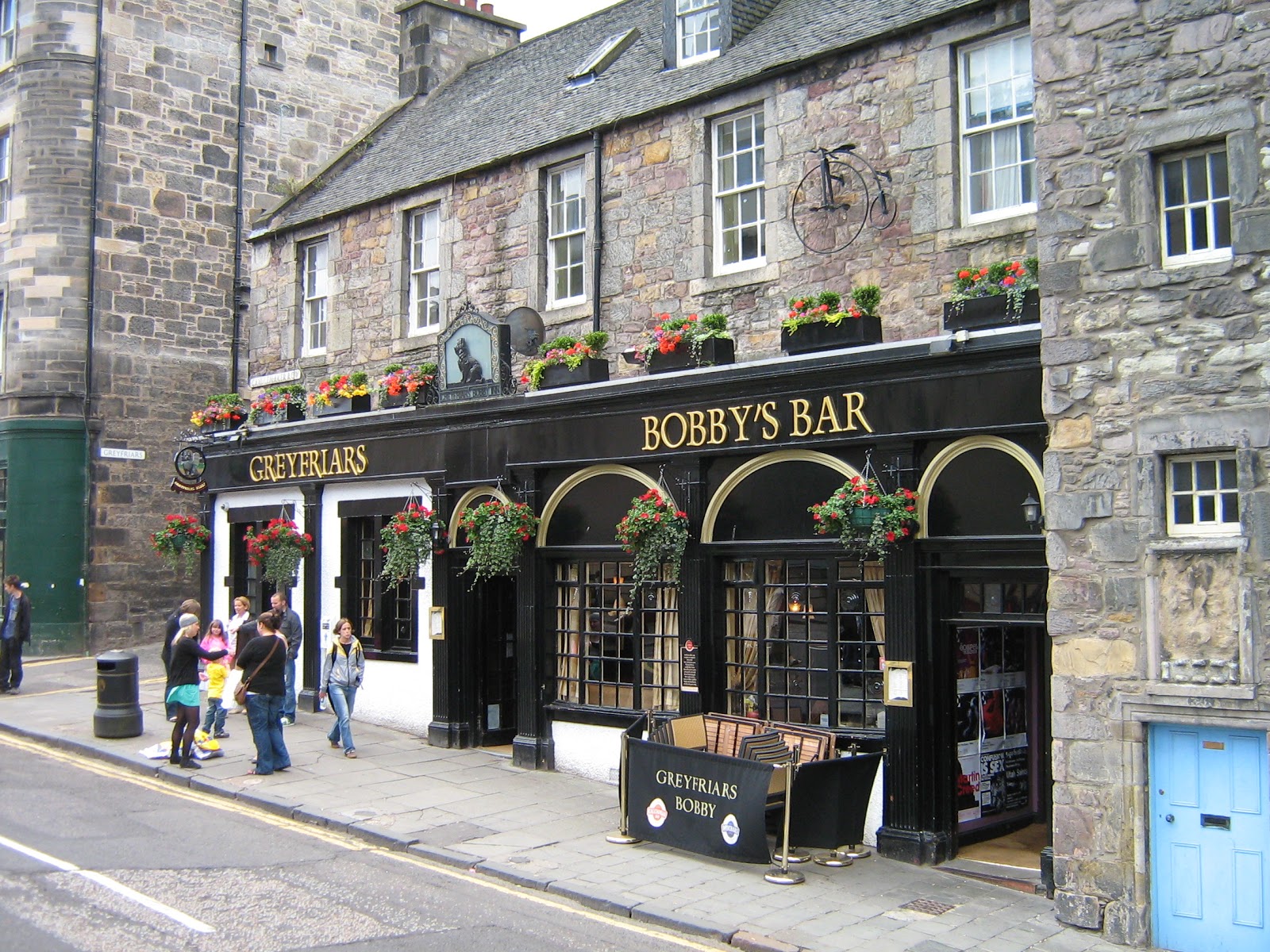
While waiting for retrievals at the National Library in Edinburgh, I scooted outside to practice my photography skills. Note to self: Surely the quantity I take will result in some quality. Two minutes away was one of Edinburgh’s iconic historical sites. The entrance to Greyfriars Church and cemetery is all but unnoticeable except for the landmark pub.
Something about a faithful dog called Bobby rang a faint bell. My ignorance of the history here was excusable, I felt, having no ancestors in the city or surrounding vicinity. Then I learned the full name is Greyfriars Tolbooth and Highland Kirk. That made me feel slightly connected, combined with immense respect for the GREY spelling which I’ve always preferred to GRAY.
Mary Queen of Scots granted the land as a town burial ground in 1562 at a Franciscan monastery, preceding the kirk itself. From 1682 the church building has been through numerous disasters, changes, and restorations. Now I’ve misplaced my brochure of pathways and monuments so I will have to crib a little from the Internet. It was good to see that Greyfriars Kirk today is an active congregation despite tolerating daily measures of gawking tourists. Thanks to http://www.greyfriarskirk.com for the sign.
Bobby? He was the loyal 19th century terrier who mourned his master’s passing by guarding his best friend’s burial site at Greyfriars for fourteen years. No question, Bobby deserves his own monument. The doggy story has some slight variations in the telling, but Bobby was himself interred just inside the gate, not in the kirkyard per se, himself not having the exact proper credentials. Trying to get a decent shot of his modest statue, uncluttered by sightseers and assorted Edinburgh youth, is nigh impossible. Thus I thank Wikipedia for this photograph.
Many luminaries of Edinburgh and Scottish history lie within the grounds ... individual monuments, family sarcophagi. As in most ancient cemeteries, some have weathered badly, others have been sealed to prevent vandalism. One would need intensive study to know who all these people were, many of whom had their moments of fame. Centuries of interments created layers of remains and raised the original ground level. But still, seventeenth and eighteenth century monuments predominate.
Flodden Wall at the edge of the churchyard is a remnant of the fortified wall built around Edinburgh after the famous battle in 1513. Self: I am so into the 16th century now! Instead of acting as a deterrent against the English, it became a barrier for southern expansion of the city’s Old Town, forcing its tenement buildings to rise to notorious heights (the higher the better for the olfactory factor). Again, I am indebted to Edinburgh's Dark Side (see below) for a quality photo which escaped me.
The National Covenant of Scotland was signed in this church to establish the independence of religious rite. The Covenant was not without trouble and setbacks based on the preferences of ensuing rulers. In 1679 about 1,200 Covenanters were imprisoned near the church in dreadful conditions, Lord Advocate George Mackenzie being their most zealous persecutor. Many died and others were tortured or put to death. Although these family plots became known in popular lore as the prison cells, apparently the original imprisonment location was nearby. Mackenzie himself has an impressive tomb here, spawning scores of poltergeist reports.
The daytime dignity of Greyfriars has a parallel life. Its history of suffering, executions, body snatchers, grave robbers, and vandalism (disrespect for the dead still occurs today) renders it a genuinely spooky place after dark. This odd little "wee" shop at the entrance caters to paranormal interests, especially Mackenzie’s ghost. "Dead of Night" tours are on offer if you’re willing to risk poltergeist phenomena or strangely unaccountable bruises and scratches. Mind you, assorted nighttime ghost tours all over the Old Town are popular and competitive.
Pretty heady stuff for a break before returning to the library. Somehow, turning in to Bobby’s pub instead would have been more fun. Self: Work a little harder at photographic skills.
A couple of places for some good shivers are Edinburgh’s Dark Side and Greyfriars Graveyard.
Something about a faithful dog called Bobby rang a faint bell. My ignorance of the history here was excusable, I felt, having no ancestors in the city or surrounding vicinity. Then I learned the full name is Greyfriars Tolbooth and Highland Kirk. That made me feel slightly connected, combined with immense respect for the GREY spelling which I’ve always preferred to GRAY.
Mary Queen of Scots granted the land as a town burial ground in 1562 at a Franciscan monastery, preceding the kirk itself. From 1682 the church building has been through numerous disasters, changes, and restorations. Now I’ve misplaced my brochure of pathways and monuments so I will have to crib a little from the Internet. It was good to see that Greyfriars Kirk today is an active congregation despite tolerating daily measures of gawking tourists. Thanks to http://www.greyfriarskirk.com for the sign.
Bobby? He was the loyal 19th century terrier who mourned his master’s passing by guarding his best friend’s burial site at Greyfriars for fourteen years. No question, Bobby deserves his own monument. The doggy story has some slight variations in the telling, but Bobby was himself interred just inside the gate, not in the kirkyard per se, himself not having the exact proper credentials. Trying to get a decent shot of his modest statue, uncluttered by sightseers and assorted Edinburgh youth, is nigh impossible. Thus I thank Wikipedia for this photograph.
Many luminaries of Edinburgh and Scottish history lie within the grounds ... individual monuments, family sarcophagi. As in most ancient cemeteries, some have weathered badly, others have been sealed to prevent vandalism. One would need intensive study to know who all these people were, many of whom had their moments of fame. Centuries of interments created layers of remains and raised the original ground level. But still, seventeenth and eighteenth century monuments predominate.
Flodden Wall at the edge of the churchyard is a remnant of the fortified wall built around Edinburgh after the famous battle in 1513. Self: I am so into the 16th century now! Instead of acting as a deterrent against the English, it became a barrier for southern expansion of the city’s Old Town, forcing its tenement buildings to rise to notorious heights (the higher the better for the olfactory factor). Again, I am indebted to Edinburgh's Dark Side (see below) for a quality photo which escaped me.
The National Covenant of Scotland was signed in this church to establish the independence of religious rite. The Covenant was not without trouble and setbacks based on the preferences of ensuing rulers. In 1679 about 1,200 Covenanters were imprisoned near the church in dreadful conditions, Lord Advocate George Mackenzie being their most zealous persecutor. Many died and others were tortured or put to death. Although these family plots became known in popular lore as the prison cells, apparently the original imprisonment location was nearby. Mackenzie himself has an impressive tomb here, spawning scores of poltergeist reports.
The daytime dignity of Greyfriars has a parallel life. Its history of suffering, executions, body snatchers, grave robbers, and vandalism (disrespect for the dead still occurs today) renders it a genuinely spooky place after dark. This odd little "wee" shop at the entrance caters to paranormal interests, especially Mackenzie’s ghost. "Dead of Night" tours are on offer if you’re willing to risk poltergeist phenomena or strangely unaccountable bruises and scratches. Mind you, assorted nighttime ghost tours all over the Old Town are popular and competitive.
Pretty heady stuff for a break before returning to the library. Somehow, turning in to Bobby’s pub instead would have been more fun. Self: Work a little harder at photographic skills.
A couple of places for some good shivers are Edinburgh’s Dark Side and Greyfriars Graveyard.
19 September 2010
McFadyen Part 13: Murder & Circumstantial Evidence
We family historians get quite excited at discovering a black sheep. Why do we react that way?
Well, we know our ancestors weren’t all boring, diligent farmers and blacksmiths and housewives and students and salesmen and clerks and milliners. One might think so from the too-often little we can dig up about them. Someone who disturbed the norm, caused problems, or attracted attention, usually in a negative way, ... in so doing created written and remembered versions of the event(s). It works the other way as well: ancestors who did something admirable, beneficial, or creative also leave their marks.
Our ancestors were human and faulty like us. Finding written sources about bad acts gives us some insight not only into the individual, but perhaps also about the effect on the family and the community. Dealing with an ancestor and event a couple of generations ago, we have distance from the original emotional consequences and pain. The following became of interest because of the name, although there is no family connection.
It’s a matter of record that a man called Neil McFadyen murdered James Kerr in Nova Scotia in 1848. What “record”? I have only two sources relating the story with slightly differing details. The Life and Adventures of Detective Peter Owen Carroll by N. Carroll McIntyre was my first encounter.
This version implies MacFadgen met James Cair right off the boat, so to speak, at Pictou, and took him to his home at Blue Mountain [written in the vernacular, the author uses phonetic surname spellings]. The next day Kerr was murdered for the cash he carried to purchase some land. The body was soon found but not identified until Kerr's father arrived from Scotland to search for his son. Identification was made from some of his clothing but more significantly by a lump on his jawbone from a childhood accident. It was known that McFadyen was the last person to see the victim.
The other version is a narrative of the coroner’s inquest in Nova Scotia Archives & Records Management (NSARM). I have a partial transcription without an archival reference. To me, it appears to be what a newspaper reporter might have published. Here we learn that Neil McFadyen arrived in Cape Breton with his father’s family in 1827 from the Isle of Tiree. He married a McKinnon woman (no first name) in 1830 and moved to “Moose River near the Garden of Eden, a lonely place in the back settlements of Pictou County” where he built a log house. He had “a number of children.” With a minor history of theft incidents, he went to work at a lumber camp in Chaleur Bay, New Brunswick. That’s where he met the unmarried Kerr, whose dream was to buy a farm, and beguiled him with tales of good land back in Pictou. Apparently Kerr’s father was already on this side of the Atlantic, in New Brunswick.
Two months or more elapsed until Kerr’s father and a brother were alarmed enough by the lack of communication to come to Pictou. Identification of the decomposed remains was dependent on clothing details. Then Kerr's vest and other possessions were found in McFadyen’s home, so Neil McFadyen went to trial on circumstantial evidence. He was convicted and hanged on 20 December 1848. My enquiry to municipal authorities revealed the improvised hanging took place on the beach at Pictou where he was buried under the sand with no marker.
Two derivative sources ... telling us something about Kerr and his family but not so much about the perpetrator. A descendant would be looking for potential court records, newspapers, census returns, to try to form a more complete sense of the man. We’d like to think McFadyen’s wife and children eventually overcame this trauma and found some normalcy in their lives.
Well, we know our ancestors weren’t all boring, diligent farmers and blacksmiths and housewives and students and salesmen and clerks and milliners. One might think so from the too-often little we can dig up about them. Someone who disturbed the norm, caused problems, or attracted attention, usually in a negative way, ... in so doing created written and remembered versions of the event(s). It works the other way as well: ancestors who did something admirable, beneficial, or creative also leave their marks.
Our ancestors were human and faulty like us. Finding written sources about bad acts gives us some insight not only into the individual, but perhaps also about the effect on the family and the community. Dealing with an ancestor and event a couple of generations ago, we have distance from the original emotional consequences and pain. The following became of interest because of the name, although there is no family connection.
It’s a matter of record that a man called Neil McFadyen murdered James Kerr in Nova Scotia in 1848. What “record”? I have only two sources relating the story with slightly differing details. The Life and Adventures of Detective Peter Owen Carroll by N. Carroll McIntyre was my first encounter.
This version implies MacFadgen met James Cair right off the boat, so to speak, at Pictou, and took him to his home at Blue Mountain [written in the vernacular, the author uses phonetic surname spellings]. The next day Kerr was murdered for the cash he carried to purchase some land. The body was soon found but not identified until Kerr's father arrived from Scotland to search for his son. Identification was made from some of his clothing but more significantly by a lump on his jawbone from a childhood accident. It was known that McFadyen was the last person to see the victim.
The other version is a narrative of the coroner’s inquest in Nova Scotia Archives & Records Management (NSARM). I have a partial transcription without an archival reference. To me, it appears to be what a newspaper reporter might have published. Here we learn that Neil McFadyen arrived in Cape Breton with his father’s family in 1827 from the Isle of Tiree. He married a McKinnon woman (no first name) in 1830 and moved to “Moose River near the Garden of Eden, a lonely place in the back settlements of Pictou County” where he built a log house. He had “a number of children.” With a minor history of theft incidents, he went to work at a lumber camp in Chaleur Bay, New Brunswick. That’s where he met the unmarried Kerr, whose dream was to buy a farm, and beguiled him with tales of good land back in Pictou. Apparently Kerr’s father was already on this side of the Atlantic, in New Brunswick.
Two months or more elapsed until Kerr’s father and a brother were alarmed enough by the lack of communication to come to Pictou. Identification of the decomposed remains was dependent on clothing details. Then Kerr's vest and other possessions were found in McFadyen’s home, so Neil McFadyen went to trial on circumstantial evidence. He was convicted and hanged on 20 December 1848. My enquiry to municipal authorities revealed the improvised hanging took place on the beach at Pictou where he was buried under the sand with no marker.
Two derivative sources ... telling us something about Kerr and his family but not so much about the perpetrator. A descendant would be looking for potential court records, newspapers, census returns, to try to form a more complete sense of the man. We’d like to think McFadyen’s wife and children eventually overcame this trauma and found some normalcy in their lives.
Labels:
Cape Breton,
Isle of Tiree,
McFadyen,
Nova Scotia,
Pictou
12 September 2010
26 August 2010
Hands On Scotland: Inverness, Culloden, and Digression
It was a grey, rainy day when we found our way to Culloden Moor near Inverness. The site of the last battle fought on British soil has been preserved, not without difficulties over the years, by the National Trust of Scotland. Properties in private hands had to be acquired, a slow process. Many clan organizations and corporate donors have assisted financially for the Culloden Battlefield Memorial Project (we noted Garfield Weston among them).
If you have the slightest Scottish blood, you’ve likely heard of Culloden: the defeat of Bonnie Prince Charlie; the slaughter of the Jacobite army; the subsequent savage attempt at genocide by Butcher Billy, the Duke of Cumberland; the final disintegration of the clan system. The date of 16 April 1746 lives long in memory wherever Highlanders dispersed.
Lindsey Bowditch et al., Hilary Horrocks, ed., Cuil Lodair/Culloden (Edinburgh: The National Trust for Scotland, 2010), 6.
The Culloden Visitors’ Centre was recently rebuilt with a roomy café and large shop; recordings are available for walking the field itself and each monument thereon. A multi-media walk-through in the Centre details both the government and the Jacobite views of events leading to the climactic battle, very informative with contemporary citations. It’s good that we allowed plenty of time for lingering and absorbing. My disappointment was in the room that proposes to give you a sense of the battle, with sound and film on all four sides to capture the essence. Maybe it works for others, but it didn’t come close for me, because ...
My “personal” history of Culloden began many years ago with John Prebble’s iconic book Culloden. Then I learned about, and rented, the amazing BBC film Culloden (a website worth reading if you’re Scots or a film fan) by Peter Watkins, based on Prebble’s meticulous research. Made in 1964, Watkins’ then-innovative device was to follow the action as if a television crew were present at the scene more than 250 years ago. It was one of the first films to employ documentary style of a historical event, and to my mind still the most stunning ever (static image below from the website hardly begins to give the sense of the action).
Nostalgia: In 1982 the Ontario Genealogical Society (OGS) held its Annual Seminar at the University of Guelph.
The theme was Scottish—what else? given the university’s renowned Scottish Studies program and its enviable McLaughlin Library collection, arguably the largest outside Scotland itself. Since OGS did not have a branch in Guelph at that time, three members agreed to run the event: Allan Hayne was the seminar chair, Harold Doan was the registrar, and yours truly was the program chair. My first thought was that we must have Donald Whyte. And so we did! It was perhaps his only invitation to Canada and he was as thrilled as we were. Happily for posterity, George Neville, then editor of OGS’ Families, colluded with Donald to publish his Canadian-visit diary in the same issue of Families with the seminar proceedings (Vol. 21, No. 4, 1982). Thus began Donald's fortuitous association with OGS.
At one point in the Saturday afternoon program, I arranged for the film Culloden to be shown. The impact the second time (for me) was as forceful and disturbing as the first. Near the end of the film and after the battle, as I recall, a woman called Agnes MacPhail was “interviewed.” Her traumatic shock was so real after what we’d seen, I was not the only one in tears (again). On leaving the theatre, Bruce MacPhail said to me in an emotional daze, “That was my ancestor!” The moment stays forever with me. Bruce had married a very attractive MacFadyen, a former neighbour of mine, which really has nothing to do with this story. Nor with my McFadyens as best we knew at the time. But you know I love to toss the name around.
Donald Whyte’s diary displays his low-key humour and his delight with his entire stay, recalling so many various OGS members of those days and the correspondents he could meet in person. May I add that the banquet entertainment, the MacCrimmon piper son of another esteemed neighbour, was well received (Donald: “If he had a fault, it was a certain lack of modesty, but he received a tremendous ovation.”) I only throw that in because the piper will come up in a future blog. Donald is missed by many friends and associates around the world.
Post-digression, the BOOKS in the Culloden Visitors' Centre shop!! More weight-breakers for airline luggage allowance! The National Library of Scotland shop and most bookshops couldn't hold a candle to this. Now, lovely stacks of them sit mourning for the spare time I promised them. There’s a Fraser in No Quarter Given✱ calling for my attention. A Gaelic primer and a Lowland Scots dictionary. Numerous Hebrides compilations. I need a Highland hermitage month.
And of course I’ve neglected Inverness, the obvious place to stay for a visit to Culloden. Brief as it was. Family history and whisky-tasting were not our only pursuits. The search for live, hot, bagrock (pipe-rock?) music was not doing too well since live music is frequently not available until weekends and somehow we kept missing the boat, er, bagpipes. Then we met Bridge Street in Inverness and scored with The Gellions, “the oldest pub in the Highland Capital.” Grrreeee and glee! The whole street was alive with the music from the pub. Schiehallion, the band. I know it’s not to everyone’s taste, therefore I spare you a link you might automatically click on and have to watch a lot of beer-soaked Invernessians packed like sardines attempting cool dance moves ... “Schiehallion New Year 2010 (2)” on YouTube has the piper working hard, but falls short of a live experience on a more prosaic night. Better you should have a link to Red Hot Chilli Pipers (PIPERS not PEPPERS!).
✱ Alastair Livingstone of Bachuil, Christian W.H. Aikman, and Betty Stuart Hart, editors, No Quarter Given: The Muster Rolls of Prince Charles Edward Stuart’s Army, 1745-1746, 3rd ed. (Glasgow: Neil Wilson Publishing, 2009) ... it IS available in the colonies ...
Three photographs by CDM and BDM July 2010; the University of Guelph photo is from somewhere on its website that hides from me now.
If you have the slightest Scottish blood, you’ve likely heard of Culloden: the defeat of Bonnie Prince Charlie; the slaughter of the Jacobite army; the subsequent savage attempt at genocide by Butcher Billy, the Duke of Cumberland; the final disintegration of the clan system. The date of 16 April 1746 lives long in memory wherever Highlanders dispersed.
Lindsey Bowditch et al., Hilary Horrocks, ed., Cuil Lodair/Culloden (Edinburgh: The National Trust for Scotland, 2010), 6.
The Culloden Visitors’ Centre was recently rebuilt with a roomy café and large shop; recordings are available for walking the field itself and each monument thereon. A multi-media walk-through in the Centre details both the government and the Jacobite views of events leading to the climactic battle, very informative with contemporary citations. It’s good that we allowed plenty of time for lingering and absorbing. My disappointment was in the room that proposes to give you a sense of the battle, with sound and film on all four sides to capture the essence. Maybe it works for others, but it didn’t come close for me, because ...
My “personal” history of Culloden began many years ago with John Prebble’s iconic book Culloden. Then I learned about, and rented, the amazing BBC film Culloden (a website worth reading if you’re Scots or a film fan) by Peter Watkins, based on Prebble’s meticulous research. Made in 1964, Watkins’ then-innovative device was to follow the action as if a television crew were present at the scene more than 250 years ago. It was one of the first films to employ documentary style of a historical event, and to my mind still the most stunning ever (static image below from the website hardly begins to give the sense of the action).
Nostalgia: In 1982 the Ontario Genealogical Society (OGS) held its Annual Seminar at the University of Guelph.
The theme was Scottish—what else? given the university’s renowned Scottish Studies program and its enviable McLaughlin Library collection, arguably the largest outside Scotland itself. Since OGS did not have a branch in Guelph at that time, three members agreed to run the event: Allan Hayne was the seminar chair, Harold Doan was the registrar, and yours truly was the program chair. My first thought was that we must have Donald Whyte. And so we did! It was perhaps his only invitation to Canada and he was as thrilled as we were. Happily for posterity, George Neville, then editor of OGS’ Families, colluded with Donald to publish his Canadian-visit diary in the same issue of Families with the seminar proceedings (Vol. 21, No. 4, 1982). Thus began Donald's fortuitous association with OGS.
At one point in the Saturday afternoon program, I arranged for the film Culloden to be shown. The impact the second time (for me) was as forceful and disturbing as the first. Near the end of the film and after the battle, as I recall, a woman called Agnes MacPhail was “interviewed.” Her traumatic shock was so real after what we’d seen, I was not the only one in tears (again). On leaving the theatre, Bruce MacPhail said to me in an emotional daze, “That was my ancestor!” The moment stays forever with me. Bruce had married a very attractive MacFadyen, a former neighbour of mine, which really has nothing to do with this story. Nor with my McFadyens as best we knew at the time. But you know I love to toss the name around.
Donald Whyte’s diary displays his low-key humour and his delight with his entire stay, recalling so many various OGS members of those days and the correspondents he could meet in person. May I add that the banquet entertainment, the MacCrimmon piper son of another esteemed neighbour, was well received (Donald: “If he had a fault, it was a certain lack of modesty, but he received a tremendous ovation.”) I only throw that in because the piper will come up in a future blog. Donald is missed by many friends and associates around the world.
Post-digression, the BOOKS in the Culloden Visitors' Centre shop!! More weight-breakers for airline luggage allowance! The National Library of Scotland shop and most bookshops couldn't hold a candle to this. Now, lovely stacks of them sit mourning for the spare time I promised them. There’s a Fraser in No Quarter Given✱ calling for my attention. A Gaelic primer and a Lowland Scots dictionary. Numerous Hebrides compilations. I need a Highland hermitage month.
And of course I’ve neglected Inverness, the obvious place to stay for a visit to Culloden. Brief as it was. Family history and whisky-tasting were not our only pursuits. The search for live, hot, bagrock (pipe-rock?) music was not doing too well since live music is frequently not available until weekends and somehow we kept missing the boat, er, bagpipes. Then we met Bridge Street in Inverness and scored with The Gellions, “the oldest pub in the Highland Capital.” Grrreeee and glee! The whole street was alive with the music from the pub. Schiehallion, the band. I know it’s not to everyone’s taste, therefore I spare you a link you might automatically click on and have to watch a lot of beer-soaked Invernessians packed like sardines attempting cool dance moves ... “Schiehallion New Year 2010 (2)” on YouTube has the piper working hard, but falls short of a live experience on a more prosaic night. Better you should have a link to Red Hot Chilli Pipers (PIPERS not PEPPERS!).
✱ Alastair Livingstone of Bachuil, Christian W.H. Aikman, and Betty Stuart Hart, editors, No Quarter Given: The Muster Rolls of Prince Charles Edward Stuart’s Army, 1745-1746, 3rd ed. (Glasgow: Neil Wilson Publishing, 2009) ... it IS available in the colonies ...
Three photographs by CDM and BDM July 2010; the University of Guelph photo is from somewhere on its website that hides from me now.
22 August 2010
16 August 2010
Hands On Scotland: KIllin
Killin sits in the Scottish Highlands of what used to be Perthshire but after a boundary shift, is now in the Stirling Council region. The beautiful back roads feature almost-hidden quaint B&Bs, evidence of the Trossachs’ popularity as a holiday retreat from the major urban areas. This is Rob Roy McGregor country. The village I was expecting turned out to be more like a 21st century town. Note to self: Stop living in the 18th century. Killin now includes the former surrounding villages of Monemore, Ballechroisk, and others.
Cousin Lizzie had given very good directions to the old churchyard. Take the path beside and around the back of the hotel which now oddly sits between the church and its burying ground. I already knew that little trace of my Perthshire Frasers awaited. Our mutual gt-gt-gt-grandfather Duncan Fraser lies there (where else would he be?) but no stone is visible. His daughter Janet and her husband seem to be the only sign of several Fraser generations.
This is the parish church of Killin and Ardeonaig, built in 1744, so one solace was that Duncan was baptized here in 1783, and his father John in 1751. The ruins of the mediaeval church that existed by 1317 are in the midst of the burial ground, no longer visible.
A bonus was the memorial erected to the Reverend James Stewart who would have served at the time of the baptisms. His memorial sits in its own enclosure near the front of the church. Note the tribute to his translation of the Bible into Gaelic: this was a major, major contribution to Highland society.
Back to the burial ground: The older stones are so unkempt and uncared-for, enough to make you cry. Mature trees have grown over many, hiding them. Few of the still-standing stones are decipherable. And naturally there could be plenty lying beneath the sod. The "programme of inspection and repair" and even the "footpaths" are not in evidence.
Members of the Scottish Genealogy Society (SGS) transcribed gravestones here in 1965. Their publication, South Perthshire Monumental Inscriptions, does not include the stone of Janet Fraser and her husband Alexander MacFarlane in the Killin cluster of eight burying grounds. Clearly legible now, the omission is puzzling. Was the stone illegible in 1965? Has someone cleaned it since?
The paucity of Fraser names in the entire SGS publication—flawed as it may be—is startling to me. Here I thought I was at the source of my Perthshire Fraser line. (I have to keep saying “Perthshire Fraser line” because I likely have two Inverness-shire Fraser lines :-) Cousin Lizzie and I don’t know where our Duncan’s probable grandfather, a prior Duncan, came from. The absence of most Highland parish registers before the mid-18th century casts that renowned fine Highland mist over us.
Here is the modern jazzed-up version, with extensions, of the smithy built by Janet Fraser’s husband in the 1880s. Janet herself descended from blacksmiths, father Duncan and grandfather John, but this is not where they worked. Now “The Old Smiddy”is a coffee shop cum teahouse with rooms to let.
The Breadalbane Folklore Centre is situated in Killin, paying tribute to St. Fillan of Gaelic tales, and to the clans that flourished here—McNab, McGregor, Campbell. A 17th century claymore is among the displays, having been preserved by McGregor descendants. Perhaps a relic once held by Rob Roy himself?
More thinking to do. Why am I getting this sinking feeling that gt-gt-gt-grandad Duncan’s grandfather may have drifted into Killin from Inverness-shire where the Lovat Frasers were concentrated? Lizzie has reached the same hypothesis. He would have been a young and healthy age at the time of the Battle of Culloden. Note to self: Get a grip on your imagination; new Fraser posting needed.
Cousin Lizzie had given very good directions to the old churchyard. Take the path beside and around the back of the hotel which now oddly sits between the church and its burying ground. I already knew that little trace of my Perthshire Frasers awaited. Our mutual gt-gt-gt-grandfather Duncan Fraser lies there (where else would he be?) but no stone is visible. His daughter Janet and her husband seem to be the only sign of several Fraser generations.
This is the parish church of Killin and Ardeonaig, built in 1744, so one solace was that Duncan was baptized here in 1783, and his father John in 1751. The ruins of the mediaeval church that existed by 1317 are in the midst of the burial ground, no longer visible.
A bonus was the memorial erected to the Reverend James Stewart who would have served at the time of the baptisms. His memorial sits in its own enclosure near the front of the church. Note the tribute to his translation of the Bible into Gaelic: this was a major, major contribution to Highland society.
Back to the burial ground: The older stones are so unkempt and uncared-for, enough to make you cry. Mature trees have grown over many, hiding them. Few of the still-standing stones are decipherable. And naturally there could be plenty lying beneath the sod. The "programme of inspection and repair" and even the "footpaths" are not in evidence.
Members of the Scottish Genealogy Society (SGS) transcribed gravestones here in 1965. Their publication, South Perthshire Monumental Inscriptions, does not include the stone of Janet Fraser and her husband Alexander MacFarlane in the Killin cluster of eight burying grounds. Clearly legible now, the omission is puzzling. Was the stone illegible in 1965? Has someone cleaned it since?
The paucity of Fraser names in the entire SGS publication—flawed as it may be—is startling to me. Here I thought I was at the source of my Perthshire Fraser line. (I have to keep saying “Perthshire Fraser line” because I likely have two Inverness-shire Fraser lines :-) Cousin Lizzie and I don’t know where our Duncan’s probable grandfather, a prior Duncan, came from. The absence of most Highland parish registers before the mid-18th century casts that renowned fine Highland mist over us.
Here is the modern jazzed-up version, with extensions, of the smithy built by Janet Fraser’s husband in the 1880s. Janet herself descended from blacksmiths, father Duncan and grandfather John, but this is not where they worked. Now “The Old Smiddy”is a coffee shop cum teahouse with rooms to let.
The Breadalbane Folklore Centre is situated in Killin, paying tribute to St. Fillan of Gaelic tales, and to the clans that flourished here—McNab, McGregor, Campbell. A 17th century claymore is among the displays, having been preserved by McGregor descendants. Perhaps a relic once held by Rob Roy himself?
More thinking to do. Why am I getting this sinking feeling that gt-gt-gt-grandad Duncan’s grandfather may have drifted into Killin from Inverness-shire where the Lovat Frasers were concentrated? Lizzie has reached the same hypothesis. He would have been a young and healthy age at the time of the Battle of Culloden. Note to self: Get a grip on your imagination; new Fraser posting needed.
09 August 2010
Hands On Scotland: Edinburgh
At last, my goal in Edinburgh. The Historical Research Room, part of the National Archives of Scotland. The morning walk took less than my estimated ten minutes ... if you disregard the fact that I first went to General Register House instead of to the Garden Entrance for the search rooms, which information I had read several times in advance and apparently forgot in the majesty of it all. I was greeted kindly and registered with a temporary pass to access the locker room. The same reception person was equally kind in issuing me with a one-pound coin for the locker in exchange for the strange, useless shrapnel in my purse.
By the time I got upstairs—lots of stairs, these are high buildings—my official reader’s ticket magically appeared when another reception person examined my confirmation order for manuscript materials. She then waved me off to the Hysterical Search Room without a road map. I saw some signage for a while, but managed to lose myself briefly in a few dead-end cubby holes and the other reading room occupied by legal types. Or maybe that was on one of my trips back and forth.
Not many people were in the appointed stately room at that hour, but they were intent on what they were doing (because they knew what they were doing). An archivist assigned me to table 22. There were three archivists or facsimiles most of the time, each of whom had different functions I began to realize. The one in charge of document retrieval produced my documents in snappy fashion.
There I was, staring at fragile 200-year old papers folded into that stiff state that every historian fears will disintegrate at the first touch. Approaching the archivist who brought me the material, I asked, “Do you have gloves for handling?” He demurred, “We don’t normally use them.” I tried to hide my surprise (and terror, if chunks of irreplaceable history are going to fall on MY designated table spot). At least I was not having a language/accent problem.
After something like four hours in one very large batch of negative searches—nevertheless contributing to my hypothesis, mostly demolishing it—I decided to have some copies. To be negotiated with the archivist in charge of copies. The best option was to pay and have them mailed. That means money which was downstairs in my locker because I had diligently observed the pencil-and-paper-only code. When I found the locker again, forgetting to memorize the return trail upstairs, the next event had to be finding a bank machine.
A kindly gentleman in the first receptionist’s lobby, a sort of greeter, was more than pleased to direct me to the adjacent shopping mall which required a circuitous route taking five minutes to explain. They are all so kind. On my way, a few remaining pieces of my annoying shrapnel paid tribute to a piper attracting tourists for photos.
At the end of the day I had satisfactorily pursued the desirable manuscripts and online resources. Various copies to follow. I might add they have not arrived yet, unlike photocopies from the National Library of Scotland which were in my mailbox the day after I returned home. The garden entrance is quite lovely, and I was touched to see the memorial to the Mitchells, many of whose monumental inscriptions—cemetery transcripts in North Americanese—I have hoarded over the years.
The National Library doesn’t mess around; they send first class mail. That said, the NLS receptionist was not as kind as the NAS people. She insisted everything goes in the locker except pencil-and-paper. The librarian in charge of photocopies, though, was sympathetic and friendly and agreed that a purse with all your worldly ID in it was eligible for carrying about, although she didn’t know my purse resembled an overstuffed hiker’s backpack. The Library also has many stairs to climb, which I probably did three or four times. Up and down while waiting for book retrieval (they have many enticing articles for sale in their shop), up and down for photocopy money.
Now I’m thinking I didn’t sign out from the National Library of Scotland. Might they still be looking for me?
Did I mention I was in Edinburgh? Ahhhhh. A great Old Town with, surprise, tons of stairs. We’re talking serious climbing. On my way up and down to the Scottish Genealogy Society I spotted some intriguing restaurants with outdoor terraces—dinner potential. Not wanting to admit I’m a lapsed member of the SGS, at their office I requested certain of their monumental inscriptions publications. The volunteers who maintain the office were almost astounded but joyful when I added I wanted to buy them. Four of us spent an entertaining half hour learning to use their credit card machine. A mutually congratulatory and bonding experience, all in all. The excess weight to my take-home luggage made the airline personnel beam with pleasure. No doubt about it, I was dispensing happiness everywhere I went.
Promises of sin, depravity, and ancient murder mysteries will have to wait for another time. When I stop counting stairs in my sleep.
By the time I got upstairs—lots of stairs, these are high buildings—my official reader’s ticket magically appeared when another reception person examined my confirmation order for manuscript materials. She then waved me off to the Hysterical Search Room without a road map. I saw some signage for a while, but managed to lose myself briefly in a few dead-end cubby holes and the other reading room occupied by legal types. Or maybe that was on one of my trips back and forth.
Not many people were in the appointed stately room at that hour, but they were intent on what they were doing (because they knew what they were doing). An archivist assigned me to table 22. There were three archivists or facsimiles most of the time, each of whom had different functions I began to realize. The one in charge of document retrieval produced my documents in snappy fashion.
There I was, staring at fragile 200-year old papers folded into that stiff state that every historian fears will disintegrate at the first touch. Approaching the archivist who brought me the material, I asked, “Do you have gloves for handling?” He demurred, “We don’t normally use them.” I tried to hide my surprise (and terror, if chunks of irreplaceable history are going to fall on MY designated table spot). At least I was not having a language/accent problem.
After something like four hours in one very large batch of negative searches—nevertheless contributing to my hypothesis, mostly demolishing it—I decided to have some copies. To be negotiated with the archivist in charge of copies. The best option was to pay and have them mailed. That means money which was downstairs in my locker because I had diligently observed the pencil-and-paper-only code. When I found the locker again, forgetting to memorize the return trail upstairs, the next event had to be finding a bank machine.
A kindly gentleman in the first receptionist’s lobby, a sort of greeter, was more than pleased to direct me to the adjacent shopping mall which required a circuitous route taking five minutes to explain. They are all so kind. On my way, a few remaining pieces of my annoying shrapnel paid tribute to a piper attracting tourists for photos.
At the end of the day I had satisfactorily pursued the desirable manuscripts and online resources. Various copies to follow. I might add they have not arrived yet, unlike photocopies from the National Library of Scotland which were in my mailbox the day after I returned home. The garden entrance is quite lovely, and I was touched to see the memorial to the Mitchells, many of whose monumental inscriptions—cemetery transcripts in North Americanese—I have hoarded over the years.
The National Library doesn’t mess around; they send first class mail. That said, the NLS receptionist was not as kind as the NAS people. She insisted everything goes in the locker except pencil-and-paper. The librarian in charge of photocopies, though, was sympathetic and friendly and agreed that a purse with all your worldly ID in it was eligible for carrying about, although she didn’t know my purse resembled an overstuffed hiker’s backpack. The Library also has many stairs to climb, which I probably did three or four times. Up and down while waiting for book retrieval (they have many enticing articles for sale in their shop), up and down for photocopy money.
Now I’m thinking I didn’t sign out from the National Library of Scotland. Might they still be looking for me?
Did I mention I was in Edinburgh? Ahhhhh. A great Old Town with, surprise, tons of stairs. We’re talking serious climbing. On my way up and down to the Scottish Genealogy Society I spotted some intriguing restaurants with outdoor terraces—dinner potential. Not wanting to admit I’m a lapsed member of the SGS, at their office I requested certain of their monumental inscriptions publications. The volunteers who maintain the office were almost astounded but joyful when I added I wanted to buy them. Four of us spent an entertaining half hour learning to use their credit card machine. A mutually congratulatory and bonding experience, all in all. The excess weight to my take-home luggage made the airline personnel beam with pleasure. No doubt about it, I was dispensing happiness everywhere I went.
Promises of sin, depravity, and ancient murder mysteries will have to wait for another time. When I stop counting stairs in my sleep.
04 August 2010
Hands On Scotland: Isle of Coll
Removed to https://camelchaser.blogspot.com/2014/12/my-island-home.html
10 July 2010
Lift Off
I know, it seems like I’ve been leaving for weeks, right? You have no idea how I can work myself up about packing the suitcase, seizing the right moment to buy foreign cash, instructions to leave for interim plant watering volunteers and mail collectors, the slew of emergency numbers-addresses-information-itinerary to disperse to anyone mildly interested.
My buddy The Educated Genealogist and I are of like minds when it comes to travel, especially conference attending. We understand the importance of shoe selection. Colour coordination is everything. Each top has a bottom to go with it. Accessories need infinite consideration. Many bits from the grooming collection must have those zip-lock baggies. All that. It’s advisable to take rest breaks between planning each outfit.
Excellence in suitcase packing is surely a sign of the mature traveller. T-shirts with writing on them are so not cool. For a slice of summertime wardrobe wisdom while away from home, see this delicious photo of senior activists, taken by Marq Frerichs at the recent G20 demonstrations. It appeared in Torontoist’s “Boulevardier” section of their Style Notebook.
We could all use a model for dress code standards. Proving once again, experience = confidence. (Too bad we can't see their sign.)
Mais je digresse. I stare at the suitcase. No apron there yet. The Reeboks went into the suitcase three times, removed for the third time. Packing principle: Heavy, bulky, clumsy, is to wear airborne, not to pack. Sometimes packing principles interfere with style principles. How glam do I look departing from broiling sauna weather in shoes the size of bricks and my heavy, all-purpose winter sweater. I know, it’s not winter over there, but what about evenings north of the 56th parallel.
While I’m not going to a convention, some genealogy is involved. It behooves the profession to look competently put together. A couple of notches above flowered capris. Adding one item means removing another. The dress goes in, one top gets heaved. How many socks should I bring? I can wash them, can’t I? Get rid of the mousse. No, I need it. Where is the insect repellent? Do they wear sandals in the Hebrides?
You can tell that weather has a role in packing. Personally, I am deeply disappointed that The Weather Channel and The Weather Network and Yahoo Weather are unsynchronized and indecisive regarding forecasts and averages. If averages mean anything any more what with climate change. Do I really need the sweltering rain jacket that doesn’t breathe? Ditch that; replace with lightweight folding umbrella.
Don’t forget the gifts. Those little guest soaps cunningly shaped like maple leaves. Uh-oh. What if someone with no English (and my sign-language skills are deficient) tries to eat them? Rush back to the shop and substitute maple sugar candy. Safer.
Staring at the suitcase again. A weight allowance of 23 kg is a challenge when you have books, family history, maps, manuals, and masses of notes. Why do the cords and plugs necessary for electronic sustenance weigh pounds apiece? Find the adaptor. Should I bring the vitamins? How many earrings are enough? Which hat is crushable?
Notice I didn’t mention the Carry-On. Worthy of its very own blog post, but time runneth short. The contents will be on my shoulder or my back for the duration with, of course, all that paper telling me what to do if I become dismembered or lose everything.✱ As long as it contains tranqs for a couple of looooong ferry crossings, I’m good. Assuming I get to meet the North Sea face to face. Don’t stint on the wine, dear flight attendant.
My inner child is screaming. Are we there yet?
✱ Trust me, I am not sending panic emails from Europe asking you for money :-D
My buddy The Educated Genealogist and I are of like minds when it comes to travel, especially conference attending. We understand the importance of shoe selection. Colour coordination is everything. Each top has a bottom to go with it. Accessories need infinite consideration. Many bits from the grooming collection must have those zip-lock baggies. All that. It’s advisable to take rest breaks between planning each outfit.
Excellence in suitcase packing is surely a sign of the mature traveller. T-shirts with writing on them are so not cool. For a slice of summertime wardrobe wisdom while away from home, see this delicious photo of senior activists, taken by Marq Frerichs at the recent G20 demonstrations. It appeared in Torontoist’s “Boulevardier” section of their Style Notebook.
We could all use a model for dress code standards. Proving once again, experience = confidence. (Too bad we can't see their sign.)
Mais je digresse. I stare at the suitcase. No apron there yet. The Reeboks went into the suitcase three times, removed for the third time. Packing principle: Heavy, bulky, clumsy, is to wear airborne, not to pack. Sometimes packing principles interfere with style principles. How glam do I look departing from broiling sauna weather in shoes the size of bricks and my heavy, all-purpose winter sweater. I know, it’s not winter over there, but what about evenings north of the 56th parallel.
While I’m not going to a convention, some genealogy is involved. It behooves the profession to look competently put together. A couple of notches above flowered capris. Adding one item means removing another. The dress goes in, one top gets heaved. How many socks should I bring? I can wash them, can’t I? Get rid of the mousse. No, I need it. Where is the insect repellent? Do they wear sandals in the Hebrides?
You can tell that weather has a role in packing. Personally, I am deeply disappointed that The Weather Channel and The Weather Network and Yahoo Weather are unsynchronized and indecisive regarding forecasts and averages. If averages mean anything any more what with climate change. Do I really need the sweltering rain jacket that doesn’t breathe? Ditch that; replace with lightweight folding umbrella.
Don’t forget the gifts. Those little guest soaps cunningly shaped like maple leaves. Uh-oh. What if someone with no English (and my sign-language skills are deficient) tries to eat them? Rush back to the shop and substitute maple sugar candy. Safer.
Staring at the suitcase again. A weight allowance of 23 kg is a challenge when you have books, family history, maps, manuals, and masses of notes. Why do the cords and plugs necessary for electronic sustenance weigh pounds apiece? Find the adaptor. Should I bring the vitamins? How many earrings are enough? Which hat is crushable?
Notice I didn’t mention the Carry-On. Worthy of its very own blog post, but time runneth short. The contents will be on my shoulder or my back for the duration with, of course, all that paper telling me what to do if I become dismembered or lose everything.✱ As long as it contains tranqs for a couple of looooong ferry crossings, I’m good. Assuming I get to meet the North Sea face to face. Don’t stint on the wine, dear flight attendant.
My inner child is screaming. Are we there yet?
✱ Trust me, I am not sending panic emails from Europe asking you for money :-D
07 July 2010
Wordless Wednesday
Just the thing for a long flight.
Robert Irwin, Camel (London: Reaktion Books Ltd., 2010).
Not to be confused with
the UK progrock band. But both are nice.
Robert Irwin, Camel (London: Reaktion Books Ltd., 2010).
Not to be confused with
the UK progrock band. But both are nice.
30 June 2010
George Porter Part 3: The Rifleman; The Blacksmith
The circle widens around my target, George Porter—George Porter the Prisoner, that is. We don’t know anything about his family and almost nothing about his associates. But there are several what I call Persons of Interest in the same time period and areas. A prior posting for background information is here. More musings ...
The Rifleman
On 12 October 1794, Thomas Small reported to Alexander McKee of the British Indian Department that a rifleman called Porter, “native of Pennsylvania,” had been brought to McKee at Swan Creek.[1] The Americans and the British were still engaged in territorial hostilities up until 1796. The man Porter had information about The Glaize (Indian confederacy headquarters; now Defiance, Ohio) and Fort Defiance. Porter was to be transferred as a prisoner under the care of “Tuscarora George” to Brownstown where Upper Canada’s Lieutenant Governor Simcoe and McKee were due for a meeting with Indian allies. Simcoe had left Newark on 17 September for Detroit and points south to attend. Brownstown was in today’s Wayne County, Michigan, across the river from Amherstburg, Upper Canada.
The Person of Interest Part:
We don’t know this Porter’s first name. After his meeting of 1794 with a reported 2,500 Indians, Simcoe returned to Newark at the end of October. Did Porter accompany Simcoe back to Newark? He was not described as a deserter on either side, so as a civilian perhaps he usefully redeemed himself. Riflemen and other frontiersmen were frequently familiar with Indian tribes and languages. Could he have been hired by military commander Colonel Gordon at Newark after this incident in October 1794? That is, could he be the George Porter later jailed in 1814, or related to him somehow ... the George Porter who was associated with Indians in the western district? He was unlikely to be our George the Carpenter who in 1794 was building his first house in York. There is no George Porter as a head of household in the 1790 census of Pennsylvania.
The Blacksmith
Lebbeus Porter first appears in Newark in 1795, requesting an Upper Canada land grant.[2] He is described as a blacksmith in various documents. On 29 December 1799 he married Ann Adams in Newark.[3] By 1800 he had received a grant in Oxford Township (“Oxford on Thames”) but was having a conflict of claims with Ebenezer Cook.[4] In 1802, he was living in Queenston along the Niagara River.[5] The dispute re land ownership must have been resolved, because Lebbeus sold the south half of lot 15 concession 1 Oxford West Township in November of 1805, when he was a resident of Onondaga, New York.[6] After that, he seems to disappear from the Upper Canada scene. He was apparently one of the petitioners to establish a Masonic Lodge in Salina, New York, in December of 1807.[7]
The Person of Interest Part:
If Internet dabbles are to be believed, men called Lebbeus—and yes, there are several of them—are accounted for in families that expanded from Connecticut and Massachusetts. Superficial exploration does not reveal a Lebbeus with a brother George, nor a space on the multi-branch Porter family tree this particular man would fill.[8] Yet his presence on the Canadian side of the Niagara River coincides closely with George Porter the Carpenter. Lebbeus’ marriage date could mean he was a contemporary in age. So it’s a distant possibility that Lebbeus’ family origins could be George’s origins, probably being no closer than cousins. Nevertheless, George the Carpenter still does not “fit” into known New England families. A weak and undeveloped hypothesis but perhaps deserving of more attention.
NEXT Persons of Interest: The Surveyor! The Doctor! (... hiatus in series till further notice).
[1] E.A. Cruikshank, The Correspondence of Lieut. Governor John Graves Simcoe (Toronto: Ontario Historical Society, 1931), vol. 5, 113-114. Cruikshank was citing Claus Papers, vol. 6, 229-231.
[2] Upper Canada Land Book A, 1792-1796, p. 232; LAC microfilm C-101.
[3] Dan Walker and Fawne Stratford-Devai, Vital Records of Upper Canada/Canada West, Vol. 1, Part 2, Niagara District, 1792-1849 (Delhi, Ontario: NorSim Research and Publishing, 1999), 114; citing St Marks Anglican (Niagara-on-the-Lake, Ontario) register of baptisms, marriages and burials,1792-1815. The original register is also available on AO microfilm MS 545 reel 1.
[4] Upper Canada Land Petition, P bundle 5, no. 54, Lebbeus Porter; LAC microfilm C-2489.
[5] Upper Canada Land Book D, 1798-1802, p. 775; LAC microfilm C-101.
[6] Oxford County Deeds, Old Series, nos. 100 and 101, Porter to Nichols; AO microfilm GS 2458.
[7] R.W. Gary Heinmiller, History of Masonry in Onondaga County (http://www.onondagadistrict.org/History.htm : accessed 18 June 2010).
[8] Joseph W. Porter, A Genealogy of the Descendants of Richard Porter, Who Settled at Weymouth, Mass., 1635, and Allied Families (Bangor, ME: Burr & Robinson Printers, 1878), digital images, Google Books (http://books.google.ca : accessed 19 June 2010).
© Brenda Dougall Merriman, 2010
The Rifleman
On 12 October 1794, Thomas Small reported to Alexander McKee of the British Indian Department that a rifleman called Porter, “native of Pennsylvania,” had been brought to McKee at Swan Creek.[1] The Americans and the British were still engaged in territorial hostilities up until 1796. The man Porter had information about The Glaize (Indian confederacy headquarters; now Defiance, Ohio) and Fort Defiance. Porter was to be transferred as a prisoner under the care of “Tuscarora George” to Brownstown where Upper Canada’s Lieutenant Governor Simcoe and McKee were due for a meeting with Indian allies. Simcoe had left Newark on 17 September for Detroit and points south to attend. Brownstown was in today’s Wayne County, Michigan, across the river from Amherstburg, Upper Canada.
The Person of Interest Part:
We don’t know this Porter’s first name. After his meeting of 1794 with a reported 2,500 Indians, Simcoe returned to Newark at the end of October. Did Porter accompany Simcoe back to Newark? He was not described as a deserter on either side, so as a civilian perhaps he usefully redeemed himself. Riflemen and other frontiersmen were frequently familiar with Indian tribes and languages. Could he have been hired by military commander Colonel Gordon at Newark after this incident in October 1794? That is, could he be the George Porter later jailed in 1814, or related to him somehow ... the George Porter who was associated with Indians in the western district? He was unlikely to be our George the Carpenter who in 1794 was building his first house in York. There is no George Porter as a head of household in the 1790 census of Pennsylvania.
The Blacksmith
Lebbeus Porter first appears in Newark in 1795, requesting an Upper Canada land grant.[2] He is described as a blacksmith in various documents. On 29 December 1799 he married Ann Adams in Newark.[3] By 1800 he had received a grant in Oxford Township (“Oxford on Thames”) but was having a conflict of claims with Ebenezer Cook.[4] In 1802, he was living in Queenston along the Niagara River.[5] The dispute re land ownership must have been resolved, because Lebbeus sold the south half of lot 15 concession 1 Oxford West Township in November of 1805, when he was a resident of Onondaga, New York.[6] After that, he seems to disappear from the Upper Canada scene. He was apparently one of the petitioners to establish a Masonic Lodge in Salina, New York, in December of 1807.[7]
The Person of Interest Part:
If Internet dabbles are to be believed, men called Lebbeus—and yes, there are several of them—are accounted for in families that expanded from Connecticut and Massachusetts. Superficial exploration does not reveal a Lebbeus with a brother George, nor a space on the multi-branch Porter family tree this particular man would fill.[8] Yet his presence on the Canadian side of the Niagara River coincides closely with George Porter the Carpenter. Lebbeus’ marriage date could mean he was a contemporary in age. So it’s a distant possibility that Lebbeus’ family origins could be George’s origins, probably being no closer than cousins. Nevertheless, George the Carpenter still does not “fit” into known New England families. A weak and undeveloped hypothesis but perhaps deserving of more attention.
NEXT Persons of Interest: The Surveyor! The Doctor! (... hiatus in series till further notice).
[1] E.A. Cruikshank, The Correspondence of Lieut. Governor John Graves Simcoe (Toronto: Ontario Historical Society, 1931), vol. 5, 113-114. Cruikshank was citing Claus Papers, vol. 6, 229-231.
[2] Upper Canada Land Book A, 1792-1796, p. 232; LAC microfilm C-101.
[3] Dan Walker and Fawne Stratford-Devai, Vital Records of Upper Canada/Canada West, Vol. 1, Part 2, Niagara District, 1792-1849 (Delhi, Ontario: NorSim Research and Publishing, 1999), 114; citing St Marks Anglican (Niagara-on-the-Lake, Ontario) register of baptisms, marriages and burials,1792-1815. The original register is also available on AO microfilm MS 545 reel 1.
[4] Upper Canada Land Petition, P bundle 5, no. 54, Lebbeus Porter; LAC microfilm C-2489.
[5] Upper Canada Land Book D, 1798-1802, p. 775; LAC microfilm C-101.
[6] Oxford County Deeds, Old Series, nos. 100 and 101, Porter to Nichols; AO microfilm GS 2458.
[7] R.W. Gary Heinmiller, History of Masonry in Onondaga County (http://www.onondagadistrict.org/History.htm : accessed 18 June 2010).
[8] Joseph W. Porter, A Genealogy of the Descendants of Richard Porter, Who Settled at Weymouth, Mass., 1635, and Allied Families (Bangor, ME: Burr & Robinson Printers, 1878), digital images, Google Books (http://books.google.ca : accessed 19 June 2010).
© Brenda Dougall Merriman, 2010
17 June 2010
Hands On Scotland: Dead Ancestors in Edinburgh
This post isn’t so much about the ancestors per se as it’s about frenzied preparations for two days of research at General Register House in Edinburgh. That’s the one at the east end of Princes Street. As opposed to the one at the west end of Princes Street, imaginatively called West Register House. NAS. National Archives of Scotland. My hotel is thankfully nearby, as memorized from a colourful and distracting street map, so I calculate a maximum 10? minute walk after breakfast heading east. No dallying at shop windows along the way.
Historical Search Room, General Register House, Edinburgh; http://www.nas.gov.uk
Anticipation of an adventure, they say, is half the fun. Who said that, anyway? It may be the only fun. Time constraints allow for two days at NAS, within the specified hours of 9 a.m. to 4:45 p.m. Every minute is precious. Who knows how much time is eaten up with registering (passport type photos required), orientation, filling out forms, and waiting for retrievals and printouts. Never mind the important in-between part of computer and microfilm searching.
My primary research goals are at the one facility. I pursue Donald McFadyen relentlessly in the perhaps mistaken hypothesis that he served in a militia unit during the 1790s. A previous search of the Breadalbane Muniments was negative, so I apply myself to the collections of the Earls of Airlie and Maclaine of Lochbuie. There are muster and pay rolls for the Breadalbane Fencibles and the Argyllshire Volunteers among them. Somewhere among the meters-long shelving of estate papers. White gloves time, I believe.
My Frasers will receive some attention at GRH since my little expedition has been ordered to make an ancestor detour to Killin in Perthshire. Cousin Lizzie paved the way for me—metaphorically speaking—into a village that may have looked like this when our mutual Duncan Fraser (1783-1867) was the village blacksmith.
Monemore Cottages, Killin, Perthshire; postcard.
I go to GRH armed with specific catalogue references. One collection alone took two days of trawling the online finding aid through hundreds of items. This is the fun part? Not that I’m complaining ... thank you, gods of the NAS for the finding aids! The kinks in my neck and shoulder muscles should recover just in time to assist my pilot in keeping the transatlantic Airbus aloft for seven hours (Monty Python helps ... “Always look on the briiight side ...”).
My confidence is still a little shaky that I will understand the accents and vernacular of the native Scots. More archival time eaten up if I embarrass myself by asking them to repeat what they said several times. Or I could pretend to get it the first time, and proceed as if transmission went well. That usually lands me in some hopeless or hilarious (in hindsight) contre-temps but then again it could be a good diversion from intensive, eye-crossing research.
Edinburgh is really the only place on the itinerary that demands absolute research discipline. But only until 4:45 p.m.! What then? The map is mesmerizing. It promises historical sites of sin, depravity, and ancient murder mysteries. Whisky tasting and tartan weaving. Greyfriars Bobby. Campbell’s Close. Grassmarket. Deacon Brodie’s Tavern? Malt Shovel Inn? Ahhh ... the Hebridean Bar; surely a place for Celtic music.
Dominic Beddow and Claire Littlejohn, The Illustrated Edinburgh Map (Harper Collins Publishers Ltd., 2007).
Now that I’ve put myself on the published record, we know there must be follow-up. The netbook may or may not decide to obey me but I have Luddite backup. The adventure will unfold, as my granny never said but someone’s did, the good Lord willin’ and the creek don’t rise. Being translated means Icelandic volcano, hold your temper, eh? I mean aye.
Historical Search Room, General Register House, Edinburgh; http://www.nas.gov.uk
Anticipation of an adventure, they say, is half the fun. Who said that, anyway? It may be the only fun. Time constraints allow for two days at NAS, within the specified hours of 9 a.m. to 4:45 p.m. Every minute is precious. Who knows how much time is eaten up with registering (passport type photos required), orientation, filling out forms, and waiting for retrievals and printouts. Never mind the important in-between part of computer and microfilm searching.
My primary research goals are at the one facility. I pursue Donald McFadyen relentlessly in the perhaps mistaken hypothesis that he served in a militia unit during the 1790s. A previous search of the Breadalbane Muniments was negative, so I apply myself to the collections of the Earls of Airlie and Maclaine of Lochbuie. There are muster and pay rolls for the Breadalbane Fencibles and the Argyllshire Volunteers among them. Somewhere among the meters-long shelving of estate papers. White gloves time, I believe.
My Frasers will receive some attention at GRH since my little expedition has been ordered to make an ancestor detour to Killin in Perthshire. Cousin Lizzie paved the way for me—metaphorically speaking—into a village that may have looked like this when our mutual Duncan Fraser (1783-1867) was the village blacksmith.
Monemore Cottages, Killin, Perthshire; postcard.
I go to GRH armed with specific catalogue references. One collection alone took two days of trawling the online finding aid through hundreds of items. This is the fun part? Not that I’m complaining ... thank you, gods of the NAS for the finding aids! The kinks in my neck and shoulder muscles should recover just in time to assist my pilot in keeping the transatlantic Airbus aloft for seven hours (Monty Python helps ... “Always look on the briiight side ...”).
My confidence is still a little shaky that I will understand the accents and vernacular of the native Scots. More archival time eaten up if I embarrass myself by asking them to repeat what they said several times. Or I could pretend to get it the first time, and proceed as if transmission went well. That usually lands me in some hopeless or hilarious (in hindsight) contre-temps but then again it could be a good diversion from intensive, eye-crossing research.
Edinburgh is really the only place on the itinerary that demands absolute research discipline. But only until 4:45 p.m.! What then? The map is mesmerizing. It promises historical sites of sin, depravity, and ancient murder mysteries. Whisky tasting and tartan weaving. Greyfriars Bobby. Campbell’s Close. Grassmarket. Deacon Brodie’s Tavern? Malt Shovel Inn? Ahhh ... the Hebridean Bar; surely a place for Celtic music.
Dominic Beddow and Claire Littlejohn, The Illustrated Edinburgh Map (Harper Collins Publishers Ltd., 2007).
Now that I’ve put myself on the published record, we know there must be follow-up. The netbook may or may not decide to obey me but I have Luddite backup. The adventure will unfold, as my granny never said but someone’s did, the good Lord willin’ and the creek don’t rise. Being translated means Icelandic volcano, hold your temper, eh? I mean aye.
04 June 2010
McFadyen Part 12
My previous post here outlined my ancestor identification problem, despite having a rather serendipitous resource to work with. For those who have satisfactorily identified an ancestor in the 1776 list for the Isle of Coll, a bigger leap is back to 1716, the next list (of adult males). That’s a duration of sixty years, about two generations.
How likely is it that an adult male in 1716 would be present in 1776? Um ... only if he were about 75 years old or over, right?! More likely that one of the McFadyens in 1716 was the father or even the grandfather of one of the parent candidates of 1776, of my Donald-the-pensioned-soldier.
Personal names of my Donald’s sons are all I have to make rather wild speculations. They were:
Lachlan (1798), Angus (1801), Roderick (ca.1802), Hector (ca.1809), John (1816), Donald (ca.1818).
The 1716 list for the Isle of Coll was created following the successful suppression of the 1715 Jacobite Rebellion.[1] The Sheriff of Argyll and his assistants tallied and supervised the disarming of male inhabitants in his districts, including the western islands. The surrender of Maclean officers on Coll took place at Breacachadh Castle. The result listed all males of military age on Coll whether they had taken part in the rebellion or not. One of those McFadyens in 1716 was almost certainly my ancestor. Who were the men? As distilled (without the slight notations), the list shows:[2]
• Donald Mcphaden at Breckachie [Breacachadh];
• Angus Mcphaden, a confessed rebel sick at ffell [Feall];
• Hugh Roy Mcffaden at ffell;
• Angus McPhaden in Breckachie;
• Angus Mcffaden his son at ffell;
• Charles Roy (ruadh) at Ardnish.
All of these men were located in proximity to the Maclean castle stronghold, supporting their historical allegiance to Maclean of Coll and some, no doubt, members of his traditional bodyguard.
What can I tell from this list? Going by naming customs alone, one of those four men (in bold) could be my Donald’s grandfather, or even great-grandfather. The names Hugh and Charles did not pass down in my line. None of the three candidates for Donald’s parents in 1776 lived in one of those mentioned townships, and one candidate was deceased at the time, forever un-named. Because parish recording virtually begin in 1776, there is no way to attempt true analysis in the depths of the eighteenth century. The fragments of parish entries 1733-1735, when patronymics were still being used sporadically, are not of help.
Trying to make rational hypotheses in eighteenth century Collach families is where the proverbial brick meets wall. Too many gaps for reasonable connections. Some of that vaunted Highland oral family history would be welcome right about now. Oh, where to find a genuine McFadyen sennachie?
[1] Nicholas Maclean-Bristol, editor, Inhabitants of the Inner Isles Morvern and Ardnamurchan, 1716 (Edinburgh: Scottish Record Society, 1998), 164-166. The source of the list is in Sheriff Court Records of Argyll, SC 54/22/54, National Archives of Scotland.
[2] Maclean-Bristol, “Special MacFadyen Issue,” West Highland Notes & Queries, Series 3, No. 5, November 2002, 4.
How likely is it that an adult male in 1716 would be present in 1776? Um ... only if he were about 75 years old or over, right?! More likely that one of the McFadyens in 1716 was the father or even the grandfather of one of the parent candidates of 1776, of my Donald-the-pensioned-soldier.
Personal names of my Donald’s sons are all I have to make rather wild speculations. They were:
Lachlan (1798), Angus (1801), Roderick (ca.1802), Hector (ca.1809), John (1816), Donald (ca.1818).
The 1716 list for the Isle of Coll was created following the successful suppression of the 1715 Jacobite Rebellion.[1] The Sheriff of Argyll and his assistants tallied and supervised the disarming of male inhabitants in his districts, including the western islands. The surrender of Maclean officers on Coll took place at Breacachadh Castle. The result listed all males of military age on Coll whether they had taken part in the rebellion or not. One of those McFadyens in 1716 was almost certainly my ancestor. Who were the men? As distilled (without the slight notations), the list shows:[2]
• Donald Mcphaden at Breckachie [Breacachadh];
• Angus Mcphaden, a confessed rebel sick at ffell [Feall];
• Hugh Roy Mcffaden at ffell;
• Angus McPhaden in Breckachie;
• Angus Mcffaden his son at ffell;
• Charles Roy (ruadh) at Ardnish.
All of these men were located in proximity to the Maclean castle stronghold, supporting their historical allegiance to Maclean of Coll and some, no doubt, members of his traditional bodyguard.
What can I tell from this list? Going by naming customs alone, one of those four men (in bold) could be my Donald’s grandfather, or even great-grandfather. The names Hugh and Charles did not pass down in my line. None of the three candidates for Donald’s parents in 1776 lived in one of those mentioned townships, and one candidate was deceased at the time, forever un-named. Because parish recording virtually begin in 1776, there is no way to attempt true analysis in the depths of the eighteenth century. The fragments of parish entries 1733-1735, when patronymics were still being used sporadically, are not of help.
Trying to make rational hypotheses in eighteenth century Collach families is where the proverbial brick meets wall. Too many gaps for reasonable connections. Some of that vaunted Highland oral family history would be welcome right about now. Oh, where to find a genuine McFadyen sennachie?
[1] Nicholas Maclean-Bristol, editor, Inhabitants of the Inner Isles Morvern and Ardnamurchan, 1716 (Edinburgh: Scottish Record Society, 1998), 164-166. The source of the list is in Sheriff Court Records of Argyll, SC 54/22/54, National Archives of Scotland.
[2] Maclean-Bristol, “Special MacFadyen Issue,” West Highland Notes & Queries, Series 3, No. 5, November 2002, 4.
29 May 2010
Habeus Corpus
One little “back story” illustrates—for the uninitiated—the trail a diligent family historian must sometimes follow to reach the authentic source for one fact. Citing a source gives the reader of the family history an idea of how grounded that fact is, how much weight it carries as evidence. It tells the reader what the source is, who created it, and where it is.
The fact I needed to verify was:
George Porter the prisoner was released from the York Jail in July 1814 on a writ of habeus corpus.
Where did that piece of information—that fact—come from? I first saw it in a typescript monograph and could have cited it as my source:
Charles Black, "Register of Persons Connected with High Treason, During the War of 1812 With the U.S.A" (monograph, 1926); Archives of Ontario, MU 1368.
Some researchers might stop here as having cited an “authority,” but was it really? What Black did was compile a list of people. A compilation is derived from material in a prior existing source. There was no footnote or citation to where he obtained the information. However, in his text, Black made reference to “AO Term Book, steel case 7” which seemed to apply to the fact I wanted.
Therefore I might have elaborated my citation as:
Charles Black, "Register of Persons Connected with High Treason, During the War of 1812 With the U.S.A" (monograph, 1926), Archives of Ontario, MU 1368; citing AO Term Book, steel case 7.
That sounds more authoritative to the reader, n’est-ce pas? But does it tell the reader what the source actually is? What was it Charles Black actually viewed to give him that information? One asks oneself, what is an AO Term Book? What is a “steel case 7”? Most readers would be nonplused to judge the merit of such a source. Or where it is located.
How to proceed from there? Well, I suspected the AO referred to Archives of Ontario (although the designation is also used for [British] Audit Office archival material). Then it seemed logical that only a judge could have issued such a writ. I knew from experience with provincial records that the Court of King’s Bench handled treason cases. Into the finding aid I went for Archives of Ontario’s court records. Yes, term books exist for the right period. Then a trip to see the source on site. No steel cases, though. The original books are now housed in acid free boxes, and I found what I wanted in box 7.
My eventually footnoted citation should probably appear something like this:
Upper Canada, Court of King’s Bench, Rough Term Books, 1794-1855, Book 7 (1812-1816), 14 July 1814: Decor, Fowler, and Porter; Archives of Ontario (AO), RG 22-127-0-7.
The rough term books are transcripts of court clerks’ records of decisions from the judicial bench. They are the closest contemporary records we have for trial results, since detailed trial proceedings—as we know them today—rarely exist in the nineteenth century. Hopefully that citation will tell the reader that a court record is a sound source to support my fact, and provides the necessary information for retrieval of the same.
Tracking ancestors is not all a family historian sometimes has to do. Tracking the provenance of a piece of information sometimes becomes necessary and is good research practice. Thanks for the clue, Mr. Black, but not for the prolonged hunt!
The fact I needed to verify was:
George Porter the prisoner was released from the York Jail in July 1814 on a writ of habeus corpus.
Where did that piece of information—that fact—come from? I first saw it in a typescript monograph and could have cited it as my source:
Charles Black, "Register of Persons Connected with High Treason, During the War of 1812 With the U.S.A" (monograph, 1926); Archives of Ontario, MU 1368.
Some researchers might stop here as having cited an “authority,” but was it really? What Black did was compile a list of people. A compilation is derived from material in a prior existing source. There was no footnote or citation to where he obtained the information. However, in his text, Black made reference to “AO Term Book, steel case 7” which seemed to apply to the fact I wanted.
Therefore I might have elaborated my citation as:
Charles Black, "Register of Persons Connected with High Treason, During the War of 1812 With the U.S.A" (monograph, 1926), Archives of Ontario, MU 1368; citing AO Term Book, steel case 7.
That sounds more authoritative to the reader, n’est-ce pas? But does it tell the reader what the source actually is? What was it Charles Black actually viewed to give him that information? One asks oneself, what is an AO Term Book? What is a “steel case 7”? Most readers would be nonplused to judge the merit of such a source. Or where it is located.
How to proceed from there? Well, I suspected the AO referred to Archives of Ontario (although the designation is also used for [British] Audit Office archival material). Then it seemed logical that only a judge could have issued such a writ. I knew from experience with provincial records that the Court of King’s Bench handled treason cases. Into the finding aid I went for Archives of Ontario’s court records. Yes, term books exist for the right period. Then a trip to see the source on site. No steel cases, though. The original books are now housed in acid free boxes, and I found what I wanted in box 7.
My eventually footnoted citation should probably appear something like this:
Upper Canada, Court of King’s Bench, Rough Term Books, 1794-1855, Book 7 (1812-1816), 14 July 1814: Decor, Fowler, and Porter; Archives of Ontario (AO), RG 22-127-0-7.
The rough term books are transcripts of court clerks’ records of decisions from the judicial bench. They are the closest contemporary records we have for trial results, since detailed trial proceedings—as we know them today—rarely exist in the nineteenth century. Hopefully that citation will tell the reader that a court record is a sound source to support my fact, and provides the necessary information for retrieval of the same.
Tracking ancestors is not all a family historian sometimes has to do. Tracking the provenance of a piece of information sometimes becomes necessary and is good research practice. Thanks for the clue, Mr. Black, but not for the prolonged hunt!
23 May 2010
Subscribe to:
Posts (Atom)


C