Pages

07 March 2011

Evidence Gets Explained

Departing from my usual posts of scratching my genealogy/family history navel, I am celebrating the advent of Elizabeth Shown Mills to my town. Said town being TORONTO.

Not that—her life so often being peripatetic for speaking engagements—she is likely to see anything of my town beyond a few gazes out of hotel windows. Hotel windows are situated in the northern reaches of North York which grieves me as unrepresentative of downtown where I live. (Don’t get me wrong, the wonderful North York Central Library with its Canadiana Department is our enthusiastic and much-appreciated co-sponsor!).

That’s the life of a wildly in-demand speaker who must be booked years in advance. One hotel is much the same as another. But one audience always differs from another. This is a rare Canadian appearance for the acknowledged standard-bearer in genealogical education. The prestigious positions she has held and the honours bestowed her by major societies attest to accolades such as "the person with the greatest impact on genealogy in the post-Roots era," and “SuperGenie.”

“Advanced Genealogical Skills: A Seminar with Elizabeth Shown Mills.” Saturday April 2nd is the day and the auditorium of the North York Central Library (NYCL) on Yonge Street, Toronto, is the place 9 am to 5 pm. Details and registration at http://ocapg.org/shown_mills.html.

My group, the Ontario Chapter Association of Professional Genealogists (OCAPG), and the Canadiana Department of NYCL are co-sponsoring this event. The Canadiana Department is the home for published/manuscript collections of the Ontario Genealogical Society, Société franco-ontarienne d’histoire et de généalogie, The Jewish Genealogical Society of Canada (Toronto), and much more.

NYCL is minutes off Highway 401 in Toronto and there’s a Novotel mere steps away within the North York Centre where the Library is located.

Elizabeth will be speaking on problem-solving techniques, the harder-to-identify females in our lines, and the process of analysis and planning for the toughest research cases. Of course, there will also be a session devoted to demystifying source citations! 

Ms Mills’ lecture handouts alone are worth the price of admission. They are not available to non-attendants. Trust me. The whole package of presentations is a bargain. It has been a few years since I was a trustee along with Elizabeth on the Board for Certification of Genealogists. Thus I disclose a personal interest in bringing her expertise to dedicated family historians in this region. And dear readers, should you show up as a result of this blog post, I will wrack my brain for a fitting prize.

26 February 2011

Dougall Part 8: Heart of Midlothan

In my previous Dougall post, I mentioned that my perspective toward the family origins had changed. Instead of conjuring a vague Highland past for good old John (fl.1750s) and his antecedents, my horizons contracted closer to home—home being Edinburghshire, latterly known as Midlothian. And the town of Edinburgh embodied the heart of Midlothian.

It’s quite apparent that, although my Dougall family history is now in print, the flow of research and information doesn’t necessarily stop. Therefore the blog is the means to serve up sequels, or postscripts. And probably won’t stop me from some idle speculation ...
Postcard, undated, West Calder Family History Society

John Dougall’s main activity was at West Calder village, located about fifteen miles west of Edinburgh. His “activity” as we know it consists merely of three recorded baptisms in the 1750s for his children. Genealogical convention says the distance a man could walk from his home or birthplace in half a day, or sometimes a whole day, is the usual radius in which ordinary eighteenth century folk connected with employment, for marriage, and where they found or established family ties. Fifteen miles sounds reasonable to me for a healthy young man.

Why hadn’t I been thinking that—instead of fleeing from the dire aftermath of Culloden—John might simply have walked away from the religious and political turmoil of 1740s Edinburgh? Would it have been “simple” to do that? A few earlier Dougalls are recorded in the Edinburgh parish of St Cuthbert with no known connections at this time. And there to this day below the famous castle sits St Cuthbert’s—the “West Kirk” of Edinburgh—on the Lothian Road! The National Archives of Scotland has hundreds of items relating to this historic church (CH2/718) including intermittent parishioner lists and examination rolls ... just waiting for a future Dougall family researcher to explore :-)
St. Cuthbert's, Edinburgh, photograph by Jonathon Oldenbuck,  2008. http://commons.wikimedia.org/wiki/File:St_Cuthberts_Edinburgh.JPG.
Probably born in the 17-teens, John Dougall could have been witness to some violent events. Edinburgh citizens were known for public demonstrations. Angry mobs sometimes took to torching and lynching. The year 1732 saw St Cuthbert’s itself a magnet for rioting; dissent over the appointment of a new minister led to police retaliation and far-reaching consequences. In 1742 the kirk beadle was a target in the “body snatcher riots.”[1] Not only that, Rev. Neil McVicar of St Cuthbert’s, a Gaelic-speaking Highlander, supported the government cause during the Jacobite Rebellions. McNeil was vocal in his opposition when Prince Charles Edward Stuart and his army occupied the city for a short while in 1745, and “... there was no public worship in the city itself during this time and many people sought refuge in the countryside.” (emphasis added)[2]

Sir Walter Scott monument, photograph CDM 2010.
But what about the Heart of Midlothian? Sir Walter saw it as the hated Tolbooth prison and tax (toll) collection office, a large brooding edifice situated in the centre of the old town. It’s not clear to me whether Scott coined the phrase or adopted it from an older usage (his book is densely packed and ripe with colloquial Scots dialect). Recent archaeological evidence shows that a vestige of the old building can be dated to 1386. The Tolbooth had once been a council and parliamentary chamber, but is remembered in notoriety as the scene of hangings, often without benefit of trial, and other atrocities. Scott’s popular novel revolves around the riots and injustices of the 1730s. Demolished in 1817, the building’s former entrance is marked by the mosaic heart inset on the Royal Mile at St Giles Cathedral.

The whole Heart of Midlothian notion does not raise quite the same ancient tribal thrills in me as a Highland warrior does. Yet, Edinburgh possesses its own unique excitement as the post-mediaeval town of teetering tenements, outspoken populace, and occasionally nefarious mysteries. I am heartened by the wonderful job the folks at Scottish Monumental Inscriptions are doing with West Lothian and Edinburgh cemeteries. There’s at least one Dougall stone in Calton Old Cemetery, Edinburgh. To be continued, bien entendu.
St. Giles Cathedral, photograph, probably by JCH Balmain, 1885, Yerbury Collection.

 
 [1] “The Bodysnatcher Riots of 1742,” Edinburgh’s Dark Side  (http://edinburghsdarkside.blogspot.com/2008/09/bodysnatcher-riots-of-1742.html : accessed 28 January 2011).
[2] “St Cuthbert’s History,” Welcome to St Cuthbert’s Parish Church, Lothian Road, Edinburgh (http://www.st-cuthberts.net/index.htm  : accessed 28 December 2010).


23 February 2011

(Almost) Wordless Wednesday

Torontoist, 12 November 2010

15 February 2011

Don't Forget to Write

Lately I see more and more discussion about writing the family history. Positively cheering! We all love the research process. We love the building of relationships and charts. We don’t love so much the citing our sources part. From the comments I see, some of us find it even harder to put it all together into written form.

Recently, Kerry of Clue Wagon opened up a nice little discussion. The little discussion took on a life of its own right into the comments. She began with genealogical software: the choices available, then why and how we use them. Kerry decided she’d put too much reliance on and expectation of software as an end product. Her post concluded that source citations and writing the history are OUR job, not that of a software program.

What is the ultimate software product? A “genealogy report”? —an automated, mechanical (boring) so-called family history? Software is just a tool, a storage tool at that. Good for data entry, but often cumbersome for real writing. In my opinion, only a word-processing program can liberate your creativity.

I hear you, those who think they have trouble writing. Maybe the mere fact of accumulating hundreds or thousands of names in your software database is what subconsciously scares the crap out of you! Feeling comfortable with writing comes with practice, practice, practice. You don’t have to write the whole family history at once. One paragraph at a time, one ancestral biography at a time.

The comments on Clue Wagon came back full circle to software preferences. Meanwhile, I particularly liked these observations, not necessarily in chronological order:

Kerry: We spend so much time and energy on being slaves to making the software fit, and we could be spending it writing or doing research.

Kerry: I'm actually finding that I sort of like doing it in Word [ed.: substitute your favourite word-processing program] ... I thought it would be awful, but it's actually kind of freeing. Who knew?

Kerry: You want the story to flow and be compelling, and no software can do that for you. I think that's one thing genealogy blogging helps you see more clearly...the need for plain old writing.

Harold: ... some of the best genealogists in the world don't use a database at all. ... There is just no substitute for a well-written, documented story of a family.

Lynn: No database can write your family history, organize it yes, but far too often we do nothing but organize and organize and never get to the writing.

Yes, some of us spurn the software for no particular reason. Building an acceptable genealogy format from scratch is a learning experience of great self-satisfaction. We savour the challenge of consistent source citations (more practice, practice, practice)—forced to think about the source it represents, its quality as evidence, and whether the germane elements are captured. And oh, the gratification of a well-constructed sentence or paragraph!

[I know, ... weird, eh? Secret pleasures. It doesn’t mean I get it right all of the time or even some of the time. But the product is all mine.]

To me, a big component of networking is encouraging, urging, people to turn those piles of research notes and database charts into writing a unique family history.

Thanks, Kerry! I hereby declare that no payment exchanged hands to promote her blog :-)

© 2011 Brenda Dougall Merriman

06 February 2011

DIY Publishing

Print-on-demand with online publishing is ideally suited for genealogists and family historians who anticipate a relatively small print run, i.e. limited distribution among family members. Not to forget donating some copies to appropriately relevant genealogical societies. Undoubtedly some will still prefer to work with a local printer who can provide a similar and perhaps more personalized service. I haven’t tried it so I can’t speak to the advantages of that choice. 

A number of companies are providing online publishing for all manner of personal and “vanity” books, from wedding memories and travel journals to first novels or blog collections. You pay for the initial printing and receive the minimal amount of author’s print copies (or more). Thereafter, interested parties can order directly from the company for a reasonable price. We are talking print copies, not a download-able digital book.  

Some of the more familiar companies are Lulu, Blurb, and NoWaste (look ‘em up). They have discovered the genealogy market. The only reason I am even posting this blog is because I am hopelessly low-tech and wanted the easiest way to get my assembled histories into print with the least amount of aggravation, anxiety, and desperation. After all, it took a lot of discipline to say to self: Stop careening around in endless research and do something tangible with it NOW!

I repeat, hopelessly low-tech, and this is not to be construed as a comparison of various offerings or quality. This is merely my kindergarten experience for enlightening any friends who happen to be equally low-tech. 

So I chose UniBook. They offer a choice of finished sizes and the cost and pricing are reasonable. Most of all, the process was the easiest to follow. It’s a good idea to print out the instructions and read them about 34 times. Then you won’t make some of the mistakes I did. Like totally omitting the cover photograph for book number one (read the step by step instructions carefully). Weep. Maybe I can re-do it before the relatives twig.

Basically you prepare your manuscript as camera-ready copy in your choice of popular size. All text and headings should be done in a somewhat standard font (they tell you what works; read the instructions again) because some fancy ones will turn out awful-looking. The manuscript includes all the photographs you want to insert. Unlike me, you will probably not spend weeks agonizing over sizing, re-sizing, and placing them. You will know how to fix the blank gaps they sometimes cause on a page with copious footnotes (and I certainly hope you are footnoting or endnoting to make it all worthwhile). Consider thoughtfully how you want the first page to look, and where your page numbering will begin.

Then you PDF the whole works (luckily, I know how to do that). You can choose hard cover or from a variety of soft cover bindings. The fun part is designing your cover and creating a word-restricted summarized blurb and bio for the back cover, plus meta tags so someone out there somewhere, a perfect stranger, will stumble on your book on the Web and might even buy it.

I am very pleased with the appearance, the paper quality, the binding, and the photo reproduction. Can’t think of any drawbacks except not reading the instructions often enough—they are quite visual and straightforward. At this point, my two family histories represent a fair amount of satisfying work. The next will be even more satisfying because surely I won’t miss anything in the instructions (don’t call me Shirley). 
    
Family response is underwhelming but not unexpected. Then again, maybe I should think beyond Facebook as a way to tell the world. Being the PR person for your own book is a big responsibility, possibly another new learning curve. Wonder if anyone will notice the misplaced research blooper in the Dougall book. That reminds me, getting someone to review your manuscript is a seriously excellent move.

UniBook is not paying me in any way to flog their services. Apparently they are saner and more professional than that.
 

28 January 2011

The Year (2010) In Pictures

Ja, I know ... 2010 is over and done with. If you think this is post facto, consider the 2010 Annual Letter I haven’t written yet “for friends and family.” Because, of course, the tightening of family history priorities means I have no friends any more and the relatives don’t care what the crazy lady does.

That takes care of that, so I am free to issue my first Annual Pictorial Record. Maclean’s does it. Time Mag does it. Why not the humble blogger? Why didn’t I think of this back in 2003. Or 1979.


C1 dons vestige of her normal patriotic costume to celebrate Vancouver Olympics.


C4 takes costume and performance art seriously, being a C1 spin-off.


C2 the biologist pathologist does her part hacking at a tiny portion of a dead whale.


C3 introduces me to Dutch culinary delights besides beer.


A resort on Lake Superior with with a superb chef.


Not a resort in Scotland.


A portrait of yours truly travelling the Highlands in comfort.


Two down, two to go. Oh well, you can read all that by merely clicking on “My Books” at the top of this blog.

10 January 2011

JURIKAS Part 4: A New Outline

Speaking of “Parts,” Jurikas posts have been somewhat arbitrarily numbered, since inception it seems. Something to do with the missing DNA math thingy in my brain. Never mind. Previous posts on this family seem to be at Part 3, Part 2, and Marija
SVEIKS!
Who would have thought the Baltic ancestry would way outstrip the Scottish ancestry in terms of historic extension? We should be so grateful for systematic European traditions of civil and religious registration, for hundreds of years. My Balts were in both Latvia and Estonia, I learn. Me, I’m in Euphoria.

Frantic typing between Sweden and Canada have been rocking my electronic universe the last few weeks. I have to credit the Internet—blogging and Facebook—for new contacts, new cousins. And a large sweeping bow to the State Archives of Latvia (Raduraksti) and Estonia (Saaga) for their remarkably inclusive work at digitizing vital records. Mind you, English only goes so far but who’s complaining?!

Cousin research has extended my lineage to a boggling (for me) QUINTUPLE grandfather. Not bad for the peasant class. Much to do yet in overcoming language difficulties and the differences in chart presentations / terminology, but sources are cited. Details of births/baptisms, marriages and wives, siblings, and some deaths are in hand. Parishes and estate references must be plotted. [Remember, I do yap on about maps and geography]. Blogs of slow and painful progress are sure to follow.  

This family migrated a LOT—I certainly don’t have the spellings and syntactical correctness of estate (manor) names under control. Truth be told, I realize how stunningly inept my education was for Latvian, Estonian, and Swedish words. I can feebly manage some German (for the Lutheran registers) and a bit of Russian (for the Orthodox registers), a process entailing loud verbal trials of pronunciation to self as sole audience; I expect my neighbours are not impressed. My researcher friend Antra and her blog are the best help I could wish for. So I feel confident in presenting the briefest outline of my direct ancestry.

grandmother Marija (Jurikas) Freibergs born 1872, Lāde parish, Limbaži, Latvia
gt-grandfather Jahn/Janis Jurikas born/baptized 1843, Limbaži, Latvia
gt-gt-grandfather Jürri Jurikas born 1817, Surri/Surju, Estonia
gt-gt-gt-grandfather Jaan Jurikas born 1793, Tori/Torgel, Estonia
gt-gt-gt-gt-grandfather Jürri Jurikas born 1772,Tori/Torgel, Estonia
gt-gt-gt-gt-gt-grandfather Jüri Jurikas born 1737, Tori/Torgel, Estonia

And maybe we’re not done yet. It seems Jüri born 1737 had a sister born 1741. One expects they had parents. Must be named somewhere. Who will ultimately reveal themselves. Unlike the lawless, independent Scots.

... I know ... my mother’s three children and their offspring—who inherited 25% of the Baltic blood—will be as thrilled as I am. Erumph. Yes, you guys out there north, south and east.

04 January 2011

Dougall Part 7 .. or Geography Raises Its Ugly Handsome Head Again

[Memo to Self: Know your geography. Know your county boundaries. Know your parishes. Maps, maps, maps.]
I’ve said that before in so many words, and am not too proud to admit mistakes (Parkhead, sigh). Luckily my cognitive skills are not so impaired that I couldn’t rescue a 30-year-old error. Reviewing old research, to my bemusement I discovered I’d misplaced a county. Or rather, identified a place name with the wrong county.

Here I’d been claiming West Lothian (alone) in Scotland as my ancestral grounds. Branding my Dougalls, you might say. After all, the important marriage took place there (the emigrant couple), when that county was known as Linlithgowshire. Once upon a time the River Almond divided two counties and all the little nearby places where John Dougall once lived and worked.

“Linlithgow” certainly struck a repeated chord in the collective family memory for five-six generations. No-one ever mentioned Midlothian or Edinburghshire. And yet, that is where most of the action took place. As much action as I can uncover.

Our John Dougall was baptized in West Calder parish, commonly ascribed (had I understood it) to placement in the County of Midlothian. It seems almost certain he was born at Parkhead—named as his parents’ residence in the parish record—in Linlithgowshire. For some reason, John’s parents ignored the kirk at Abercorn near Parkhead. Each time a new Dougall came along in the 1780s they  travelled about thirteen miles and across five parishes to West Calder in a different county for baptisms. Needless to say, family ties are suspected for the aberration.

For a long time the town and parish of West Calder were in Midlothian. ’Twas not always thus. Formerly, they sat in the County of Edinburghshire. The boundary between the two counties changed somewhat in 1891—long after my people left—just enough to confuse historical research. In fact, twentieth century decisions changed Midlothian to Lothian Region, and then West Lothian Council replaced all former administrative names.
The illustration is of a church that today lies in ruins, having been replaced by a new kirk in 1880.

Rest assured, West Calder was not playing musical chairs, but has always occupied the same position on the south side of River Almond since at least 1647. The Family History Library microfilms have the Midlothian label. My old gazetteer goes with Edinburghshire (the maps and print are so tiny only an insect could read them; I should have hired an ant to decipher).[1] The National Archives of Scotland uses either name indiscriminately without regard, it seems, for appropriate time periods. Scotland’s Places explains all, praise be.

The title of a genealogy or family history normally includes—at a minimum—a surname and associated place name (identification). Perhaps “the Lothians” here would be an acceptable glossing over. Titles are not the place to muse as above. Having already screwed up one self-published family history by forgetting the wonderful cover illustration,[2] recklessly onward I plunge.

Edinburghshire/Midlothian definitely re-shaped my hypothesis about the origins of John Dougall’s grandfather. The man appeared in 1752 in West Calder to baptize his first known child without the kindness of revealing his own baptism or marriage record. My list of his parent-candidates takes on a new perspective. I can dispense with the previously-favoured Highland fantasy and gather romantic notions about Heart of Midlothian. The place, not the book. Or both ... who knows.
Photograph, Heart of Midlothian, Royal Mile, Edinburgh, David MacClean, 2004.

[1] David E. Gardner, Derek Harland, Frank Smith, compilers, A Genealogical Atlas of Scotland, 2nd ed. (Provo, UT: Stevenson’s Genealogical Center, 1972).
[2] Brenda Dougall Merriman, Ancestors and Descendants of Donald McFadyen and Flory McLean, Isle of Coll, Scotland to River Denys, Nova Scotia (Alpharette, GA: UniBook Publishing, 2010); http://www.unibook.com/en/home, Biography category.

29 December 2010

Year End 2010

End of the year. GeneaBloggers stir ourselves once again from the turkey coma. Forthcoming are affirmations of mission statements, re-orientation of goals, new lists, all that stuff. You know, what I accomplished this year and/or what I intend to do in 2011. The earnestness is tangible and sometimes self-admonishing. Wo. Woe. Whoa. It’s not like I for one am going to check up on you mid-June and castigate you for your lapses. Really.

Don’t get me wrong. Personal stock-taking, genealogy-wise or otherwise, is not a bad idea, especially for aging family historians (making it public is another matter). TIME is the biggest element we wrestle with. Time management (Better Time Management) and concentration become paramount. Therefore, fellow aging boomers, I recommend striking everything unproductive out of your daytimer. Everything distracting and interruptive. Forget the movies you wanted to see, forget the friendly lunches, don’t answer the telephone, ignore your kids, hide the tax return forms, and stay off Facebook. See if that helps.

There’s a perverse fly in the ointment, of course. If anyone under say 50 is reading this, you need to know that Getting Old is a full-time job in itself. Your head overflows with life’s accumulation of information and sometimes wisdom. Your mental filing cabinet efficiently retrieves useless trivia and not the information you want right now. Senior people, your very own friends (if you have any left), get struck by impairments without warning. So you’ve unwittingly shouldered an unwelcome parallel goal—to retain command of brain and limbs—while continuing to research and write the family history projects. 

And so the ideally blank daytimer starts to fill again. Annoyingly. With self-protective measures. Be judicious about making medical appointments because at this stage of your life it’s clear your (younger) doctor has less than a 50% grasp of Getting Old. He will refer you to the optometrist, the hearing aid people, the physiotherapist, the neurologist, the chiropodist, the gastroenterologist, the hematologist, the dermatologist, or perhaps yoga classes. Naturally, this is well aside from your dentist who these days is apparently only good for repairing old fillings. The dental industry burgeons with specialists: the surgeon for extractions, the root canal guy, the periodontist, the orthodontist (hopefully we’re past that point), the bridgework technicians, and so on. Breathtaking.

Being judicious means recognizing what’s important and what’s not. When to call for external help or not. A sympathetic computer consultant (the 24-hour kind) should be the only person on your speed dial. Cut back on time-wasting items at every opportunity. Stop sleeping is one suggestion. Catching the flu or a cold should not prevent logging on every day. You aren’t going to get prescription medication for it so why waste time with the doctor. Corns on your feet, stiff joints, cataracts, bursitis, sciatica: we have to suck it up, as they say. It takes too long to commute to the gym but you can exercise at home along with a TV celebrity.

Eating meals—if you still do that—at your computer saves time. Popcorn has some nutritional value; to avoid grease on your keyboard, just dip your whole face in the bowl. I learned that from my children.  Double expressos in the morning are a lifesaver if you were working all night. Pamper the hand that controls your mouse and the arm that controls the hand. They too enjoy small flexibility exercises every so often.
    
As for your brain, the occasional reality check is useful. You want to ensure your cognitive skills are more or less intact beyond the realm of intense genealogical proof arguments. Some of us like to indulge in crosswords or sudoku but why not just save more time by answering a pre-printed self-compiled quiz like:
Where are the car keys?
What is my social security number?
Name ten items in my fridge.
What day and time did I last water the plants?
Who was the person who told me that obsessive-compulsive disorder is being struck from the DSM-V?
What is my password for PayPal?
Can I raise both arms? No, wait. That was the Have You Had A Stroke quiz.
(Then congratulate yourself on keeping up with the wellness business).

I have done my altruistic part, temporarily (... oh yes, there could be more) to sustain and stave. By now you understand being in such fine shape I have not Made A List. My resolution is simply Get On With It. Happy New Year!

17 December 2010

Christmas Lights

Christmas Tree, Toronto City Hall, Nathan Phillips Square, 2005

09 December 2010

Frasers Part 11 (Inverness-shire)

In researching my ancestor John Fraser—of St Andrews East in Argenteuil County, Quebec—a few clues to his origins emerged. I can say with confidence that he married Margery McIntyre 17 August 1808 at St Gabriel Street Presbyterian Church in Montreal.[1] He stated his age as 32 (inferring birth year ca.1776) and was a “farmer of Rivière Rouge.” Census and land records indicate he lived and farmed on lot 21 of the Rivière Rouge Road by St Andrews.[2] His entry in the 1842 census declared he’d been in the province for twenty-six years. Death and burial information for John and Margery have not emerged.

Underpinning a research plan for John’s Scottish origins were some basic “identifiers,” coming from different sources of information and strengths of evidence:
1. John was from Inverness-shire in Scotland.
This is an assumption relying on a derivative source.[3] A compiler of local history in 1896, when John’s descendants were still there, said John was from Inverness-shire ... probably to distinguish him from other John Frasers in the neighbourhood (e.g. one from Banffshire, another from Perthshire, and so on).
2. John had a first wife called Ann Fraser.
At the baptism of his daughter Elizabeth in 1806,[4] and on her burial record,[5] her parents were cited as John Fraser and Ann Fraser. Highland custom was followed in St Andrews East Presbyterian parish registers in identifying married women by their birth surnames. This also coincided with Quebec usage.
3. John had three children by his first wife: Alexander ca.1802, James ca.1804, Elizabeth in 1806.
The two sons were born in Scotland according to all census returns. The sons stayed very much in synch with Highland naming customs—their first sons were named John after their father; both had daughters called Ann/Nancy.[6]
  
Therefore, an online search in Inverness-shire (and sometimes all of Scotland) parish registers seemed like a good preliminary. Back a while ago I had used the IGI and then the FamilySearch.org database when it came online. It was time to update the searches at the excellent site of the National Archives of Scotland, ScotlandsPeople, where digital images are available for all parishes of the established Church of Scotland (OPRs). The site seems to present less indexing/spelling problems than other databases..

Outline of the research plan:
➣ Find a John Fraser & Ann Fraser marriage before about 1802 when their first known son Alexander was born; not confined to Inverness-shire.
➣ Find couples called John Fraser and Ann Fraser having sons called Alexander and James baptized between 1801 and 1805; correlate with marriage and parishes.
➣ Hopefully, find the baptism of a John Fraser using parameters around his age at the second marriage and various census returns, i.e. 1770-1780, with a father called Alexander or James.

Here on the blog I’m trying to condense the increasingly wordy analysis within the Fraser family history itself. It was soon apparent that many marriages have not been recorded in OPRs (no need here to reiterate why there are gaps in such records). Results of the third leg of the search are postponed to another time, because the marriage became so complex.

In the period 1790-1803 there was one marriage that might fit the bill:
✶ John Fraser married Ann Fraser 4 January 1792 in Kirkhill parish, Inverness. An indecipherable place name [Gr___an] appears for the place of marriage, possibly a farm or estate name.
Just to extend the options, there were six John Fraser marriages to women called Ann with other surnames:
✶ Ann McIntosh 3 April 1790 in Inverness (town) parish.
✶ Ann McKenzie 9 September 1790 in Inverness (town) parish.
✶ Ann Reid 27 November 1790 in Inverness (town) parish.
✶ Ann Grant 5 March 1792 in Inverness (town) parish.
✶ Anne Simpson 12 January 1799 in Inverness (town) parish (J soldier in the 21st Regiment)
✶ Anne Mackay 22 February 1802 in Lochbroom, Ross & Cromarty.

Upon investigating births/baptisms of sons 1801-1805, the Kirkhill couple had a son James born 5 October 1803 and baptized 12 October. So far, so good. But Inverness-shire OPRs have no son Alexander for them. But wait ... the IGI has an Alexander, son of  John Fraser & Ann Fraser, baptized 25 July 1802 in Dores parish! Same couple? Timing is plausible between Alexander in 1802 and James in 1803, but the change in “venue” raises a flag. But the IGI entry is an old patron submission uncorroborated in the Dores OPR and contact could not be made with the submitter. Also, why no children between the 1792 marriage and James' birth in 1803? Too many BUTs !

Are any other mothers called Ann (but not Fraser) a match for both sons? The short and long answer is NO, according to the OPRs. A son Alexander was baptized 17 April 1802 in Inverness town to John Fraser & Ann Grant; no son James. A check of Ross and Cromarty parishes is equally unforthcoming.

Baptisms earlier than 1801 to a father John Fraser and mother Ann might eliminate certain couples because no children are known for our John before Alexander ca.1802. Or did not accompany him to Quebec, or survive until the 1825 census. This leg of the search revealed a John Fraser, husband of:
✶ Ann Fraser (three children baptized 1794-1797 in Boleskine/Abertarf/Fort Augustus parish)

Another Ann Fraser possibility? ... The couple in Boleskine parish do not appear again after 1797 (the three place names apparently indicate periods of mission clergy or changing predominance of churches in a rather isolated parish on the southeast side of Loch Ness; again, there are record gaps). Am I to think, if they are “candidates,” that their three pre-1801 children—Grizel, Christian, and William—died as infants? 
                       
Baptisms later than 1806, when our John was in Quebec, show more unrecorded John Fraser marriages, to:
✶ Ann Webster (daughter Ann baptized 9 September 1807 at Inverness)
✶ Ann Fraser (son Donald baptized Inverness town 13 August 1809)
These two mothers are out of the equation because of having children at post-1806 dates, and the same reason eliminates the Anns called Reid, McIntosh, Webster, Simpson, AND the Ann Fraser in Dores who had three more children there from 1807 to 1810.

What about wives Ann McKenzie and Ann Mackay, you ask? John Fraser and Ann McKenzie had a son Hugh baptized in Inverness in 1797, seven years after the marriage. John Fraser and Ann Mackay had a son John baptized in Kirkhill in 1799, clearly different from the same-name couple who married in 1802. I can find no other children for these two couples.

Attention to Inverness District East, Monumental Inscriptions Pre-1855 (Scottish Genealogy Society, 1996) does not give any insight into child deaths or John Fraser deaths in the relevant parishes. Wonderful as the published MI resources are, they too are limited by fallen, missing, or indecipherable  stones.

Is a marriage conclusion even possible in a search among incomplete records and such common names? 
Genealogists, FEEL MY PAIN! 
~ thank you ~
Your comments or remedies, no matter how off the wall or outside the box, warmly received.

[1] Fraser-McIntyre marriage, St Gabriel Street Presbyterian Church (Montreal, Quebec), register 3, p. 47; Archives of Ontario microfilm MS 351 reel 1. Digital images can be seen on “Quebec Vital and Church Records, Drouin Collection, Ancestry.ca (http://www.ancestry.ca) .
[2] Quebec Census returns: 1825 York County, Argenteuil Seignory; Library and Archives Canada (LAC) microfilm C-718. 1831 Terrebonne, Argenteuil en Deux-Montagnes; LAC microfilm C-723. 1842 Deux Montagnes, St Andrews parish, p. 1222; LAC microfilm C-728. 1851 County of Two Mountains, ED 11, St Andrews, p. 91, sheet 46; LAC microfilm C-1147. 

[3] Cyrus Thomas, History of the Counties Argenteuil, Quebec, [and] Prescott, Ontario (1896; reprint, Belleville, ON: Mika Publishing, 1981).
[4] Grace D. McGibbon, Glimpses of the Life and Work of the Reverend Richard Bradford as Scholar, School Principal, Chaplain Priest of the Church of England, and S.P.G. Missionary (Calgary: Macleod Letter & Print Services, 1971), 80. Rev Bradford was residing upriver in Chatham by 1805. He kept a register dating from that time but it disappeared. The author of the biography, a descendant, located a duplicate copy of the missing register in the 1940s. Ms McGibbon quotes from it: “The last entries for 1806 were the baptisms of three baby girls, at River Rouge on Sunday November 16th” and “Elizabeth daughter of John Fraser and Ann Fraser was born September 7th, 1806.”

[5] St Andrews Presbyterian Church (St Andrews East, Quebec), register IV, p. 14: died Oct. 27th, 1884, age 79 yrs. [sic], Elizabeth Fraser, daughter of the late John Fraser and Ann Fraser.
[6] St Andrews Presbyterian Church register I, 1827-1850; LAC microfilm C-2950. Alexander’s Ann was born 12 February 1836; James’ Ann was born 3 August 1841.

19 November 2010

"There's One in Every Family"

Couldn’t resist an entry for the 100th edition of Carnival of Genealogy. Congratulations to Jasia of Creative Gene on this milestone! One in Every Family is the theme. We are encouraged to write about special individuals, family heirlooms, or “interpret as you like.” I’ve interpreted the theme loosely as One in Every Generation (of the family).

Part of the family history fabric for me is to see a pleasing characteristic or skill appearing in one generation after another as a recurring sort of genetic inheritance. Sometimes the evidence is not so pleasing! Granted, none of us can expect to live long enough to witness such interesting developments more than say three-four generations. But we can record what we see now, so the present youngsters can make future additions ... extended family, are you listening (reading)? 

Certainly there are recurrent threads (genes?) in branches of my family history. Shades of a Carnival of Genealogy theme about two and a half years ago! Some recurring characteristics are fairly easy to spot, such as noted then in my red hair monologue. Old photographs can be helpful to confirm physical attributes of ancestors we ourselves didn’t know. Mental and psychological traits in long-gone relatives probably depend only on rather unreliable anecdotes; nevertheless, a cousin and I did capture memories and observations of less perceptible but recurring characteristics ... another post, another time. Having turned this Carnival subject to my own ends, I address the stated theme! 

Victor Carl Freiberg lived most of his life in Port Arthur, Ontario. He was a blue-collar working man who found a niche at the mighty Provincial Pulp and Paper Mill. That was after a few stints at rough railway building in Northwestern Ontario and unsettled years of moving back and forth to Blind River in the pulp and paper industry. And those years were after a harrowing flight from his native Latvia at the age of twenty-one.

Born Victor Karl Freibergs in 1884, he and his three siblings had a good life. His father had a prosperous farm with sub-tenants on the Marzingshof (Mārsnēni in today’s Latvian) estate in Riga District, province of Vidzeme, Latvia. His father was also an influential member of the local Kastrāne parish council. As a young man Victor was vigorous and strong, with a special pride in his horses (the experience served him well for handling horse teams during a Canadian winter of hauling logs for railway ties). Then the 1905 uprising in the Russian Empire changed his life forever (see this for his father’s story).


After his unhappy exile, Victor apparently never entertained a wish to return to his homeland. He was not pleased when his insistent wife left for a six-month visit during the euphoric 1920s days of Latvia’s freedom. A relatively uneventful life in Port Arthur suited him. Grandchildren were bounced on his knee as he recalled bits of old Latvian songs—the best part was when he imitated the musical instruments. He did not achieve total fluency in the English language but it didn’t hamper his self-expression.

He found his second nature—and at times would wax poetic about nature’s pantheon—in gardening. He turned the garden of his modest home into a summer showcase. Several times he won civic garden tour awards that gave him enormous satisfaction. Sadly, my inherited old photographs don’t do justice to his labours. My assisted research efforts with Latvian records and kin now show that Victor’s grandfather, Ansis Freibergs, also had dedicated horticultural interests. His descendants still take pride in the trees he planted over 150 years ago.
 

In retirement life Victor loved his strolls downtown, critically inspecting all the gardens along the way, to socialize with the other old men. The “regulars” would sit on park benches with their faces lifted to the sun, exchanging amiable words now and then.  

The corollary to this quiet story is the gardening gene that pops up again. A grandson has it in spades (pun intended), nurturing a greenhouse with spectacular flowers and vegetables. A great-granddaughter has it—actually trained to maximize the interest—eventually making her own home a blooming delight.

Five generations along from Ansis Freibergs. And likely more I don’t know about. Egad. Something so very satisfying about seeing a gentle, creative family legacy unfolding before your very eyes!

08 November 2010

Family History: Truth or Fiction?

Which is stranger, truth or fiction?
In family history, the real question is which survives longer or stronger?

That depends, bien sûr, on two things in every generation: the level of interest among assorted family individuals, and the abilities of a family historian.

One of my main blog goals has been to reach extended family members who feel the occasional curiosity regarding their antecedents, their cousin relationships, or perhaps their biological inheritance. Now I’m seriously questioning this goal. Not that I will stop my mission, because family history contributes a much wider significance to the grass roots of ALL history. The necessary mental gymnastics themselves are a singular challenge and satisfying reward.

My particular subject of the moment is Family Stories—a special source my fellow genealogists will recognize at once, rolling their eyes. We have other terms for the same concept: derivative sources, oral tradition, family legends, family lore, hearsay, word of mouth, and so on.

My personal favourite is mythinformation, a coinage oh-so-suitable for historical/genealogical permutations. A few generic stories seem to cross all ethnic and genetic boundaries in the New World ... e.g., the Indian Princess ancestor, or The Three Brothers who arrived to go their separate ways, just waiting for us to hook them up again. By the time you reach the bottom of this post you will get the connection between the aforementioned goal and mythinformation.

Stories of the olden days are often what capture us to first explore our unique piece of history. Some ancestors were more colourful than others. Their exploits and events—heroic or scandalous—tend to alter as the years go by. Parts of a story get embroidered or censored. Bits get added or omitted. Sometimes the years blur two ancestors into one person. By the time a few generations pass, we researchers understand that it takes a certain amount of the proverbial salt to digest the stories.    

It’s like that old parlour game with a circle of people. The first person whispers a fairly simple statement into the ear of the next person. The second person whispers what she or he heard to the next person. The whispers continue around the circle. Last person compares what she/he heard with the original statement. Hilarity ensues. Point taken: how little the statements resemble each other.

Family stories can be vivid for “adding flesh to the ancestral bones” as we say. Lord knows, anecdotal evidence can be useful when trying to describe long-gone people in writing. But they are only stories, identified as such, until otherwise researched. We spend a lot of time trying to track down the truth behind stories-gossip-rumour handed down to us. And it sure ain’t ever easy, separating the wheat from the chaff.

Example: An articulate cousin, at every family gathering, takes centre stage with tales of Highland glory and our imaginative descent from Simon Fraser the explorer. The indulgent audience is always rapt. I gave up arguing privately with him because I finally understood his need to repeat the fond stories without factual spoilers from me.

Searching for the truth is an obligation that comes with the genealogy package—at the least, doing our best to verify the straight goods. Biographical writing of real, documented ancestors, even if it looks slim at times, is the result of intensive research. We pay tribute to the ancestors who contributed so much to make US who and what we are.

However, that presumes perhaps impossible interest from the very family members we try to reach: enough genuine curiosity, and some respect for the researcher who’s writing it down :-) 

Notice the emphasis on old family stories, and the passage of generations. How can we tell if the morphing into mythinformation began in mere carelessness or if more deliberate motives were at play?

To my surprise and regret, I find bizarre family stories propagating in my lifetime about an ancestor whose life events I’ve researched in contemporary, original sources. I hear: rum-running during prohibition! Military honour awarded by the Queen in greatest secrecy! Murderous post-war hunting of Nazi criminals! Yowser. Sounds like an unwritten novel. Idle minds? Wishful thinking?

Readers and GeneaBloggers, I ask you: Any similar experiences? Is there a moment when we stop proselytizing, if that’s what we’re doing, and forget the “audience”? Just work on family history for the sheer joy and peer support?

If any family members are lurking along, remember you can comment anonymously! Or do I detect a movement to lock up the crazed genealogist in a computer-unfriendly environment?

05 November 2010

Death Customs Stay With Us

Museo de Antropologia, Xalapa, Mexico; photograph BDM 2007
Any excuse for a photo! Dia de los Muertos is not dead yet for this year. All weekend Toronto's Harbourfront Centre celebrates Mexican historical traditions, honouring deceased ancestors among them.

13 October 2010

Frasers: Part 10 (Perthshire)

A post of agony about the Frasers of Perthshire, to be tolerated with kind empathy. Especially by those searching for equally frustrating families like Smith and Jones. I noticed that I’d been spelling Killin in Scotland as Killean half the time so changes were made for consistency. They sound the same to me. For a long time I lived in an Ontario township where communities were named after places in Perthshire ... Crieff, Badenoch, Aberfoyle, Killean [sic] ... some kind of pre-ordained Scottish omen, I suppose. So I say Killeeeeeeen however it’s spelled.

My post about the town of Killin lamented the surprisingly (to me) scant number of Frasers in South Perthshire burials recorded by the Scottish Genealogy Society (SGS). I said: Why am I getting this sinking feeling that gt-gt-gt-Duncan’s grandfather may have drifted into Killin from Inverness-shire where the Lovat Frasers were concentrated? He would have been the age to be young and healthy at the time of the Battle of Culloden.


 We’ll have to scrap that romantic notion because not one Duncan Fraser appears in No Quarter Given, a work that took years of research by many scholars and may never be definitive.[1] There were plenty of Frasers who fought for Prince Charles Edward, most notably among Lord Lovat’s clansmen of Inverness-shire. Simon Fraser, 11th Lord Lovat, is the one who was executed after Culloden for his support of the controversial Young Pretender. Don’t get me started.

As for the “missing” gravestone of Janet Fraser and husband Alexander MacFarlane in South Perthshire Monumental Inscriptions, which I had viewed in person, cousin Lizzie rightly pointed out that the SGS was concentrating on pre-1855 inscriptions. (Self: I knew that, didn’t I?) Because from 1855 onward, Scotland has official registrations of deaths, along with births and marriages.

A research plan is needed. What do we know about our earliest ancestors?
➢Duncan Fraser was baptized 24 July 1783 at Killin. His marriage to Catherine Robertson took place at Killin on 18 July 1807. Duncan died 15 February 1867. His parents were:
➢John Fraser, baptized 17 June 1751 at Killin. His marriage to Janet Buchanan before 1783 has not been found; they had five children born after Duncan. John’s parents were:
➢Duncan Fraser and Margaret McKeracher. The couple had three other children later than John, but neither baptism nor marriage for Duncan has been found. A burial index at Stirling Archives indicates a Duncan Frazer of Luib (another nearby hamlet) was buried at Killin 7 January 1787. The date would fit this particular Duncan—if there had been a gravestone, it’s no longer visible.


Most of the above is based on parish register searches as indexed at FamilySearch.org. Parish extractions  for all of Scotland have not produced a “likely” Duncan married before 1751. Here is where we lose our thread, stalled at 1751.

It’s not as if the information is there and Duncan has somehow failed us. The available records do not include marriages at Killin which are missing 1699-1708 and 1720-1782. Um, yes, have we not heard this problem before? ... in other parishes and other families. Does anyone tell us why they are missing, or does the answer really matter? The records have disappeared through some kind of neglect or misadventure or might never have been written at all. So we have to suck it up.

Genealogists and family historians call this a brickwall or a roadblock problem. One strategy then, perhaps the only strategy, is the attempt to reconstruct every contemporaneous Fraser family in the area (SIGH). Say from 1700 to 1800 in this case. Tracking the available (Self: SO regretting over-usage of this word!) existing Fraser baptisms, marriages, and gravestones in and around Killin is the main way to do this.
At the same time, adjacent parishes and place names need to be kept in mind while searching databases and records. Additional monumental inscriptions need studying (but can’t expect volunteers to have recorded every burial ground in the country). Contact with local family history societies is essential—they have members’ interests, query pages, or copies of compiled family histories. Someone out there, in Wazoo, Australia, or Bottomley-on-Sprye, England, could have a missing link for me. I haven’t given up on the notion that Killin Kirk Sessions might have references to pertinent Fraser individuals (especially if they were naughty) because they do exist from 1723-1762.

Why did Duncan’s descendant Dr William Fraser (1810-1872), brother of my gt-gt-grandfather John, name his third son William Lovat Fraser? Did the doctor know from oral family lore something we don’t know? Oh no. Am I ultimately facing the complicated parish records of Inverness-shire? Complicated, because in that region the name Fraser is the equivalent of the dreaded Smith everywhere else.

Lizzie, our work is cut out for us. The next batch of monumental inscriptions is on its way to me.

09 October 2010

Silent Sunday

Photograph BDM, July 2010.

05 October 2010

George Porter Part 4: The Surveyor(s)

... continuing a small series on less-than-exhaustive searches for two mysterious George Porters.
One George disappeared from Upper Canada about 1800; another George surfaced in 1814, outlined here. Family origins for both are unknown. Two previous “Persons of Interest”have already been introduced. The Rifleman was said to be from Pennsylvania; the Blacksmith apparently originated in New England.

Speaking of Porter families in New England, one branch produced some prominent figures in the Buffalo and Erie County area of New York ... which is where? ... across and upriver from our George Porter the Carpenter’s first appearance in Newark (long since renamed Niagara-on-the-Lake but often referred to as simply Niagara). The next Persons of Interest:

The Surveyor
Augustus Porter (1769-1849) was born in Connecticut, the son of Col. Joshua Porter (born 1730, son of Nathaniel) and Abigail Buell.[1] The six children of this couple, by various accounts, do not include a George. Augustus was a surveyor who arrived in western New York in 1789 and became well-acquainted with the region.[2] His brother Peter B. Porter (1773-1844) later joined him, both purchasing extensive lands along the Niagara River to become pioneer residents, developers, and wealthy businessmen of Black Rock (Buffalo) and Niagara Falls. Augustus eventually became a judge and Peter became a general in the military, which are huge (and shameful) over-simplifications of their respective lives.[3]

The Person of Interest Part:
Number one, George the Carpenter named his second son Augustus. Not your run-of-the-mill name (the first son was David). The name does not occur in his wife’s family. It seems to be rare among the New England Porters. No use asking about baptismal sponsors ... George quite successfully avoided all contact with church and clergy in Newark and York. Number two, a descendant recalls a family tidbit that George himself had been engaged “as a surveyor” at one time. Number three, the Niagara proximity features again—but that is a given with all persons of interest. Residents on each side of the Niagara River were well aware of each other’s activities and considerable traffic—economic and social—went back and forth. References to leading citizens were published in newspapers on both sides.

When George the Carpenter’s son Augustus was born about 1798, the family was in the town of York. But George still had some unresolved property claims in Newark. Did he pull the name Augustus out of a hat? Or did it come from his own unknown, now forgotten, ancestral line? Or could it be he deeply admired a well-known entrepreneur across the river? A man, coincidentally, with the same surname ...

The Surveyor’s year of birth makes him a contemporary of the Carpenter. Augustus from Connecticut was unlikely to be the captured Rifleman in 1794, if we are to trust the report of the Rifleman being a “native of Pennsylvania.”

The Other Surveyor
Admittedly, I am hung up on the name Augustus. So hung up I might suspend credibility with this one. In 1788 Augustus Jones (c1757-1836) was sworn in as a Crown surveyor near Newark.[4] From 1791 to 1800 he served as chief surveyor for the old Nassau District of Upper Canada which encompassed the Niagara peninsula and well beyond. Augustus came from a family settled in Newburgh, in the Hudson River Valley, and had trained as a surveyor in New York City.

 Does it defy possibility that, when George the Carpenter first came to Upper Canada, he worked on Jones’ survey crew for a year or so? If Augustus Jones actually recorded the names of his axe men, chain bearers, and so on (few surveyors seemed to do this in their working diaries), it might give us a reason for the naming of George’s son ... assuming he had great respect for Jones.

The earliest surviving survey diary of Augustus Jones is from the winter of 1793 with no names of the men he hired.[5] His 1797 diary, at work on the Grand River, illustrates the occasional reference to the largely nameless employees: “one of the hands” was bitten by a rattlesnake, and applying some roots to the wound “made the man easy.”[6] 

Both scenarios for naming a child Augustus—the surveyor in New York State, and the surveyor in Upper Canada—would eliminate the name as a clue to family origins. 

Now that I’ve taken up this much space, the promised Doctor will have to wait till next time. It’s not all bad to have your imagination working for you when the target keeps dodging. But the circles around the bulls-eye target expand wider and fainter. Perhaps these preliminary surveys of “Persons of Interest” will clarify where more disciplined and focused research should apply.

[1] Albert Welles, History of the Buell family in England: from the remotest times ...(New York: American College for Genealogical Registry, Family History and Heraldry, 1881), 108 and 110. [Dates of birth vary slightly in other family accounts.] 
[2] James Harvey Hotchkin, A History of the Purchase and Settlement of Western New York (New York: M.W. Dodd, 1848), 14.
[3] Charles Mulford Robinson, The life of Judge Augustus Porter, a pioneer in western New York, by his great-grandson, Charles Mulford Robinson (Buffalo: Buffalo Historical Society Publications, 1904).
Bob Kostoff, “Porters Prominent Locally,” Niagara Falls Reporter (http://www.niagarafallsreporter.com  : accessed 17 June 2010), 2 August 2005.
[4] “Augustus Jones,” Dictionary of Canadian Biography (http://www.biographi.ca/ : accessed 23 September 2010).
[5] Crown Land Survey Diaries, Field Notes and Reports, “regarding a survey of Burlington Bay to the Forks of the Thames,” [Augustus Jones, January-February 1793], RG1-59, vol. 47, no. 614; Archives of Ontario microfilm MS 7438.
[6] Correspondence and Memoranda Relating to Surveys, “Survey at the River Ouse for Capt. Brant,” [Augustus Jones, from August 1797], RG 1-2-1, vol. 46, 75-76; Archives of Ontario microfilm MS 7438.
    Some of the books can be viewed on Google Books or Internet Archive.

© Brenda Dougall Merriman, 2010.

24 September 2010

Cemeteries Part 12: Greyfriars

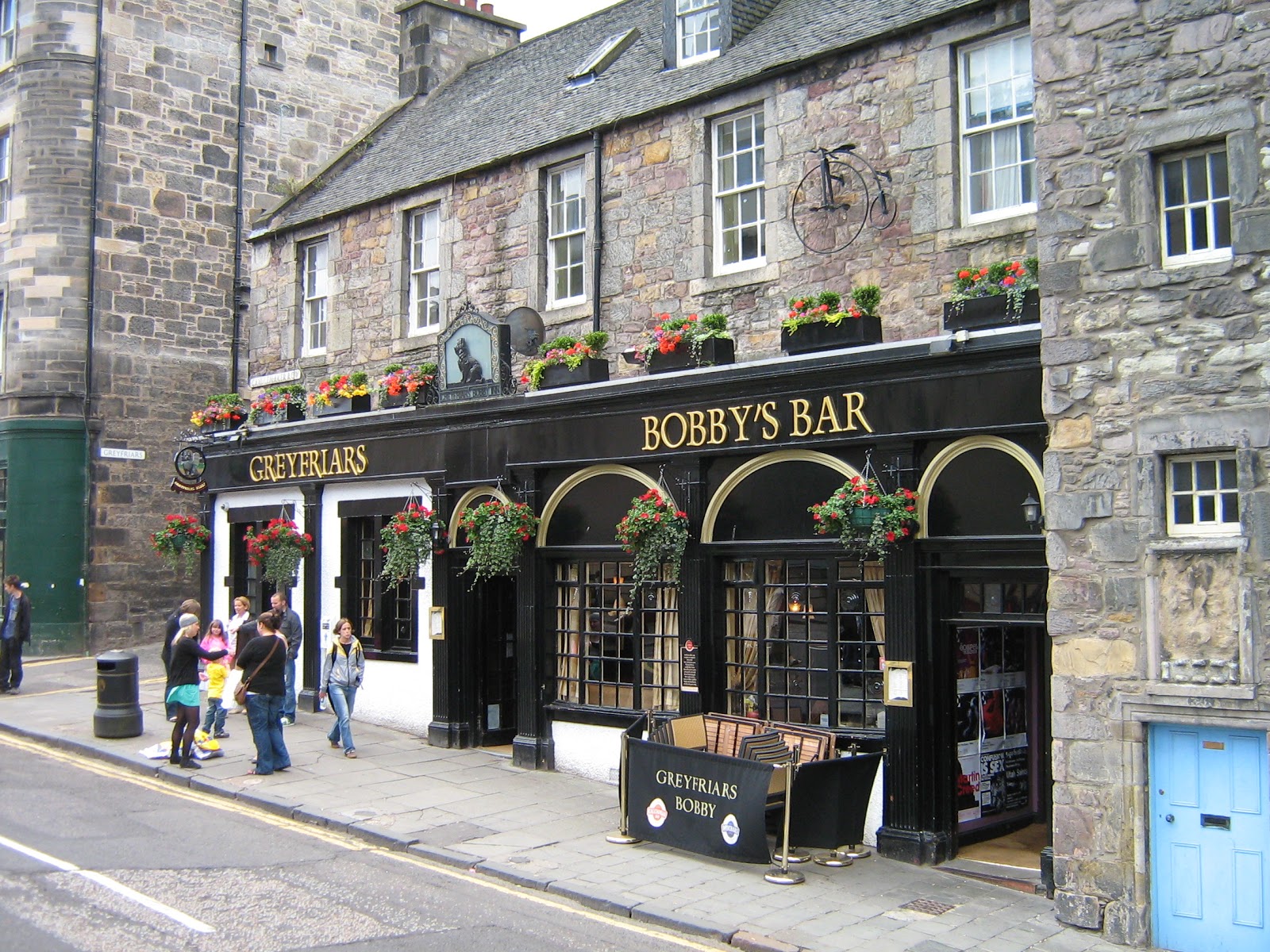
While waiting for retrievals at the National Library in Edinburgh, I scooted outside to practice my photography skills. Note to self: Surely the quantity I take will result in some quality. Two minutes away was one of Edinburgh’s iconic historical sites. The entrance to Greyfriars Church and cemetery is all but unnoticeable except for the landmark pub.


Something about a faithful dog called Bobby rang a faint bell. My ignorance of the history here was excusable, I felt, having no ancestors in the city or surrounding vicinity. Then I learned the full name is Greyfriars Tolbooth and Highland Kirk. That made me feel slightly connected, combined with immense respect for the GREY spelling which I’ve always preferred to GRAY.


Mary Queen of Scots granted the land as a town burial ground in 1562 at a Franciscan monastery, preceding the kirk itself. From 1682 the church building has been through numerous disasters, changes, and restorations. Now I’ve misplaced my brochure of pathways and monuments so I will have to crib a little from the Internet. It was good to see that Greyfriars Kirk today is an active congregation despite tolerating daily measures of gawking tourists. Thanks to http://www.greyfriarskirk.com for the sign.

Bobby? He was the loyal 19th century terrier who mourned his master’s passing by guarding his best friend’s burial site at Greyfriars for fourteen years. No question, Bobby deserves his own monument. The doggy story has some slight variations in the telling, but Bobby was himself interred just inside the gate, not in the kirkyard per se, himself not having the exact proper credentials. Trying to get a decent shot of his modest statue, uncluttered by sightseers and assorted Edinburgh youth, is nigh impossible. Thus I thank Wikipedia for this photograph. 


Many luminaries of Edinburgh and Scottish history lie within the grounds ... individual monuments, family sarcophagi. As in most ancient cemeteries, some have weathered badly, others have been sealed to prevent vandalism. One would need intensive study to know who all these people were, many of whom had their moments of fame. Centuries of interments created layers of remains and raised the original ground level. But still, seventeenth and eighteenth century monuments predominate.


Flodden Wall at the edge of the churchyard is a remnant of the fortified wall built around Edinburgh after the famous battle in 1513. Self: I am so into the 16th century now! Instead of acting as a deterrent against the English, it became a barrier for southern expansion of the city’s Old Town, forcing its tenement buildings to rise to notorious heights (the higher the better for the olfactory factor). Again, I am indebted to Edinburgh's Dark Side (see below) for a quality photo which escaped me.


The National Covenant of Scotland was signed in this church to establish the independence of religious rite. The Covenant was not without trouble and setbacks based on the preferences of ensuing rulers. In 1679 about 1,200 Covenanters were imprisoned near the church in dreadful conditions, Lord Advocate George Mackenzie being their most zealous persecutor. Many died and others were tortured or put to death. Although these family plots became known in popular lore as the prison cells, apparently the original imprisonment location was nearby. Mackenzie himself has an impressive tomb here, spawning scores of poltergeist reports.

The daytime dignity of Greyfriars has a parallel life. Its history of suffering, executions, body snatchers, grave robbers, and vandalism (disrespect for the dead still occurs today) renders it a genuinely spooky place after dark. This odd little "wee" shop at the entrance caters to paranormal interests, especially Mackenzie’s ghost. "Dead of Night" tours are on offer if you’re willing to risk poltergeist phenomena or strangely unaccountable bruises and scratches. Mind you, assorted nighttime ghost tours all over the Old Town are popular and competitive.

Pretty heady stuff for a break before returning to the library. Somehow, turning in to Bobby’s pub instead would have been more fun. Self: Work a little harder at photographic skills.

A couple of places for some good shivers are Edinburgh’s Dark Side and Greyfriars Graveyard.

19 September 2010

McFadyen Part 13: Murder & Circumstantial Evidence

We family historians get quite excited at discovering a black sheep. Why do we react that way?

Well, we know our ancestors weren’t all boring, diligent farmers and blacksmiths and housewives and students and salesmen and clerks and milliners. One might think so from the too-often little we can dig up about them. Someone who disturbed the norm, caused problems, or attracted attention, usually in a negative way, ... in so doing created written and remembered versions of the event(s). It works the other way as well: ancestors who did something admirable, beneficial, or creative also leave their marks.

Our ancestors were human and faulty like us. Finding written sources about bad acts gives us some insight not only into the individual, but perhaps also about the effect on the family and the community. Dealing with an ancestor and event a couple of generations ago, we have distance from the original emotional consequences and pain. The following became of interest because of the name, although there is no family connection.

It’s a matter of record that a man called Neil McFadyen murdered James Kerr in Nova Scotia in 1848. What “record”? I have only two sources relating the story with slightly differing details. The Life and Adventures of Detective Peter Owen Carroll by N. Carroll McIntyre was my first encounter.

This version implies MacFadgen met James Cair right off the boat, so to speak, at Pictou, and took him to his home at Blue Mountain [written in the vernacular, the author uses phonetic surname spellings]. The next day Kerr was murdered for the cash he carried to purchase some land. The body was soon found but not identified until Kerr's father arrived from Scotland to search for his son. Identification was made from some of his clothing but more significantly by a lump on his jawbone from a childhood accident. It was known that McFadyen was the last person to see the victim.

The other version is a narrative of the coroner’s inquest in Nova Scotia Archives & Records Management (NSARM). I have a partial transcription without an archival reference. To me, it appears to be what a newspaper reporter might have published. Here we learn that Neil McFadyen arrived in Cape Breton with his father’s family in 1827 from the Isle of Tiree. He married a McKinnon woman (no first name) in 1830 and moved to “Moose River near the Garden of Eden, a lonely place in the back settlements of Pictou County” where he built a log house. He had “a number of children.” With a minor history of theft incidents, he went to work at a lumber camp in Chaleur Bay, New Brunswick. That’s where he met the unmarried Kerr, whose dream was to buy a farm, and beguiled him with tales of good land back in Pictou. Apparently Kerr’s father was already on this side of the Atlantic, in New Brunswick.

Two months or more elapsed until Kerr’s father and a brother were alarmed enough by the lack of communication to come to Pictou. Identification of the decomposed remains was dependent on clothing details. Then Kerr's vest and other possessions were found in McFadyen’s home, so Neil McFadyen went to trial on circumstantial evidence. He was convicted and hanged on 20 December 1848. My enquiry to municipal authorities revealed the improvised hanging took place on the beach at Pictou where he was buried under the sand with no marker.

Two derivative sources ... telling us something about Kerr and his family but not so much about the perpetrator. A descendant would be looking for potential court records, newspapers, census returns, to try to form a more complete sense of the man. We’d like to think McFadyen’s wife and children eventually overcame this trauma and found some normalcy in their lives. 

12 September 2010

Silent Sundays

BCE Place, Toronto, photograph by BDM.