Pages

26 January 2014

RIIS Ancestors (Estonia) Part Two

Despite the complexities of tracing families before surnames were acquired (generally not until the nineteenth century in the Baltic region), the RIIS surname comes with attached Estonian folklore — folklore that explains why and how an early individual could leave traces of his existence. I am doing my best with the newly found "popular tradition" to decipher the weird syntax and the personal and place names yielded by online translations. I don't think it's time to call in a living, breathing translator for this yet. The lineage has more pressing holes to address before connecting to Tiit Kolgiks (see Part One).

Words and phrasings in quotation marks are from the Estonian folkloric accounts, that is, the translations thereof.

"Tiit Kolgiks" or "Tiit Kolk" (born ca.1650) was the apparent progenitor of the family in Baltic lands. It's said the man was a Swedish knight-soldier; there's mention of the Great Northern War (1700-1721). He came to a place in what is now Estonia, a village called Sandra on the Raudna river, in a large area called Viljandi. Whatever his real name was, the people there called him Tiit Kolgiks. The two countries as we know them, Estonia and Latvia, were long known as Livonia. The Great Northern War (1700-1721) was a power struggle between the Swedish and Russian empires whereby the Swedes lost control of Livonia.
A little early for my purpose but
nevertheless; bennosfiguresforum.com
  
Tiit was legendary for his fine clothing, magnificent boots (always with spurs), and big handsome horses with fancy harness — the man definitely had resources. Tiit built himself a large wooden house with glass windows which had never been seen before; the dwelling was also fortified, including a portcullis gate that was closed at night and raised every morning. If you have never used online translation from a foreign language, I give you a sample:
He made yourself into a wooden house with a spacious and large glass windows to put down, which at the time before the thing was seeing.


Tiit's grand house sounds almost like a manor house itself. Historically, the Vastemöisa estate, one of the oldest in Livonia, was located in the old county of Viljandi (Viljandimaa) and parish of Suure-Jaani; there were twelve manor estates in the parish. Each estate would also have a number of farms.

Additional information becomes more puzzling. Tiit fell one day while working on horseback, "driving a large mallet." The resulting injury to his hip (lameness?) prompted the nickname "Old Kolk." I had a great deal of trouble with that word kolk; no particular language was owning up to it until Wolfram|Alpha said it means hip in Slovenian. Our man was apparently real enough because his birth and death "may still be seen on the grave" ― at least whenever that was written ― but no specific year or age is now known.

That's about the extent of the man's personal information that I can extract from the trees on Geni, supplemented with links to archival and local history websites. All the accounts of Tiit use more or less the same words and phrasing; I can't be certain yet but they seem to derive from an unnamed page related to the URL of the Tartu Observatoorium website.[1]

Based on practices in other countries, his being a soldier and possibly a knight could indicate his Viljandi lands were a reward for military service. In the 1600s the Swedish Empire extended over all of Livonia and further south.

If we accept a mid-seventeenth century birth year for Tiit, and the existence of an adult son in 1690, then Tiit would have been integrated into his chosen surroundings well before the end of that century. I'm thinking from the information so far that the man likely died before the Great Northern War, and possibly before 1690 ― a theory to be explained in due course.

It's worth a digression to mention that the concept of manors, or estates, developed here in the Middle Ages during the Crusades. Christianity only came to the region in the thirteenth century with the Livonian Order of Knights (part of the Teutonic Order). With the influx of robust bishops and knight-led retainers, the first estates were organized ― hence the predominant Germanic influence. Thus the native peasants were managed by loyal "vassals" of the landowners. Over the next few centuries manor estates became an all-enveloping way of life.
Kabala Manor house in Rapla parish, 17th century example; Wikipedia
 
The Livonian War that took place in the middle of the 16th century left local strongholds in ruins, but at the same time, it boosted the development of manors. Side by side with the disappearance of the Order and bishoprics, the former vassals began to play an increasingly important role in the local state arrangement. Nobility associations known as knighthoods performed in Estonia (in the whole of Old Livonia) local government functions up until World War I. The so-called knight manor ... became the main type of manors, the owner of which had a number of status-related rights along with many stately responsibilities. The number of manors had grown to around a thousand by the 18th century.[2]
Needless to say, the Baltic region has always been a site of conquest between warring powers. Despite intermittent bloody battles and changes in overlords, locally managed government generally continued. So the scenario of "knights" arriving periodically to settle and establish farms has historical legs.

This strange tale has developed a life of its own. I shall have to continue into yet another blog post.

[1] The direct URL is http://www.aai.ee/~urmas/aba/abaja1.html (accessed 14 January 2014). But if one goes to the Tartu Observatoorium website (http://www.aai.ee/) it seems impossible to find the page. Töravere Observatory seems to be another name for the institution.
[2] Estonian Manors (http://www.mois.ee/english/history.shtml : accessed 15 January 2014).

© 2014 Brenda Dougall Merriman

20 January 2014

The Book of Me (6)

The Book of Me as Written by You Me has its rewards. Above all it keeps me from noticing how I've lapsed on things genealogical. While I struggle with delayed but more edifying posts, this makes a welcome distraction. It also allows for as much cringing self-exposure (or silliness) as one's nature permits, along with the liberating thought that no-one on the interweeblies is forced to read our exposés.


Special People (Prompt 14). Repeat the suggestions for Prompt 13. Uh oh. More socializing and food. But this time it's for ANCESTORS. So I can't invite a few old boyfriends out of simple curiosity ("and how did your life turn out with that boring bottle-blonde you married on the rebound?").

First off, I do want to say I am grateful to all the ancestors for their contributions to the family gene pool, making the present generations what they are. Speaking for myself, I would have appreciated fewer freckles and a lot more energy chromosomes. But thank you for good bone density, low cholesterol, and a healthy liver.

The invitation they cannot refuse (and by the way, they are not all direct-line people; aren't siblings and collaterals the most willing to spill the family dirt?) ―
* Number one, my Dad so he can tell me about his life before I knew him;
* His irascible grandmother IsabellaCampbell (Gaelic translator required);
* "Uncle" Peter Dougall because he was a beautiful human being;
* My beloved cousin Heather, gone way before her time;
* Grandpa's sister Milda (Freibergs) Lielmanis to untangle her romantic liaisons (more translators);
* Grandma's brother AlexanderIvanovitch Jurikas, the priest cum teacher cum newspaper editor (where are my lost cousins, your Russian descendants?!);
* Ansis Freibergs, maternal great-great grandfather, Free Thinker and donor of the gardening genes;
* Eiwertil Riis my purported 7th-great-grandfather born ca.1670 in Viljandi region, Estonia; he has some 'splaining to do about his legendary father.

Hits a nice balance between my Celtics and my Baltics, don't you think? Eight seems quite enough to keep me occupied, frantically recording their stories in between hugs and tears.

We shall have a picnic, I think. I will order up a perfect day on Lake Superior. Lolling about on chairs and blankets and cushions near a beach, no-one will be able to escape my probing questions now that they see I too am a bona fide grownup. I've always wanted to try making that 7-layer terrine I scrounged from a French magazine about forty years ago: very complicated, layers of chopped chicken, spinach, ham slices, asparagus, boiled egg, paté, une petite tomate ferme, and so on — one brilliant tour de force encompassing the major food groups with massive doses of mayo to hold it all together. Don't look at me like that. Come on, it's not like these guests really have to worry about food poisoning. This could take place around the end of June so the only extras we need are some baguettes and strawberries with lots of whipped cream (dairy = calcium).

Oh, who got me started on the foodie thing. Naff off. Now.
wildtextures.com

Snow (Prompt 15) What a relief. A complete non-sequitur. Easy. Snow is white and cold and I had enough of it growing up in northwestern Ontario and Manitoba to last a lifetime. Now it has followed me the odd winter into the city's geodome. Apart from the fact that most winters are odd these days. Unfortunately summers too can be odd lately.


Look, I'm trying to find something good here to say about snow. It's for young people, isn't it. That's what I've decided. Skating and skiing. Toboggans. Frostbite. Should I even mention ski-doos? Well, I did my share; then I moved on. There's a lot to be said for comforts like fireplaces or heading south whenever possible.


Message in a Bottle (Prompt 16) ... be serious! Write a message that a stranger somewhere in time and space might discover? For sure my bottle would go into Lake Superior in the expectation it would transit through the Great Lakes out the Gulf of St. Lawrence into the Gulf Stream and end up in Murmansk or maybe bobbing along the west coast of Africa; who knows — what with the aforesaid weather doing its own independent and undependable thing.

What could possibly be said to enrich (or baffle) that unknown recipient for an instant? Should it be treated like a teaching moment? No, too much like ubiquitous, annoying tweets. Makes one think along the lines of Chinese fortune cookies or perhaps epitaphs:
‒ No rest for the wicked[1]
‒ Living well is the best revenge[2]
‒ It must have been the effect of a nutmeg tart[3]
‒ Trust in Allah, but tie up your camel[4]
‒ It's over. It's O-O-O-VER![5]

And so forth. I really don't expect the stranger will care one way or another about footnotes. On that note the editorial we are collapsing till next time.

[1] Attributed to The Book of Isaiah in two different chapters.
[2] The irrepressible Dorothy Parker.
[3] Joseph Finsbury (Sir Ralph Richardson) in The Wrong Box, on the cause of death of his brother.
[4] Sumaiya Kazi, 16 Jan 2012 on Google+.
[5] Probably said a trillion times but Roy Orbison sang it like an aaaaangel!

© 2014 Brenda Dougall Merriman

07 January 2014

RIIS Ancestors (Estonia) Part One

Somehow, some time ago, a distant cousin pulled me into the Geni networking website. I cooperated on the initial level, thinking this would give me a leg up on Latvian ancestors that turned into Estonian ancestors because I don't know the languages and can barely navigate Saaga, the excellent Estonia archival site of digitized historical and genealogical records.

For me, the Geni learning curve was rather steep. I didn't find their mechanisms particularly user-friendly. Therefore, much tearing of hair to straighten out the craziness that either I or the cyber gods had manipulated on my fledgling family tree: my ex-husband was shown as my father, my father was my brother, and such-like nonsense. The connection had to be shown because timewise, the Riis family is a very long way from someone with the names Dougall and Merriman. The process was compounded, naturally, by the struggle to communicate with others pursuing the same family.

The newest information on one direct line is pieced together from numerous offerings on the site. I do not know the contributors nor their research habits but few have cited specific sources of information. The exercise is for my own clarity, for what it's worth. Mistakes herein with spelling in noun cases and diacritic marks are solely my melancholy responsibility.

What I knew in advance through reliable research (not mine) in Latvian and Estonian records — population schedules of farms and Lutheran church registers — was that my great-great-grandfather Janis (aka Jaan, Jahn) JURIKAS was baptized 24 June 1793 in Tori parish, now Estonia, son of Jűrri and Ann Jurikas of the Alliko farm.[1] Janis married Liso RIIS about 1813-1814. She was born in 1794 on the Vastemöisa estate in Suure-Jaani, a parish to the east of Tori.[2] "Estates" were also known as manors. They were generally owned by upper-class Baltic Germans, Baltendeutsche, whose families had generations of residency. A parish, so-called, might be a religious or a civil administrative entity.

Janis moved his family from farms on one estate to another over a forty-five year period, traced in six different estate records, also known as "revision lists" because they would be amended from time to time to show migrations and other notations. A little more on that here. It was unusual in the early nineteenth century for a peasant to make such changes unless the next estate was owned by the same landlord (not the case in his journey). The children's baptisms in different places also reflect the family movements. 
mapsof.net
Estonia and northern Latvia as we know them today were, in that time, a province of the Russian empire. There were no geographical or political boundaries as such between them in Janis' day. We can only make guesses at why he kept moving (or was allowed to move). Family lore speaks of his rebellious nature, his small acts of disobedience against the stifling restrictions of peasant life. His later conversion to the Orthodox faith (more in a prior post) supports this portrait.

On Geni, the generations from JURIKAS back to RIIS accelerated into multiple greats. At least seven researchers have input and/or agreed on the lineage (a happenstance that does not make it so!). Herewith, in brief, the bare information from my "Merge Center" on Geni with its linked connections — at face value for now.
3rd great-grandmother:
Liso Riis born 10 February 1794 Vastemöisa estate
4th great-grandfather:
Andres Riis born ca.1754, died 21 November 1843; wife Anno
sources: "according to the Church Book was born c1856"
5th great-grandfather:
Jaan Riis "Terrama" (aka Töramaa) born ca.1725, died 12 January 1800; wife Anno
sources: "popular tradition" – "Both were born Teramane (Abaja) farm"
6th great-grandfather:
Hans Riis born ca.1705 "Riisa, Tori," died 9 March 1785; wife Kai
sources: "popular tradition"
7th great-grandfather:
Evert (Eiwertil) Riisa Riis born ca.1670
sources: unnamed 1690 tax list [household/family composition is unclear]
8th great-grandfather:
"Tiit Kolk" born ca.1650
sources: folklore

The "sources" above are merely my quick summaries from the individual profiles. Online translation programs are a daunting experience, trying to making sense of the resulting gabble! It's clear to me that some types of records revealed the specific dates of death but they aren't mentioned. Approximate years of birth were calculated from a man's age as an adult on an estate or tax list. The timeline back to Hans looks plausible but things get even fuzzier after that. While potential sources for all vital events such as baptisms and burials have perhaps not been uncovered (wouldn't it be gratifying to see some marriages!) religious records are scarce before the mid-eighteenth century.

Preliminary evaluation only shows the obvious holes. My admiration is boundless for those family historians who doggedly overcome the difficulties of tracing people with no surnames in a foreign country, foreign language, in the eighteenth century and earlier.

The folklore about Tiit Kolk and his origins is interesting, to be investigated for another post. There's work to be done on geography and history and records and the language barrier. Eight greats may begin to materialize ghost-like but require much more substance to be real or true.

[1] Pärnu Eliisabeti (Pärnu, Estonia) Lutheran baptisms, 1793; Estonian Archives (EAA) 1279.1.142, p. 258.
[2] Vecsalaca, Latvia, revision list 1834; Latvian State Historical Archives (LSHA) 199.1.399, pp. 189-190.

© 2014 Brenda Dougall Merriman

01 January 2014

Wordless Wednesday (Cemeteries)

Jerusalem cemetery outside the walls on the slope of Mount of Olives; photo BDM November 2011.


                 It's also New Year's Day and Hump Day as well!
Israeli camel

23 December 2013

The Book of Me (5)

Instead of a genealogy problem-solving post, more pressure from the biographical division of blogging. As anyone can see, it's an uphill struggle to stay on top of The Book of Me, but can't let the side down now. The project has a fatal attraction if only because I keep saying to myself who knows "me" better than "me" and let's face it, genealogists have a congenital desire to keep the record straight. We have principles.

The Year I Was Born (Prompt 12) had WAR in it. Like really, what else do we need to know about that? With no personal memory of the year I can attest that the war had an exciting conclusion called V-J Day when all the grownups in summer camp country went nuts, donning outlandish costumes, making a celebratory procession from house to house, trailing fumes of whisky and the occasional soul lost in the dark. Dr Langtry dressed up like Alley Oop (of vintage cartoon fame) and broke his ankle tripping over a chamber pot.

Creator of this series, Julie Goucher, probably suspects some of us are slacking so she makes it more complicated. If I got the message correctly (note to self: go see what other Geneabloggers have done with it). Special/Iconic People (Prompt 13) is about having no more than twelve people to your home for a proper meal. Celebrity people, famous people, living or dead. Fantasizing, shall we say. I am also fantasizing I have a dining room any more. It's not to include any ancestors because Julie is going to throw that at us next up.

Plus, what food would you serve? A tall order, that. If I still lived on the farm I could have a corn roast and that would be that because I have totally forgotten how to cook. Maybe throw in some Octoberfest sausages for the barbecue. No, save that idea for the relatives. I'm breaking into a sweat here, trying to remember all the gourmet meals I used to make from scratch; celebrities deserve a little more fuss, don't you think? Musing along the lines of suckling pig with preserved crabapples and a green veg — how's that asparagus doing in the garden patch. A little Calvados in the dessert soufflé, hmmmm?

It gets tougher. Whom to invite? Thinking we should have dinner music but hey, would kd lang make an appearance? Get Grandma's humungous crocheted tablecloth out of the cupboard. The guest list is hardest of all. First I made a long list. It got out of hand right off the bat, a huge traffic jam in my flailing onward progress. Categories something like the Nobel Prize has would have eased the project. Am I going to choose writers? Politicians? Musicians? Historical greats? Shit disturbers? I'm exhausting myself already, suppressing the thought that the future with Julie promises even more hard work.

Anyhoo, a mix of the quick and the dead: Gertrude Bell ranks right up there with Emma from one of my favourite blogs; Jo Nesbo and Christopher Hitchens are a must; John Cleese and that delicious rake Peter O'Toole at about age 50 (eliminating the need for George Clooney as eye candy); Mary Stuart, Queen of Scots, and Anna Politkovskaya; CC Landon, cherished philosophy professor of my formative years, and Dr. Donald Low would add to the growing ecumenical flavour. How we doing? Eight. We will need translators; do they count? Let's add Alexander the Great and Miriam Toews and Leonard Cohen and Col. Chris Hadfield. 

There. I see I am building a noisy evening of opinionated rascals and ideologues. Let's hope the wine settles them into a mood of respectful rapport. Oh dear, the wine list; the house wine Goats Do Roam seems a bit plebeian. I shall be slumped in a corner making weak efforts at maintaining order. Horrors, for sure I am omitting some really great people I want to meet. Must save the long list for another time.

No principles were sacrificed in the creation of this post.

© 2013 Brenda Dougall Merriman

17 December 2013

Year End Approaching

December had a sneaky way of accelerating while I was on pirate watch along the coast of Yemen and we find yours truly unapologetically unprepared for the festive season. At this rate, The Annual Letter might surface in February.


Besides, it was not the best of years. Sickness and death hovered. Genealogy for a large part was ignored. Nonetheless a few things did get sorted.

  
My Camelogue® was published with ShopMyBook.com and has sold a whopping sixteen copies, pleasing me no end. Wouldn't you know it, updating looks like a future requirement since recently visiting Oman and the UAE. But not too soon in the future. Abu Dhabi and Al Ain are still on my bucket list.


I believe I've satisfactorily demonstrated that the "first house in Toronto" as designated by a local archaeologist was built by George Porter, not John Small.


In April with two of my daughters I had the greatest pleasure in meeting my Latvian cousins. Visiting the farms, churches, cemeteries, and environs of two different families created warm, indelible memories.

Madara, Ieva, Jolanta

Elviss, Zane, Rasma


My brother and I were very happy to see publication of Jacq Cook's The Real Great Escape, in which our father's First World War POW diary is excerpted.


I found a camel in Toronto in 1906. And I found just the right room-mate. Smiley face.
 

Since little other than travel euphoria is percolating in my vacant brain and Christmassy things often end up cranky and disruptive with the dyspeptic feeling of why did I eat all that lovely tempting food (Hello Scrooge), I bring to you some educational historical material to illustrate the dangers of overdoing the festivities. Summarized from the December 2012 ScotlandsPeople Newsletter:

The 16th-century Scottish Kirk reproved the populace for customary Christmas season activities as "popish superstitions." Christmas was to be treated as any other ordinary day; only the Sabbath was to be regarded as holy. Apparently the joyful but denounced festivities included playing cards and gambling, "masked dancing with bells, selling yule loaves, cross-dressing and 'extraordinary drinking.'" In December 1574 fourteen women were reprimanded in the St Nicholas, Aberdeen, kirk session minutes for "plaing, dansink & singing off fylthe karellis on youll day."
fairly inappropriate mediaeval image

Obviously the Kirk faced a losing battle and our activities have not changed a lot although let me know if you've heard a filthy carol lately.

© 2013 Brenda Dougall Merriman

15 November 2013

The Book of Me (4)

The Book of Me Written By Me is more pathetic than ever. The bloom is off the rose. My fault entirely, of course: lack of commitment, a preference to pick and choose, too many eclectic pursuits, creative excuses like I have to clean my kitchen or my hard drive crashed, and so on. 

Maybe I can hustle into combining the missing ...


Diaries and Journals (Prompt 6) are something I gave up on — apart from travel journals and boring attempts to track medical-health issues — because Facebook appeared and it has a lot of leniency for recording the important, exhausting trivia of daily life. My Latvian Grandparents (Prompt 7) have been written into posts on this blog; my Scots-descended Grandparents whom I never knew personally are admittedly a bit neglected. No-one has yet pressed me to hear about Will's gentle decline into depression after his brother got run over by a train, a brother who may or may not have ruined the family business.


A Time Capsule (Prompt 8)is simply not big enough to hold (I should say choose) a few treasures or cryptic artifacts. A memo attached to my will that lists the family heirlooms (few) and personal treasures (many) including provenance for all is quite enough to gobsmack my kids. Halloween (Prompt 9) and sticky little children I avoid at all costs but do pay due respect to All Saints Day and All Souls Day.


Can't recall offhand any Unexplained Memories (Prompt 10) but would this count? An old recurring dream about being shot in the spine has since been replaced by being lost in a huge hotel — make of that what you will, Dr. Freud.  


Good! That moves us right along to Military (Prompt 11). And like many Geneabloggers, I did a post for the eleventh day of the eleventh month. In fact it's sitting right below this one. In my families, there's a certain dearth of eligible ancestors and collaterals in the military category. Why? — there we go, another adjunct idea to mess around with.


In future, applying myself better would be worthy of all those others who are creating such interesting posts.

The Desert Life, June 2013


Now, faithful reader, you will find a hiatus here until the festive season is truly cranked up to Code Green levels. I'm just taking my fest a bit early and away.


© 2013 Brenda Dougall Merriman


07 November 2013

REMEMBRANCE - Holzminden POW Camp

A German, if asked, might know Holzminden as a pretty little town on the Weser River in Lower Saxony. The name might have an entirely different context for an Englishman, an Australian, a Canadian, and others. Today's town seems to function without conscious memory of its own history a "mere" century ago. 
From Neil Hanson's Escape from Germany
Ninety-five years ago my father Lt. Hector Dougall and his colleagues in Holzminden Prisoner of War (POW) Camp received the news of Armistice Day (more on Hector's escapades here). The camp inmates in 1917-1918 were captured Allied officers with some enlisted men as orderlies. In 2013 when we asked a few residents of the town about the old camp buildings and their First World War role, they were bewildered; shared memory seemed barely to encompass the Second World War. The daring (and later celebrated) wartime escape of 1918 in their midst was not on their radar.

The buildings housing the prisoners were constructed as army barracks in 1913 and still exist today, above the town, as part of a German military base. Holzminden was deemed a punishment camp for rebellious prisoners, repetitively described as the "most notorious" of First World War prison camps ― the German Black Hole, as Hanson mentions.[1] Its notoriety was due to the strictest of controls and the reputation of the bullying, brutal, temperamental Kommandant: Hauptmann Karl Niemeyer.
Courtesy of contributor to The Real Great Escape, Michael Melching's website: www.holzminden-camp.com/
The camp conditions may pale in view of later conflicts, but this was probably the last great war of traditional military manners when officers of opposing forces gave due respect to rank.[2] However, Niemeyer flouted the Hague Conventions, treating the men contemptuously as criminals, verbally and physically. Escape attempts were punished with solitary confinement for arbitrary, long periods, disgusting food rations, and denial of medical aid. Real or perceived infractions incurred deprivation and standing for hours in freezing weather. Red Cross parcels and packages from home were pilfered or even withheld. Sometimes Niemeyer ordered the guards to shoot randomly into the prisoners' quarters. The facilities were sorely inadequate for the numbers of incarcerated, so prisoners were usually cold and hungry; by all accounts, there was never enough food and much of what there was, was inedible. In winter, six hundred men shared three stoves for heat.[3]

Judging from their personal diary excerpts, the prisoners for the most part exhibited the plucky, stiff upper lip syndrome and a sense of humour in foul conditions. They mocked and defied Niemeyer whenever possible. Under his very nose the men of Kaserne B dug their incredible escape tunnel. The epic project was well-documented by a participant: the meticulous planning; the inventive details; the coordination; the patience; the courage.[4] Twenty-nine men escaped before the tunnel collapsed, leaving a disappointed waiting lineup and the rest of the camp to face Niemeyer's apoplectic, vindictive anger. Eventually nineteen men were recaptured in a great manhunt effort. They were held in solitary confinement until a court-martial was arranged; fortunately the turning tide of war prevented enforcement of their sentencing.
Wikimedia Commons

Niemeyer has been widely demonized as a dangerous, self-aggrandizing buffoon. His own guards feared and despised him to the extent that some collaborated with the prisoners. When word of the Armistice came, he disappeared; some say he donned a disguise to avoid facing Allied troops. That last month of November into December, the guards also trickled away to be replaced by German soldiers. Both captors and prisoners were ill at ease as political turmoil reigned among the defeated population. Lack of food was an even more serious issue for everyone, including civilians. Time seemed to drag on forever for the weary POWs whose collective expectation of repatriation was dashed several times in the general confusion and logistics failures. It took another month until a train was finally arranged to transfer the men from Holzminden to the Dutch border. As if in a dream come true, hundreds of weakened servicemen were proceeding back to "Blighty." Niemeyer's later whereabouts are unknown: myths arose about "sightings" to feed the fantasies of would-be bounty hunters. 

Holzminden today, courtesy Michael Melching: www.holzminden-camp.com/
 Maybe we are all guilty of collective memory deficit. As the twentieth century rolled on, the evolution of broadcast media and film created modern, indelible wartime images in the public eye. The Second World War and further conflicts became more immediate and visual. Most of us remember Steve McQueen in the movie "The Great Escape," right? And so the original Great Escape was eclipsed.

But now the exciting, gratifying news. The lengthy project called Faces of Holzminden has identified over 500 Allied war prisoners who were "guests" in that camp. This month it gave birth to the Random House (Australia) publication The Real Great Escape (see also the dedicated Facebook page).[4] I rather regret the new title ― it lacks the emotional pull for those of us descendants heavily involved with author Jacqueline Cook ― but marketing wisdom prevailed. Publication coincides with world-wide First World War commemorations.

The tunnel story has been told before. Half the book dwells on it while the rest pays attention to the flesh-and-blood men. To my mind, what distinguishes The Real Great Escape is the generous usage of many prisoners' personal wartime diaries, most of them shared for the first time in public. Daily life in the camp becomes real through their comments, reactions, and struggles. Thanks to the warmly extended interest of Cook and her colleagues, we descendants became a cohesive resource group. It was especially rewarding to make contact with grandchildren of the man whose life Hector once saved.

Hector was not involved in the tunnel operation; due to previous escape attempts he was originally assigned to long weeks of solitary confinement in the wretched basement cells of Kaserne A. He came home to Canada in 1919 clutching the enormous flag he had jubilantly "liberated" after a crazy climb up the camp flagpole. Some of his diary thoughts appear in The Real Great Escape.

Like all the soldiers, sailors, and airmen who preceded and followed them, these were once lively young men whose war experience would remain with them and affect them to different degrees throughout their futures. We lost a great many of them.

There are many stories about the Great War. Lest we forget.

[1] Neil Hanson, Escape from Germany (London: Doubleday, 2011), 32.
[2] Jacqueline, Cook, The Real Great Escape (Australia: Random House, 2013), 28.
[2] Ryan Lenegan, “The Great Escape,” Merredin-Wheatbelt Mercury, 18 April 2007
(http://www.merredinmercury.com.au/news/local/news/general/the-great-escape/283988.aspx?storypage=2 : accessed 16 August 2013).
[3] Hugh Durnford, The Tunnellers of Holzminden (UK: Cambridge University Press, 1920).
[4] Jacqueline Cook, The Real Great Escape (North Sydney: Random House Australia, 2013).

© 2013 Brenda Dougall Merriman

03 November 2013

"Thick Like Rain"

One of those chance things you come upon that distract you far away in time and place.


A meteor storm was seen by two awestruck young children of Adam Spencer UE, on the Niagara Peninsula in 1799:
"The shower of stars that was visible in North and South America November 13, 1799 was witnessed by them. Their fire, which at that time was always kept alive in the fireplace of the homes, by banking up at night, had gone out, and two of the children were sent in the early morning hours to a neighbour for coals. This was not an uncommon occurrence in those days as there were no matches, fire could only be obtained by flint. My grandmother then a very little girl and an older brother, together witnessed the beautiful sight. She said the stars fell thick like rain until a few feet from the ground and then disappeared. The beauty of it was beyond description, though awe inspiring the children were not afraid, but many of the people in the neighbourhood were panic stricken, thinking that the end of the world had come, or was near."(1)

The spectacular sight the night before was apparently the first record of a meteor shower, probably because astronomer Andrew E. Douglass reported the same event from a ship near the Florida Keys:
"the whole heaven appeared as if illuminated with sky rockets, flying in an infinity of directions, and I was in constant expectation of some of them falling on the vessel. They continued until put out by the light of the sun after day break."(2)
 Also according to This Day in History:
The Leonids meteor shower is an annual event that is greatly enhanced every 33 years or so by the appearance of the comet Tempel-Tuttle. When the comet returns, the Leonids can produce rates of up to several thousand meteors per hour that can light up the sky on a clear night. Douglass witnessed one such manifestation of the Leonids shower, and the subsequent return of the comet Tempel-Tuttle in 1833 is credited as inspiring the first organized study of meteor astronomy.

Meteorologist Joe Rao says:
"Other accounts were brought to light of a shower of thousands of bright meteors on November 12, 1799, described by the Prussian scientist and explorer Alexander von Humboldt from his camp in Cumanã, Venezuela. In his words, there was 'no part of the sky so large as twice the Moon's diameter not filled each instant by meteors.' An observer in Florida that same night noted that the meteors were 'at any one instant as numerous as the stars,' while at Iserstadt, Germany, 'bright streaks and flashes' were seen even though day had already broken."(3)

As we know, spectacular meteor showers are not everyday happenings. The largest ones can more or less be predicted and measured every thirty-odd years, thus the flurry of popular interest when celestials align. November is usually the time of year for watching.

We are so sophisticated now we do not fear that the sky is falling. We can share the Spencers' childish rapture at nature's dazzling cosmic display. You can bet they remembered it all their days and obviously passed the story on.

 (1) Eugene O'Leary, "Notes on the Spencer Family," 15 May 1914; Toronto Branch, United Empire Loyalists' Association of Canada (UELAC), Accession Box 994.005.1, File 16, Correspondence January-June 1914.
(2) "First Meteor Shower on Record," This Day in History (http://www.history.com/this-day-in-history/first-meteor-shower-on-record : accessed 20 March 2013).
(3) Joe Rao, "The Night the Stars Fell," Illinois Genealogy Trails History Group (http://genealogytrails.com/ill/stars.htm : accessed 20 March 2013); originally from Sky and Telescope Magazine, 1998.

© 2013 Brenda Dougall Merriman


29 October 2013

Dia de los Muertos


Do you know where your ancestors are? 
Are you ready for All Saints' Day and All Souls' Day?

27 October 2013

Silent Sundays

Pioneer Memorial on local pink marble, River Denys, Nova Scotia; photo BDM July 2006 

10 October 2013

The Book of Me (3)

More catchup. Really, I am taking this seriously. Hats off to those who are diligently keeping up! Julie's prompts are making me realize where photographs of yore are regrettably missing.

Prompt Four: Seasons. 
SUMMER. No contest. No ambivalence, no waffling, hands down the winner.  
If you lived in Thunder Bay at the head of Lake Superior, you annually waited ten months for the magic of summertime (about six weeks long, although some like to say it lasts only two). People decamp from the city for their summer camps, meaning "cottages" or "cabins" in other cultures. Liberation! Kids go wild, barefoot, sunburnt (olden days, obviously), blissfully running their own agendas. There's just the lake, our boats, our bikes, the baseball teams, and sleeping in tents if we feel like it. Parents are also chilling out with few responsibilities other than hauling their refrigeration needs from the ice house at the tiny nearby store and ensuring the honeyman comes by the outhouse regularly.


Then you move to a new camp that has indoor plumbing! You get to be a teenager, play spin-the-bottle at wiener roasts, have romances with young pups who are learning to drive cars, what more could anyone possibly want. Then you get your own kids and one hundred years of tradition at Amethyst Harbour go on ...

SUMMER also included, from time to time, Banff, Alberta. The Banff School of Fine Arts, as it was known then, was a vibrant summer community of young musicians, singers, dancers, actors, and theatre students. Lots of socializing, despite curfews; introduction to the pastry called butterhorn, riding the Hoodoo Trail, sunrise on a mountain (was it Sulfur Mountain?). But we worked our butts off: in a six week period, each part of the program mounted a full production.

On to Prompt Five, Your Childhood Home.
My first home was at the top of a hill on North Court Street in Port Arthur, an awesome hill for the winter toboggan. Mysterious photo from unknown source. It's exactly the shape and design of our house which was red brick; possibly the house next door? My Dad built a playhouse in the backyard and my Mom painted murals on it. Sadly, no picture of my house itself. Some time later the homes along the ridge were torn down to allow an extension of River Street and the building of a medical clinic. 

An old family photo of my best buddy and little brother proves the red brick. Did someone add siding after we left?

My second home was our farm on Oliver Road, a one-plus year sojourn while our new city house was being built. Again, no photo! Whatever happened to the one of me on Mickey the pony ... I recall he was faintly terrifying. A Yorkshireman called Arthur was the livestock handler (mainly egg-laying hens and some dimly recollected horses and pigs). Horrendous amounts of snow in winter. Commuting by car five miles to Pine Street School in town. Mom hitting a moose in her Chev and for months thereafter driving white-knuckled after dark like five miles an hour, an impatient procession of cars behind us.

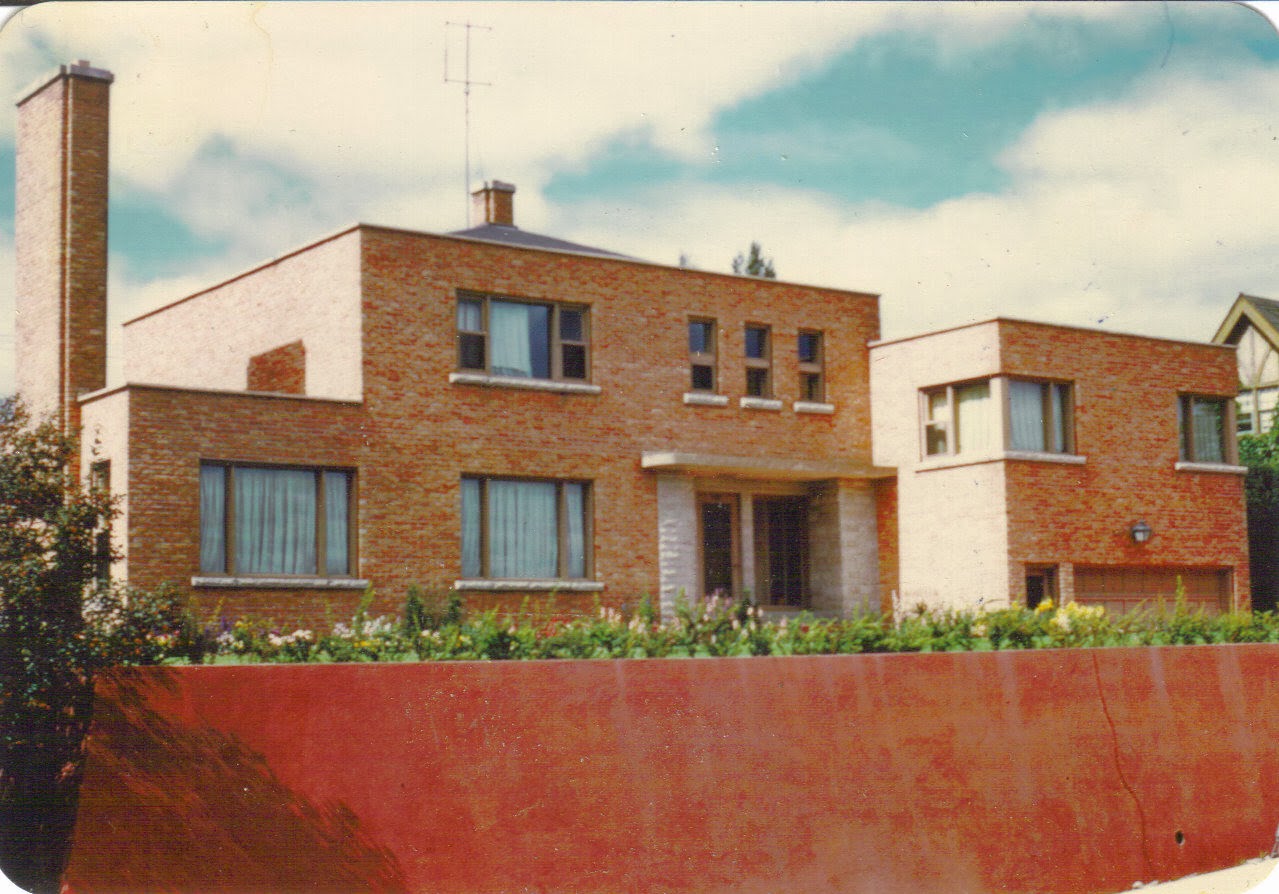
Third home on High Street, Port Arthur, was sort of po-mo and very roomy but had a few inexplicable things. The pink retaining wall clashed with the brick colour. The always-frigid upstairs bathroom. The unfinished bomb shelter in the basement (hey, this was the Cold War 50s). My Dad built the entire basement "rec room" basement area himself. 

Fourth home (when does childhood end ... ?) was Balmoral Hall, my home away from home, secondary education years. In effect, the school then partly functioned as a residence for Royal Winnipeg Ballet students. I loved my time there, but after four years I was ready to move on.

The "homes" all pale in comparison with SUMMER on the greatest lake in the world and the greatest place to be on that lake.

© 2013 Brenda Dougall Merriman