Pages

12 February 2008

Who's For Dinner?

A number of genealogy bloggers are egging each other on with creative ideas. “Carnival of Genealogy” is like that, at http://creativegene.blogspot.com. One edition I enjoyed was: which four ancestors would you like to have dinner with and why? (4 February 2008) Naturally, my ideas began to perk ... along with a dinner menu, which I used to enjoy planning before I had a 24/7 career in genealogy. Never mind four ancestors, two of my choices would be ggg-grandfather Donald McFadyen the pensioned soldier, and great-uncle Alexander Jurikas the Orthodox priest. They will be appearing here later.

Not to invite under any circumstances is great-grandmother Isabella Campbell McFadyen (1845-1924). By all accounts she was an impossible visitor in her later life, descending on adult children without notice, making demands that exceeded all bounds of civilized hospitality, having the rude manners of an untutored dictator, and throwing each household into mass disarray. Bella would stay for months at a time. I was told her fractured English was usually indecipherable, and she increased her decibel level in direct proportion to the dumbfounded looks on nearby faces. Someone chose an ambiguous epitaph for her: She Hath Done What She Could.


If I really try to put myself in her shoes, as good genealogists attempt to do, it’s not easy. We have to think multicultural shock here. Bella grew up in a Gaelic-speaking household. I’ve read numerous books about the transplanted highlanders in Cape Breton, even some written in the vernacular. Growing up in a crowded household where a pack of kids had to work all the time at domestic responsibilities, heavy farming requirements, or often working at out-sourced jobs for extra family income, when schooling was minimal and English was rarely required ... is a big stretch.

Nevertheless, I understand they managed to have excellent parties, ceilidhs, with great music to offset their otherwise sober lives. No problem relating to that, a tradition that survives exceedingly well in Cape Breton. Having ancestor Bella to dinner would be a trainwreck, balancing the agonizing communication difficulties with potential rewards on the hope that she knew anything of her ancestors. My 21st century is battling with the 19th.

Now take my late Aunty B (1906-1979). Not really take her, she’s not for giving away! There’s a woman to have dinner with. As a house guest, she would never bemoan or turn up her nose at a plate of pad thai and schezuan cucumbers. Unlike Bella, Aunty B was totally familiar with knife and fork usage at the dinner table and was in all ways cool. She didn’t even have to say it: she’d been there, done that, probably hid the T-shirt in her underwear drawer, and wasn’t going to tell a soul about it. Aunty B knew plenty of family gossip I’d like to cross-examine her on now. No-one remembers now why she got called Aunty B. Her official name was Isabelle (family habits die hard) but that’s the only similarity to Bella.

That’s for you, Heather.

21 January 2008

Peace (2008?)

Apart from classical music immersion in the dance world, one of my earliest musical exposures to popular music (with due respect to Elvis) was the Kingston Trio. I hear myself and friends happily and beerily bellowing the MTA song ... apologies to the original lyricist: “Did he ever return? NO he never returned, he was lost forever ’neath the streets of Boston, the man who never returned ... .” And et cetera. Some of us probably had not even seen a subway system yet.

But what really sticks in my mind all these years is their Merry Minuet. It was composed in the 1950s when the Cold War was alive and well. What strikes me is that even in those days, when television was an infant--before satellite communications, the Internet, talking heads, and amateur on-the-spot filmographers brought global war into our living rooms--some “ordinary” people were aware of the sad and longstanding divisive elements among the world’s peoples.

You really have to remember the tune to get the intended effect:
They’re rioting in Africa.
They’re starving in Spain.
There’s hurricanes in Florida,
And Texas needs rain.
The whole world is festering
With unhappy souls.
The French hate the Germans.
The Germans hate the Poles.
Italians hate Yugoslavs.
South Africans hate the Dutch.
... And I don't like anybody very much!
But we can be tranquil and thankful and proud
For man’s been endowed with a mushroom shaped cloud.
And we know for certain that some lovely day
Someone will set the spark off and we will all be blown away.
They’re rioting in Africa.
There’s strife in Iran.
What nature doesn’t do to us
Will be done by our fellow man.
[compliments of MusicSongLyrics.com; Kingston Trio lyrics provided for educational purposes.]

Goes to show. None of the news we hear today is very new. Even in the 1950s it wasn't new. The players may change, or they ascend or descend in global awareness, but what happened to the lessons of history and human tolerance for different from me?

24 December 2007

Jurikas Part 2

Introducing Marija Jurikas (26 November 2007) means .. yes .. I have a totally different Latvian family line. Some tales have appeared here about the Lutheran Freibergs. It’s hard for me to grasp the multiple historical influences on this small country. Through invasion and war over centuries, the Germans and the Russians deeply affected the indigenous population. Force and fear were routinely employed by both at times. Ultimately, and this is purely my own interpretation, German culture and values were more attractive than Russian. Germany of course was a wellspring of religious Protestantism. Latvia became predominantly Lutheran. Germanic people became the elite class of merchants and governing officials, even if it made for uneasy relationships, sharing limited power under Russian rule. They and their descendants were the main owners of large landed estates, or manors. Their descendants consider themselves wholly Latvian. But the status in the old days was clear: Latvian peasants were kept in the underclass. And yet, there were always those who resisted the strictures that kept them in place.


The Jurikas family also butted up against the authorities, but earlier than Otto Freibergs of the 1905 revolution. Families would apparently do what they could for survival and self-respect. Back in about the 1830s, Juris (George in English) Jurikas was said to be of Estonian origin, living in Latvia as a tenant farmer. It’s unclear where this estate he worked on was located, but presumably within some kind of reasonable distance from Estonia. The estate owner ordered the men of his village to build a Lutheran church. Juris refused to work for no pay and encouraged his neighbours to object. For this offence he was sentenced to a public whipping (a commonly favoured punishment for ‘misdemeanours’) but managed to evade the sentence by slipping away to Riga. He joined the Russian Orthodox church, perhaps out of defiance, which gave him some kind of sanction. It is said his original punishment was revoked but instead he was evicted from the property he farmed.

The Russian Orthodox Cathedral in Riga (photo) was not built until the 1870s so was not the exact church where Juris converted.

With some savings, Juris was able to secure a farm near Limbazi in the Livonia, or Vidzeme, region. We don’t know if his second farm was in the same general region as the first. Certainly it would not have been on the same landlord’s estate! The story is that only some rough, uncultivated countryside was available to him. He named his farm Krumini, meaning “bushes,” alluding wryly to the dismal condition of the land. All of the above is family hearsay, as yet. It’s likely that more years of hard work were necessary to clear the land and establish some family comfort. We do know that the land was part of the Ladenhof estate. The Germanic name Ladenhof is translated as Lade in Latvian.

This imperfect photo, taken from the bus window as we sped north along the Baltic coast, shows a typical countryside izba, much like that of the Jurikas home. I was able to snap it near the crossroad leading to Limbazi.

The name of Juris’ wife is not known. He may have married before he appeared in Lade parish, as the name Jurikas does not seem to appear in the registers of the Limbazi-Lemsal Alexander Nevsky Orthodox church before 1856. His wife was said to possess healing powers for sick animals and was called upon to help neighbours in this way. It is unknown when Juris died, although it is said he lived to a fine old age assisted by a daily quart of whiskey. I have a report of a marriage at the Limbazi-Lemsal church for Ivan Juriyev (John, son of George) Jurikas of the Schloss Lemsal estate, a widower aged 67, on 4 November 1856 to widow Maria Jacobova Kruklin. The translation from Russian is still in question. Since this man was born about 1789, his father Juris/George is clearly not the man under discussion. It would make sense if the bridegroom’s name was Juris or Georgiy, making this a second marriage for the aging Juris. But “Ivan” is quite evident on the record. Still, clergymen have been known to make errors!

The family ties with the Russian Orthodox church were to serve them well in succeeding generations. To be continued.

30 November 2007

161 Meme (What Is It?)


I’ve been tagged? By the “161 meme” book doojiggy. My colleague Steve (www.stephendanko.com) did it. The idea is to get friends and colleagues to respond with the 6th sentence on page 161 of the current book they are reading. A little explanation usually helps! By the time I caught up to Steve’s message, it fit nicely with my toying around for a blog article on the kinds of non-trade literature genealogists like to read, especially novels. While I also have two or three books on the go at once, I chose A Russian Diary by Anna Politkovskaya.

Page 161, sentence 6: “They say it is a small victory for us.” This is a quote from government apologist Ella Pamfilova in September 2004, Chairperson of Putin’s (then) newly created Presidential Commission on Human Rights. Ella sees it as a another victory for “the benign nature and democratic credentials” of Vladimir Putin. She reports support from all regions for this move. Cynical journalist Anna sees the commission as an action to control the human rights movement in Russia, which Putin considers his real opposition. Putin had already marginalized political opposition in elections by restricting the registration of other parties and removing the people’s right to vote for individual candidates. An outspoken advocate for democracy and human rights, Anna was murdered in the stairwell of her Moscow apartment building in 2006. Her friend Alexander Litvinenko, a former FSB agent in exile in London who had urged her to flee death threats in Russia, accused the FSB of assassination. Anna was one of several free-speaking Russian journalists who have been mysteriously killed. Not long after, Litvinenko himself died from radiation poisoning placed in his teacup.

Now I wonder what these people are reading: AWCH, CDM, John Reid, Mary Anne, and Elayne. You know who you are. Just send your comment here.

26 November 2007

Marija


St. Petersburg before the turn of the twentieth century was one of the greatest cities (THE greatest in some opinions) of Europe. It was a magnet for European intellectuals and artists and bons vivants. That’s where grandma Marija Jurikas headed to find gainful employment and perhaps adventure. She might demur if I described her as a small, stubborn woman. But when middle class women were supposed to stay at home, marry well, and demonstrate domestic virtues, Marija left the family home in rural Latvia with her skills and a longing to see and be part of something new.

In 2006 I saw where Marija lived in St. Petersburg. She was employed by Baron Kusov as the family seamstress and dressmaker.A 1910 city directory described Vladimir Alexeyevich Kusov as a state councillor, a technical director of the Mariinsky Theatre, treasurer of the Emperor’s Russian theatre society, and a sponsor of St. Alexander Nevsky church. His mansion is on the boulevard embankment of the Neva River on Vasilievsky Island. Marija designed and made the fashionable dresses for Kusov’s wife and daughters. With a seat at the head butler’s table for meals, she had high ranking in the domestic pecking order.


A short carriage ride would take Marija to the Mariinsky for some of the continent’s most exciting operas and ballets. All of Kusov’s household were able to take advantage of regular seating in the famed, fairytale theatre because of his position there. The Mariinsky was built in 1860 and became Russia’s premier showcase for music and performance. During Soviet times it was known as the Kirov Theatre.


Marija was born in 1872 in Lade parish near the town of Limbazi. Limbazi is just east of Latvia’s northern Gulf of Riga coast. We don’t know how or where she was trained, but her workmanship was exquisite. It included not only dressmaking and designing, but related details like embroidery, smocking, crochet, tatting, knitting, and other hand crafts. She was probably in Petersburg in the 1890s and early 1900s. However, she migrated to Switzerland at some point, before embarking to visit her brothers in Canada in 1908, at the age of 36. The ship’s manifest said she was 32. It’s a bit of a mystery why she hadn’t married by that time, but brothers Janis and Paul remedied that. They knew a handsome young Latvian man in Port Arthur, Ontario, an excellent candidate. They decided to marry in 1912. Now I know why my mother was an only child. Even though Marija’s age kept slipping downwards in various documents, typically for a woman of her time, she was 41 when she gave birth.


Marija’s handiwork and sense of fashion never ended, even in a Canadian “outpost.” She always wore the garnet earrings which were a gift from the Kusov family. Oh how I longed for the European sophistication of pierced ears, as a child! To her daughter’s dismay, she crafted her clothing by the latest Parisian styles, to the general ridicule of her conventional small-town classmates. Exquisite details were worked into the tiny dresses for grandchildren. Many of them survive, including a christening gown. She made me several dolls, the like of which I’ve never seen since. You turned the beautifully dressed doll upside down and a second doll appeared in a completely different outfit. The voluminous skirts hid the surprise.


Surely the next time I'm in St. Petersburg the ballet season will be on. White Nights!

07 November 2007

All Hallows' Evening

Dia de los Muertos came and went without much ado in this corner of downtown Toronto. Little Halloween ghosties demanding trick or treat are scarce in urban high rise buildings. Is this the best we can do to remember an ancient holiday (holy day)?


In Mexico, the first two days of November (a.k.a. All Saints Day and All Souls Day in similar religious calendars) are marked with many traditions to honour the deceased. Foremost among them is the customary trek to the local cemetery to tend family monuments which may need weeding and paint and colourful paper decorations, but especially new flowers be they fresh or artificial. The exercise is in the nature of a family (and community) picnic. Depending on the locale, celebratory masses are not unusual. Nor are candlelight vigils, processions, a love for song, and perhaps fireworks displays.


How slightly dull and ancestrally-disinterested we North Americans seem in comparison.

29 October 2007

Cemeteries Part 5


Couldn’t resist. From the lowly to the elite. A typical roadside cemetery where you can hardly tell the markers from the natural rocks and stones ... and the so-called Royal Tombs at the ancient carved city of Petra in the Hashemite Kingdom of Jordan. The nomadic Bedouins seem to be a lower class because they resist royal offers of housing and education? Because they continue to live and dress and tend their animals as they did 2,000 years ago?

Genealogy is normally not far from my mind, but parts of this blog will still feature bits of Brenda’s inexplicable love for eastern and southern Mediterranean locations (and camels). Jordan in 2007 was a revelation in archaeology, biblical sites, Middle East history, and especially Arab culture.

26 October 2007

Cemeteries Part 4

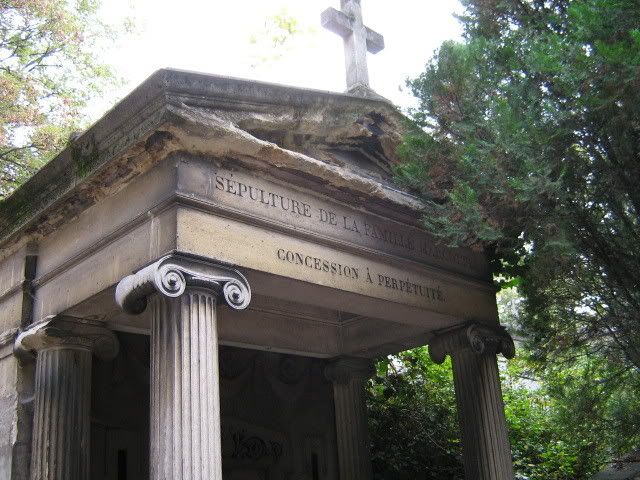
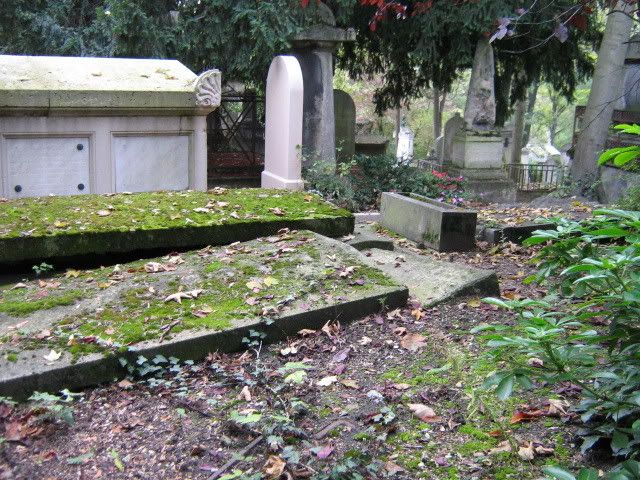
The genealogically-related pursuit of interesting or offbeat cemeteries is relentless and demanding but someone has to do it. Recently I found myself in Paris to do just that—enjoy a site I’d regretfully missed on a number of previous visits. Père Lachaise cemetery is not on everyone’s top ten Parisian landmarks. But it does hold hallowed ground (pun intended) among cemetery connaisseurs.

The old monuments are family dedicated forever. Note the concession à perpétuité. Navigating over 100 acres of hilly territory amidst small gaggles of gaping tourists and the occasional funeral procession or maintenance vehicle was a challenge. Isadora Duncan eluded me, even with my selection of drooping site maps (uh oh, I’m looking like a tourist myself). Maybe she is just there by the crematorium building which was blocked off for restoration.


And where oh where did Jane Avril go? Back and forth, up and down, weaving criss-cross between the markers on that particularly difficult hillside, I couldn’t find her. While Toulouse-Lautrec is not there, his friend Jane is, without visible epitaph.


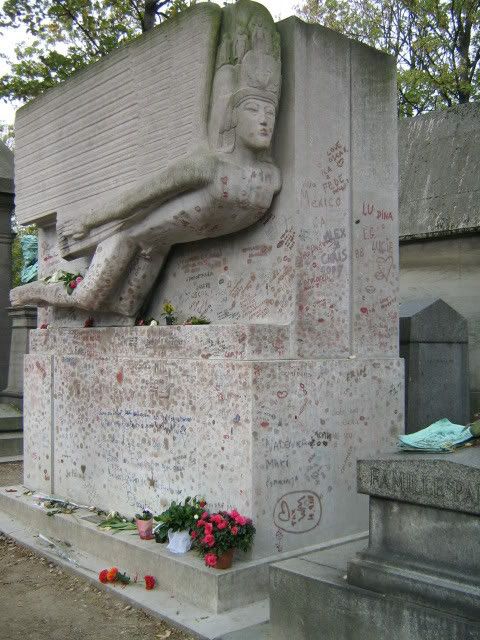
We all know Jim Morrison has his fans, but Oscar Wilde was a clear favourite. Admonitions to respect the dignity of the deceased had no effect on this lipstick-smeared, rather ugly memorial. Victor Hugo and Chopin were accorded more appropriate homage with many flowers. Simone Signoret and Yves Montand. Modigliani, Proust, Balzac, Rothschilds. Pause for Molière, remembering Le Misanthrope in French 401!


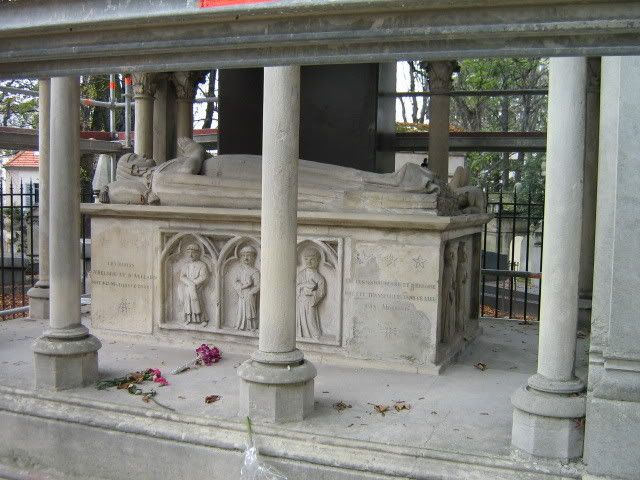
Héloise lies beside her Abélard for eternity now, their mediaeval remains having been reinterred here. With all the activity going on within and without the gates, I feel that concession à perpétuité is assured.


My techie CDM says click on the photos to enlarge them. You probably already knew that. Magic.

24 September 2007

Ryan


One year ago today my friend Ryan Taylor took a bus from Toronto to Niagara Falls and ended his life. His body was not identified for several days, on the New York side of the river. Missing person reports caused intense distress and confusion. Ryan would never have intended to add such extra anguish to family and friends. In solitary preparation, he had tied up a number of professional loose ends. He had completed and returned the updates for his courses at the National Institute for Genealogical Studies. He spent time to sort his papers for sending to an local archive. He timed his leave when the first television season of Ancestors in the Attic was wrapped. For all I know, he may have done the same tidying up in his job as a librarian. Ryan liked things tidy.

Suspicions of alternate scenarios die hard when people are shocked. Those are the people who knew him as the bigger than life, commanding but charming presence ... the speaker who could captivate an audience, patiently explain family history to a library patron, share tea and cake or cocktails and appetizers with friends of all ages. So many friends. So much talent. He never failed to amuse with his encyclopaedic knowledge and humour. Then it was easy to induce and share his irresistible laughter. Those were the good times. He needed and loved them. In lonely times, which he couldn’t share, he was diminished and finally defeated.

Endogenous depression is very, very difficult for the afflicted person to admit, express, describe or share ... close to impossible. This is not the same as exogenous depression which results from a drastic “life event,” usually a one-time happening. Endogenous means recurring or chronic bouts of debilitating mental suffering that has physical as well as mental effects. 


Chronic depressives are almost helpless to fight the unpredictable biochemical change that plunges them into a bottomless black pool of deep anxiety, self-recrimination, self-loathing, panic attacks, agoraphobia and/or suicidal thoughts, not to mention shame at their inability to control it. Medication works for the fortunate few. Medication often means years of monitored experimentation to find something that works. And often a hard, discouraging journey in itself.

My dear friend. How we wish we could have eliminated your pain. You would have loved the last joke we never got to share. Your everlovin’ buddy, Brenda Harriman.

19 September 2007

Plus ca change ...

As the plodder moves on through book revision, finishing one chapter at a time, it is this writer's fate to learn that some source or reference has changed, something new has been added, something old was replaced. A non-fiction 'textbook' must be as up-to-date as possible. Imagine that, when the world of genealogy has embraced the Internet with mucho gusto. The seductive, sly and slightly neurotic Internet.

Keeping track of URLs is bad enough. But whoa, it's back
yet again to rewrite even less happy news. The Archives of Ontario has stopped its photocopying service in the Reading Room, replacing it with order forms for service and longer waits. Even more serious, Library and Archives Canada has made drastic reductions in its open hours and service ... after their publicly announced commitment earlier this year to the ideals of family history. Quite the catch-22. By channelling their efforts into more electronic resources, LAC shortchanges all the researchers who need their on-site material.

And my carefully revised section on adoption may be defenestrated. Ontario's long-planned new legislation to open formerly sealed records was finally implemented this month. Just days later a Superior Court judge struck it down as unconstitutional.

I'm at the mercy of these people, whoever they are. And sadder for it.

26 August 2007

Plodding and Slogging

Plod and slog does not refer to my blog. Am plodding on a revision to my Genealogy in Ontario: Searching the Records. And what a job. The last really effective revision was in 1996 and the world of genealogy has changed incredibly since then.


Equally incredible to me, by the time the 2008 edition appears, it will be almost 25 years since the first slim version was published in 1984. Originally, writing it for the Ontario Genealogical Society was a trade-off for me. I was able to weasel out of organizing their first Church Registers Project and write something for them of which I knew better.

With revisions or new editions in 1988, 1996 and 2002, I lost track (probably OGS has too) of how many copies have been sold, but it must approach 10,000 by now. I’m told that is beyond what is considered a “bestseller” in Canadian publishing terms, but what do we amateurs know. Amazing to some, but not to me, how many North Americans have Ontario roots or branches. The first two editions bore a cover designed at my vague direction by one of my artistic children, another satisfaction.

The fourth edition has the advantage of a unique friendship to steer me among the reefs and keep the jib trimmed. At last, I am learning about writing and editing. Meanwhile, the blog suffers from inattention.

04 August 2007

I Was Adopted

If ever a picture was worth a thousand words, this is it, for me (unhappily, the "original" does not reproduce well). Who do you think this gorgeous creature is? What time period? How old do you think she is? I’ll tell you something about her but I want to see if anyone guesses her age in this photograph. Since this blog is dedicated to family history interests, I have to say she belongs in a unique way.


The striking beauty evoked gypsy or exotic Mediterranean comparisons, but she was born in Winnipeg to a working mother who struggled to make ends meet. As Yvonne Mason Reynolds, she was a child entertainer on prairie and western vaudeville circuits when “acts” would travel from one theatre to another with a manager—in her case, with her mother as chaperone. Vonne was eventually paired with sister Adele, but Vonne was rapidly growing, looking older than her years, while Adele was tiny and blonde. They sang, danced, did comedy routines on their physical differences, and were a great hit. Once—Winnipeg was on a prairie circuit for imported acts—her mother managed to persuade Bill (Bojangles) Robinson to give her tap dance lessons.

Theatre life was tough, along with life in general, and sometimes she wanted to give up. She knew her unacknowledged father was a scion of an old prairie family, and she only met him when he was on his deathbed. As vaudeville waned, she became a fashion model: a natural, with her perfect figure and over six-foot height. Early experience taught her to develop a shielding persona in her adult life of elegant appearance and wisecracking humour.

Some time after marriage to Ken Sherman, they moved to Thunder Bay where they bought a local photography studio. Vonne learned and managed every aspect of the photography business; her own glamour was no small point in selling customers on having their portraits captured, and she brought out the best in them with her fussing and uninhibited remarks. Her former stage career gave her the knack for posing her subjects, perfecting the lighting, and using imaginative props. In an era before colour film, Vonne’s artistic talents were instigated by colourizing of black and white portraits. Before long she also became a devoted member of the artistic community. She befriended Norval Morrisseau during one of his detox hospitalizations in the 1950s, bringing him art supplies, and treasured the paintings he gave her.

This is when I met her as a family friend; we shared a certain love of the footlight experience. And shared a cross-country trip to the Banff School of Fine Arts, me with two chaperoning mothers. Vonne’s public persona was a magnet for men and women alike. Dinner parties at the Shermans’ always involved exquisite meals with ingredients uncommon to most Thunder Bay tables. She never had children, but became a surrogate mother to a couple of “chosen” daughters, delighting to repeat in her smoky drawl that she never had to spread her legs to get them.

Vonne never lost her enthusiasm for the stage and returned to it later in life. She and Ken retired to Victoria in the 1970s. She proceeded to become well-known in Victoria for her participation in dozens of theatrical productions; early on, she was persuaded to join the cast of “Auntie Mame” as Vera. Other major roles followed in “Gypsy” and any number of musicals. Her can-can high kicks and later character performances—which she kept up until she was 80!—endeared her to fellow performers and audiences alike. This is where she really felt alive. There was nothing better than a cast party where she could be persuaded to croon at a piano Dietrich-style. One of the most public moments was the visit to British Columbia of Vonne’s look-alike Bea Arthur (remember “Maude” on TV?). They were posed in “twin” pictures with an interview which was flashed all over newspapers up and down the west coast. No doubt in my mind who was the star.

As she lost her sight, underwent numerous cancer operations and debilitating physical humiliations, she refused to lose her imagination or the stalwart humour. In fact she regularly tortured herself to apply makeup and fix her hair just so for a photo, to prove to her distant friends she was still alive. From her original majestic height, she had shrunk to a painful five feet six inches by the end, and at the age of 93+ years her body finally succumbed. Vonne insisted on no death notice or obituary or public burial when her time came, and her wish was honoured.

I still half expect to hear that voice coming down the phone line, “What’s on your mind today, love? What can Momsie do for you?” She knew how much she was loved.

24 July 2007

Cheers and Boos

In early 2007, Library and Archives Canada (LAC)—the national repository for Canadian historical documents and heritage in Ottawa—made a public declaration of its commitment to genealogy and family historians:
“At the individual, family and community level, genealogy is an essential and primary learning tool for creating an understanding of who we are. It celebrates the social contract between the individual and society through one’s family structure, history and heritage.... Creating a focus around genealogy gives LAC a unique opportunity to reach many new audiences who are interested in genealogy and, at the same time, encourage them to go beyond a name on a family tree.” www.collectionscanada.ca/genealogy/index-e.html

The announcement of the LAC Strategy for its Genealogy Program was, in itself, a historic moment. It represents another success in a long struggle for recognition of family history as a valid study and genealogy as a legitimate discipline. Way to go, National Archivist Ian Wilson and your team!

Academia is a much harder road to hoe in terms of mutual respect. Genealogy has been considered as almost irrelevant in the halls of history. And yet our standards of proof are now higher than those employed by historians and related disciplines that rely on “secondary sources” and/or preponderance of evidence for presenting their conclusions. In the last fifty years, genealogical standards of research and evidence have reached a high level of refinement, thanks to the Board for Certification of Genealogists: www.bcgcertification.org/. Ivory towers take note: university degrees in family history will win out!

That is why it’s still discouraging to counteract ignorant or negative impressions, especially when those impressions are published in a high profile, prestigious magazine. An article in the July 2007 Smithsonian Magazine by Richard Conniff called “The Family Tree, Pruned: Its Lure is Powerful—but Genealogy is Meaningless, Relatively” raised a powerful reaction on my professional listserve. The article paints genealogists and family historians with the pathetic old brush of seeking noble or celebrity ancestors (we only want to connect ourselves to an aristocratic or famous historical figure). *Yawn.* Where did this man do his research? Are we too sensitive to a little humour? Was humour actually employed? If it was tongue in cheek it leaves quite a bad taste in the mouth. Never mind the unsuspecting readership who will take it at face value. And so old myths are perpetuated.

Some of the hurdles we continue to surmount are inherent in the dual nature of ‘genealogy.’ We have professional genealogy—those who work at it as a career, whether in client research or a wide variety of educational activities and family historians who want their end results to be as accurate as possible. We also have ‘hobby’ genealogy—a greater majority who work at their family histories as a part-time pleasure, perhaps in splendid isolation apart from the ambiguous effects of Internet searching. Those of us who live it at a professional level have an obligation to help educate the ever-expanding growth of “newbies” about acceptable standards of proof and presentation.

Ultimately, what all of us want is to honour those who went before us. We want our own ancestors to come alive. Most of us want to know what makes us tick, who and where did it come from, how did they live, what local events influenced them. We uncover connections to “lost” family members, medical history, genetics, community and religious history, migration movements, legal issues, and social context. As we age, it’s so interesting to see physical features or personality characteristics repeated in the new generations sprouting up.

Still, sometimes it seems that only commercial concerns recognize us as a large and important segment of the North American population, albeit as a driving business force. But we are more than consumers. And we aren’t going away.

04 July 2007

Cemetery Power

One of my favourite subjects again ... The New York Times 25 May 2007 had a lovely article (“Cemeteries Seek Breathing Clientele”) by Patricia Leigh Brown in Philadelphia. Hardly breaking news to family historians that cemeteries are heritage sites and deserve attention! We struggle to save abandoned cemeteries and fight municipal bureaucracies that favour development over respect for the deceased. Now, the boards of historic cemeteries have created novel fund raising ways for the necessary upkeep. I quote:

“Historic cemeteries, desperate for money to pay for badly needed restorations, are reaching out to the public in ever more unusual ways, with dog parades, bird-watching lectures, Sunday jazz concerts, brunches with star chefs, Halloween parties in the crematory and even a nudie calendar. Laurel Hill, the resting place of six Titanic victims, promotes itself as an 'underground museum.' The sold-out Titanic dinner, including a tour of mausoleums, joined the 'Dead White Republicans' tour ('the city’s power brokers, in all their glory and in all their shame'), the 'Birding Among the Buried' tour, and 'Sinners, Scandals and Suicides,' including a visit to the grave of 'a South Philly gangster who got whacked when he tried to infiltrate the Schuylkill County numbers racket.'

“Some cemeteries are betting on infotainment. At Heritage Day last weekend at the 200-year-old Congressional Cemetery in Washington, a 70-piece marching band serenaded the grave of John Philip Sousa, and dog owners held a parade for dogs dressed as historical cemetery personages, including a Union soldier.”

Great stuff. The mind boggles with rapture at the nascent possibilities. Guelph, Ontario, was a leader here with creative tours of Woodlawn Cemetery that feature the raising of the dead in period dress and their tales of miscreants, mystery or mayhem (the ideal ancestors). The old burial ground at St. James Cathedral in Toronto still contains the bones of first citizens of the historic town of York under its adjacent lawns and parking lots. I'm all for a son et lumiere spectacle at the Cathedral reenacting ancient duels, distillery building, cholera shed workers, free speech at bar-room gatherings, temperance complaints, and other tranches de vie.


Unfortunately, this is not a photo of burials at St. James, because no stones are left to mark the remaining forgotten who were never transferred to newer cemeteries. Brenda has substituted a photo from a Loyalist burial ground in Bear River, Nova Scotia.

Nevertheless, family historians, take note of fundraising and fun. GO, cemetery directors!

23 June 2007

FRASER Families Part 1

This is my lovely-looking petite great-grandmother Catherine Fraser, known as Kate to her husband. Not sure yet, but I may be facing several Fraser lines of descendancy but I do think it’s a fine name. Turns out both Catherine’s parents were Frasers who settled in Argentueil County, Quebec, around St. Andrews East. Many of her descendants through the generations have given the first (or second) name Fraser to their sons.


Catherine was born 29 December 1833, daughter of John Fraser and his wife Nancy Fraser at St. Andrews East.(1) She married Peter Dougall there in March 1852.(2) The fact that Nancy was also a Fraser was reinforced by the marriage bond of Catherine’s parents in 1832, so I had two different "lines" to deal with.(3) A local history gave some lore about many Fraser families, but even along with church registers and census returns, not enough to figure them all out.(4) The parents John and Nancy Fraser do not appear in the local burial register or St. Andrews East Protestant Cemetery, so I didn’t know when they died.


Catherine’s mother Nancy (short for the formal Ann) Fraser had a father called John Fraser, who was my Catherine’s maternal grandfather.(5) By eliminating another early John Fraser in the St. Andrews area, who came from Banffshire in Scotland, Nancy’s father John was most likely from Inverness-shire. His second marriage is documented in Montreal,(6) and his first marriage in Inverness has narrowed to two 'candidates.' The wife of one of them is yet another Fraser! The Inverness region was liberally populated with Frasers in the eighteenth century, and his ancestry is unresolved for the time being.

The man from Banff could be credibly eliminated as Catherine’s father John Fraser. All we knew about her father was that he was a blacksmith and he died some time after the 1842 census and before the 1851 census. Again, no burial information from St. Andrews Cemetery. There the research had stalled and been put aside. Then I had one of my few serendipitous discoveries thanks to volunteers who abstract newspaper notices:

"Died Jan. 31 [1892], St. Andrews River Rouge, Que., Nancy Fraser, widow of the late John Fraser, and sister-in-law of the late Dr. Wm Fraser, Montreal, and mother of Mrs. P. Dougall, Renfrew, aged 85 years."(7)

Bingo! Three relationships mentioned in one source! Nancy’s identification as the widow of John Fraser and the mother of Mrs. P. Dougall (Catherine) was happy news. Even more intriguing was the reference to a Dr. William Fraser of Montreal. By tracing this medical man, the sibling of Catherine’s father, I was able to establish their roots in Killin, Perthshire, Scotland, for another two generations. Dr. Fraser will have his moment here another day. But I still wonder what happened to his brother John, my great-great-grandfather.

(1) Photocopy from St. Andrews East Presbyterian Church register, Vol. II, p. 6. The registers 1827-1850 are also on Library and Archives Canada (LAC) microfilm C-2905.
(2) Dougall-Fraser marriage, 2 March 1852, St Andrews East Presbyterian register; extract by minister W. Harold Reid, 23 September 1970.
(3) Fraser-Fraser marriage bond, 5 January 1832, Library and Archives Canada, Upper Canada Marriage Bonds, RG 5 B9, no. 3322,; LAC microfilm C-6782.
(4) Thomas, C. History of the Counties of Argenteuil, Quebec, and Prescott, Ontario. (Belleville, Ont.: Mika Publishing, 1981 reprint of 1896 original by John Lovell & Son, Montreal).
(5) Ann Fraser baptism 14 June 1812, St. Andrews East Anglican Church register, 1812-1849; LAC microfilm C-2905.
(6) Fraser-McIntyre marriage, St. Gabriel Street Presbyterian Church, Montreal, p. 24; Archives of Ontario microfilm MS 351 reel 1.
(7) Renfrew Mercury, 8 February 1895.

17 June 2007

Cemeteries


It's time I thought more about visuals. This blog is not keeping up with the herd. So here are a couple of photos related to the genealogist's favourite relaxing pastime: cemetery browsing.

This is inside the grounds of the Bahia Palace in Marrakesh, one of the four royal cities of Morocco. The royals allowed their loyal servants to be buried in the grounds, although this particular dynasty themselves are buried in a mosque.

Infidels are not allowed into mosques, except for the spectacular Hassan II Mosque in Casablanca. When I was there, we couldn't enter because it was the first day after Ramadan and the mosque was crowded with the faithful at prayer. Hassan II is the second largest mosque in the world after the one in Mecca. Its setting is spectacular on the gorgeous Atlantic coastline.


This "gem" of a gravesite is only one of many, many artistic and creative personal burial markers in Novodevichy Cemetery in Moscow. Some are sculptures of the dearly departed; some are symbolic representations of their status or claim to fame in life. There are many notables from different walks of life. In fact, Soviet leaders who were buried in the Kremlin will be reinterred here. Kruschev already lies in Novodevichy, since he died out of office. Raisa Gorbachev's grave was smothered with flowers.

The place is incredibly beautiful ... with narrow paths, tidy but not manicured, and one eyecatching monument after another. The cemetery adjoins a 17th century convent where aristocrats sent their troublesome wives. The convent in turn overlooks Swan Lake, said to be Tschaikovsky's inspiration. More to come on this subject, to be sure! The gem, of course, is Baltic amber.

14 June 2007

The Daily Grind

Since I retired from many years of client research work, and from the genealogy lecture circuit, I anticipated long, lovely days of freedom from deadlines. Freedom to compile my own family histories, and to pursue some of those unsolved client problems that still itch—problems that might contribute to the literature on case studies. Never mind some aspiration to fiction writing!

Now I am wondering where my time management went, if I ever had it. To be up front about my dependency, I am wed to my computer—this box that sits under my desk, the monitor that shows me everything, and the keyboard in front of me. "Wed" may be the wrong word. It’s more like a life-support medical apparatus without which I am lost. It’s also called freaking-out desperation by this techno-dummy if the computer crashes or the email program goes wonky.

Staying in touch with the (overwhelming) news of the genealogy world is absolutely necessary, given my stated aspirations. One must keep up with the activities of local groups and subscribe to email lists, as well as tend to the ever-growing list of favourite bookmarks. One must continue to learn the latest offerings and changes of important research centres. One must know the guidelines for articles submitted to different journals and magazines. So far, so good. In times past, I could have two cups of coffee first thing in the morning and fairly quickly dispense with the daily computer check-in ... with hours to spare for my real work.

What is happening now? Almost everyone I know, and sometimes their dog or cat, has a blog. I’m not guilt-free myself. And of course I need to know what my colleagues and friends have opinions about. So how did it get to be the afternoon and I am still mesmerized, actually petrified (original meaning intended) in a sitting position that cries for immediate exercise. Where is my lunch? Why is the fridge empty? The electronic revolution seems to have a downside.

My brain is so stuffed with interesting information I’m in danger of not enough mental filing cabinets. Should I throw out useless and amusing bits of trivia to make space for today’s allotment? Is that what they mean by garbage in, garbage out? Housecleaning is part of good time management, n’est-ce pas? In theory this would work if one had perfect control of the inflow and outflow—probably a matter of practice and discipline. In my case, the outflow can include the inadvertent oblivion of such essentials as how to make the DVD player work, pin numbers, user names, passwords, my children’s birthdays, and how my mother made hard-boiled eggs. Why would the pot want to boil itself dry?

I remember an archivist speaking once in admiration of a remarkable genealogist who used to work in their collections: "She has probably forgotten more than we [archivists] will ever know." Simpler times, not so long ago, pre-Internet. He had no idea then how prescient he was. The information age may be wonderful, but aging itself resembles the goal of simplifying (some call it downsizing) physical space and possessions. I’m working on the management part. Useful or amusing suggestions are entirely welcome.

13 June 2007

OTTO

This older post has been updated for the 28th edition of the Carnival of Central and East European Genealogy, ... "War Stories." Hosted by Discovering Latvian Roots, I am bound to support Antra who has been immensely enlightening and helpful! Her blog and her projects are models for those of us separated from ancestors by distance and language.

Mine is not a story labelled war, but it was war, make no mistake. My information has been based on my grandfather Victor's memorable stories and the reports from a researcher in Riga. I've removed a portrait photograph from this version of the post about Otto Freibergs, because of mistaken identity. Since then? I’ve been able to add more details for the family history, thanks to Antra and the wonderful Raduraksti databases. Church registers cited below are from that website


In 1905, Latvia was a “province” of the Russian Empire where ethnic Latvians were the peasant class, with few exceptions. Young men were required to serve in the Imperial army. The lives of ordinary rural and working folk were dominated by the governing Baltic Germanic nobility who owned the vast estates being farmed. Apparently the Tsar was content to leave hands-on control to this upper class and its administrators. Their restrictive regime long brewed a movement for popular reform and nationalism until the under-class exploded into open rebellion. The politics of the era within Latvia were very complex, and not totally grasping it, I am greatly simplifying from one family’s viewpoint. and I probably don't always have the correct diacritical marks reproduced here.


Otto Freibergs was born in July 1855 and baptized in August, the son of Ans and Truhle[?] Freiberg of the Marzingshof estate, Mālpils parish, some 40 miles east of Riga.(1) Oral family history says his mother was Trude Greenfeld. There is some discrepancy about Otto’s date of death. I am told his headstone in the family burial plot says 1905. His son Rudolf later was more precise by saying the date was 4 February 1906.(2) The dates are “Old Style,” i.e. Julian calendar.
   
Otto Freibergs of Kalna Koneni on the Marzingshof estate married Ilse Indriksons of the Vatrāne estate on 25 January 1881 in the church at nearby Suntaži. (3) One wealthy landlord owned both estates, from whom Otto’s father had been allowed to buy a farm he called Koneni, near Kastrāne village. Entries in the church registers describe or address Otto as “landowner” (Grundbesitzer; the registers are in the German language). Otto himself had a few tenant farmers.

Freibergs Farmhouse, Kastrāne, Latvia ca. 1920s (Otto's son Rudolf and famly); BDM collection.

The general protests against oppression did not sit well with the often-absentee landlords and their representatives. They met the growing demands "with bullets and whips" as Grandpa related. In December of 1905 Otto was elected head of the Kastrane parish executive, a reform committee. The committee seized control of parish funds, to the fury of the estate owners and the Lutheran pastor who condoned their restrictive measures. The committee's first agenda was to pay salaries to school teachers, establish the right for all citizens to hold bank accounts, and allow the population to buy firewood to heat their homes from the deeply wooded baronial estates.

While this effort was underway, others were more demonstrative in their protests. The Freedom Fighters and mežabrāli (forest brothers, or resistance)—hiding in and emerging from the forests—retaliated against brute force by burning estate manor houses and fighting their enforcers. Otto's two sons played some unstated, perhaps peripheral, part. In turn, the landlords had police or soldiers at their beck and call who enjoyed shooting suspected revolutionaries and torching homes. Neighbours began to suspect Tsarist informers amongst themselves. The revenge cycle of violence and fear continued with shootings, murder, and fire.

Attempts to work within the system had no more effect than violent means. Otto’s personal convictions led to his death, sadly like so many others. The 1905 Book of Remembrance and a court file preserved in the Latvia State Historical Archives verify and clarify the family story.(4) Otto’s son Rudolf testified that the chief of police of Riga District, called Von Ksaver, was under heavy pressure by trustees of the Vatrāne estate to issue the order for Otto’s arrest. On 4 February 1906, Otto was seized from his home where he was sick in bed, taken to Madliena (about ten miles away) and shot. His terrified wife was left to make arrangements to bring the body home. Son Victor (1884-1978) followed family advice and fled the country, never to return; son Rudolf (1886-1943) left in 1907 and returned about 1922.
Ilse (Indriksons) Freibergs and daughter Milda (1893-??) pose for a family portrait. The man may be son Rudolf or possibly the father Otto. If Milda was age 12 (1905) or younger, her father was still alive. BDM family collection.

Inevitably, Imperial troops were sent to brutally quash the 1905 Revolution. Thousands of Latvians were killed, imprisoned, or forced to emigrate during “the summer of graveyards 1906.”(5) The events, bad as they were, were but a precursor to the devastation of the First World War and the War of Liberation that followed. The attempted reforms did not see the light of day until 1920 when a liberal majority was elected to a parliamentary government.
Monument to the 1905 Freedom Fighters, Riga, Latvia; photograph 1972, HFD.

(1) Lutheran church register (Mālpils, Latvia), 1855; Latvia State Historical Archives (LSHA) 235, apraksts 4, lieta 1750.
(2) Aleksandrs Feigmanis, “Genealogical Report: Research About Freiberg Family,” p. 4, citing  “Kastrāne, Mežabrāļi Kastrānes Pagasta,” Latvijas Revolucionārio Cīnītāju Plemiņas Grāmata, (Riga: Avots, 1983), 37-38; report and photocopies to author, 16 May 2007. The information was submitted by Otto’s son Rudolf in 1933. The title is loosely translated as Book of Remembrance or Memory Book, dedicated to the 1905 freedom fighters, notably those who died, and was first published in 1933.
(3) Lutheran church register (Suntaži, Latvia),1881; LSHA 235-7-792.
(4) Feigmanis, “Genealogical Report,” pp. 3-4, citing Riga District Court file “Re: Andrey Graudin, Andrey Lielmezh and Peter Riekstin, started 1909”; LSHA 115-11-2589.
(5) “The New Current and the Revolution of 1905,” Latvian Institute (http://www.li.lv/) : accessed 31 January 2010). 

31 May 2007

McFADYEN

This spectacular pioneer memorial is at River Denys, Nova Scotia, dedicated to the dozen or so "founding" families of this rural settlement on Cape Breton. Most of them were immigrants from the western islands and coast of Highland Scotland.

I think it's spectacular because of the unique red marble from the nearby once-famous Marble Mountain quarry. To the untrained eye it looks pink, but red is its name. The quarry provided a livelihood for hundreds of families in the 19th century ... when farming and fishing did not suffice. Hard physical work as it must have been, it likely claimed far fewer lives than the Grand Banks where every generation lost brothers and fathers.

The inscription seems eminently suitable to the pursuit of family history:
" Look to the rock from which you were hewn,
The quarry from which you were dug."

27 May 2007

Politically Correct, the Canadian Way

Seems like everything is bad for us now, the food we eat, the urban air we breathe, the water we drink (or don’t drink). We have rules about eating pounds of vegetables daily. Food packaging must be labelled so we waste even more shopping time, squinting helplessly at levels of trans fats and all the other fats we didn’t want to know about. Debates rage on about the negative impact on our psyches from pervasive influences like popular music and violent television or movies. Big Brother alerts us against our self-indulgent ways, even if he contradicts Himself about the benefits of consuming eggs or a glass of wine. But whoa. This is supposed to be about political correctness.

Luckily—in this overwhelming information age—we have the PC language police to tell us what’s what. "Sticks and stones will break our bones, but names will never hurt us." The day of the healthy old schoolyard retort is over. We are directed to walk about on tiptoes not to offend anyone with a mere word. Every historic place name in the United States with the word "squaw" has been re-named. Pundits outdo themselves in creating euphemisms for words and phrases deemed harmful to someone. Left alone, the passage of time and cultural changes usually allow such words to wax and wane quite naturally on their own. No, we can speed up the process by revising history.

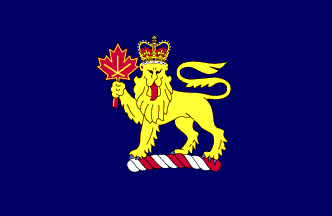
So what was one of the most threatening things we Canadians could be exposed to? Drinking copious amounts of dubious "spring" water from a plastic bottle? Watching "Trailer Park Boys"? Not exactly. Step forward, former Governor General of Canada, Roméo LeBlanc—a highly unsung hero in the political correctness movement. During his tenure (1995-1999), the Hon. M. LeBlanc wished to save millions of Canadians from a slice of blatant public pornography. He strongly proposed emasculating the proud heraldic lion, an ancient symbol incorporated into the sovereignty of Canada. The lion’s claws were deemed violent instruments, and the wisp of his identifying male appendage too provocative. Not to mention the suggestive lolling tongue (Mick Jagger, take a bow). Whatever were those filthy mediaeval heralds thinking? Or the Queen herself when she approved the official GG flag in 1981?

We will never know what panicky discussions this proposal might have caused chez Rideau Hall, the centre of the Canadian Heraldic Authority (and also the GG’s home). I did have confidence that cooler heads would prevail and tradition would triumph. It’s not easy to tell on the original image, but we can see his claws and tongue are still intact. Let’s hope some social pendulums are swinging back to reality.

26 May 2007

Truthiness

Stephen Colbert of the Colbert Report won’t mind if I cite one of his new words. I think of it with the ancestral family tales I hear. Events happened, no doubt about it. But subsequent telling is subject to memory’s imperfection and sometimes imagination, which build layers of pearl around the grit. “Truthiness” usually surrounds a real fact. So family legends are seldom static. Mine have been known to shape-shift—at different times to spare the teller’s or the listener’s sensibilities.

Grandpa Victor Freibergs had intensely interesting stories to tell of a world far away and unknown to his grandchildren. Revolution, freedom fighters, guns, neighbours turned against each other, revenge, killings—these were real experiences for him in his youth. The grit of truth in one story is that his father Otto Freibergs was shot and killed in the middle of the night during the unsuccessful 1905-1906 winter revolution in the Russian Empire. The circumstances surrounding Otto’s murder have been veiled by the passage of time, the absence of contemporary records, the complex politics of the times and the Freibergs’ precise part in them. I’m not sure I will ever understand the complicated history of this small but proud country. Thanks to my researcher in Latvia, communications have newly opened with relatives in Riga. We know the essential truth of the story. Maybe now we can work in reverse to dissect and examine the added layers of truthiness.

14 May 2007

Cementerio Fabuloso!

In typical genealogist’s fascination with cemeteries, or perhaps more than most, I enjoy visiting these quiet places to see how different people accord respect to their ancestors. However, during a recent visit to Mexico, I came across the most bizarre cemetery yet. Cementerio Mexicano del Pueblo Maya was inaugurated on 1 November 2004 (Dia de los Muertos—Mexico’s celebrated Day of the Dead) as an element of a theme park! Gulp. Ixcaret Park at Playa del Carmen in the Yucatan added this new attraction, claiming it as a fusion of the Maya and the Spanish, creating a new race. They began to lose me at that point. Creating a new race from the dead sounds more like a zombie movie or a mad DNA experiment than an artificial cemetery.

Unfortunately—or fortunately—I was not able to visit the cementerio myself, so my observations are based on an illustrated newspaper article. The owner of Xcaret Park and his son directed designers and artists to reproduce spectacular gravesites, monuments and crypts from many real locations in Mexico. The Mayan part? Forget it. As far as I can see, some lip service is paid to Mayan symbolism only in the basic layout of the setting, something to do with numbers of levels and objects. Do we even know what the Mayan did with their dead? The “structures” all reflect Christian culture, indeed with numerous churches among them, and thus the cementerio is very likely worth a visit to see eye-catching death styles of the devout. It is not clear from the article if the inauguration two and a half years ago means it is open to the public. It’s not yet on the Xcaret website.

Among the 365 reproductions at this time is one true burial site. The chief construction engineer for the park died after the cemetery was completed and was buried among his own artifacts. Milagroso!

22 April 2007

Remembering Ken

My colleague and genealogy friend Ken Aitken died yesterday .. the Queen's birthday .. not unexpectedly. He was 59. It was less than a year ago he was diagnosed with ALS (Lou Gehrig's disease) although not all the doctors agreed, nor how far it might have progressed even then. Ken leaves a legacy in the genealogy world as an active, dedicated librarian and an educator who continually encouraged and challenged genealogists and family historians to "sharpen your saw." He had a powerful mind and passionate ideas. We didn't always see eye to eye, but we always had much to talk about. The National Institute for Genealogical Studies certainly benefited from his great interest in creating discussion groups to study articles from scholarly journals in our field. Most of us last saw him at the OGS Seminar in May 2006. While his health was failing then, he was up to form in lectures and conversation, bubbling with his love of family history. Ken will be missed in many circles, not just in Regina where he worked and his home of Penticton, but also among the international genealogy community he enjoyed so much.

It's a sad thing when familiar personalities are no more. Somehow we expect the leaders to be ageless. Some day I will write about another colleague who was a dear, treasured friend, Ryan Taylor.

13 April 2007

Ca-li-fra-gil-ist-ic

Today was one of those supercalifragilistic days a genealogist gets every so often. Contact was established with one of my missing "Minneapolis cousins." Of course she wasn't missing at all, just minding her own business in Denver and having a life. It's hard to say which of us was more thrilled. I found her by googling and then hours of checking forum messages. Being distracted by the forum's interesting content did not speed things up. It's 18 years since I saw her; 1989 was the last time I visited Minneapolis (time flies even when you stand still).

The preliminary catching up had its sad moments, speaking of time. Both her father and her uncle, the sons of my dear "Uncle" Peter, have died in the past few years. Her brother has taken over their family business.
Kaylynn has the red hair and family similarity to me and my brothers in our youth. She also reminds me of my cousin Heather Dougall Miller, now sadly gone too. The colouring is also popping up among our grandchildren. I was told the red hair has been inherited from our Campbell ancestors ... but more on that another time.

30 March 2007

DOUGALL

This is a trial to give an introduction to a family history and see how it would work. Unfortunately, the footnote numbers and notes don't transfer easily into this medium. So far, I'll be content to show bits and pieces. Footnote numbers appear in the text in (brackets) and the footnotes should show at the end of the post. More news about the main families and research stories will appear later on the blog.
Title:
Ancestors and Descendants of John DOUGALL and Marion HASTIE from West Lothian, Scotland, to Argentueil County, Lower Canada (Quebec).

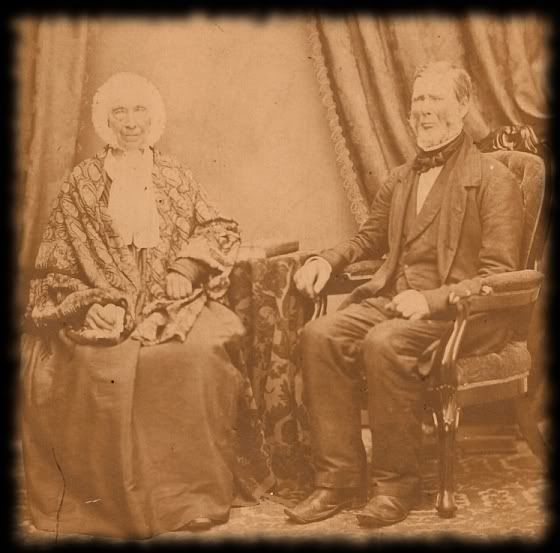
This photograph was taken some time before John Dougall died in July 1867 (see below). He lived just past Canada's birth as an independent nation. The photo has hung above my desk for the thirty years I have worked as a professional genealogist for thousands of clients worldwide. The look on John's face suggests disapproval that I was not paying attention to my own family history. I sincerely hope he will cheer up now. As I've already said, this is a work in progress and I have quite a way to go still. More information needs to be hunted, collected and sorted for several lines yet. As of this date I am also cleaning up footnotes ... the source citations which are all-important to a credible genealogical compilation.

The work itself includes data and stories (when possible) on:
* The emigrating Couple and their Ancestry
* The Second Generation
Names of spouses: Cameron, Fenton, Moffat, Lloynachen, Laing, FRASER, McCunn
* The Third Generation
mainly from Peter Dougall (1824-1914); names of spouses: Ormiston, McFADYEN, Hemenway, French, McAdam, Kenning
* The Fourth Generation
from John Fraser Dougall (1852-****)
from William Charles Dougall (1854-1934)
from Margaret Jane French (1867-****)
from Peter Robinson Dougall (1872-1962)
from Mabel Kate Kenning (1881-****)
The Fifth Generation:
Hector Fraser Dougall (1896-1960)
Peter McAdam Dougall (1900-1993)

To the last two above, I dedicated my work: my father, whose interest and preliminary findings unknowingly set me on this lifelong path, and my "uncle" who unfailingly provided support and good humour.

John Dougall (Thomas, John) was baptized 20 July 1781 in the parish of West Calder, West Lothian, Scotland, the son of Thomas Dougall and Marion Pollens;(1) he died 20 July 1867 at Beech Ridge, Argenteuil County, Quebec.(2) John married on 13 May 1810 in Livingstone parish Marion Hastie, daughter of John and Margaret (Brown) Hastie.(3)

(1) West Calder Old Parochial Register (OPR), baptisms 1645-1854; Family History Library microfilm 1067792.
(2) Suzanne Rossignol and Pennie Redmile, St. Andrews East Protestant Cemetery, St. Andrews East, Quebec (Quebec Family History Society 1991).
(3) Livingstone OPR, marriages 1718-1820; FHL microfilm 106636. John Dougall's family bible, published in 1811, has disappeared; it was transcribed by Miss Helen Locke as a girl and her notes say the wedding took place 13 July 1810.


21 March 2007

UNDER CONSTRUCTION

...MORTUI VIVOS DOCENT
... the dead teach the living

Why a blog? Well, 'everyone' seems to be doing it in the 21st century. Some of the family history I've been working on, i.e. trying to get back to, can be posted here. Uh oh ... better ask CDM if footnotes can be pasted into a blog. My tech knowledge is severely limited! Like all good genealogists, I have plenty of footnotes sprinkled through my work. We decided to try this medium, rather than a website, to see how it will work. My main purpose is to share some of the various family histories as they evolve, and some of the associated stories.