Pages

20 July 2008

(Almost) Silent Sunday

A lot of genealogy bloggers are into mutual fun like Carnival of Genealogy (which threatens to explode from its own popularity) and Wordless Wednesday and lord knows what else. And a creative and humorous lot they are! Now I hear even more networking rumours that involve FaceBook of all places. Gaggles of genie bloggers unite? Next thing you know, they will start having categories and contests and star grading systems. Or oscars. I don’t have to worry about it because no-one reads this blog anyway so I can carry on self-indulgently without anyone (especially me) taking myself seriously.

Having viewed some beautiful photographs on Wordless Wednesday, I enjoy them. Mostly, they speak for themselves. The slight hint of mystery about a photograph with no wordy exposition is alluring. Now you find me thinking of doing something about it, as in acknowledging a nice idea without being FaceBookably sociable or submitting to weekly pressures. My problem is that I can scarcely get one or two posts per month up, never mind one every Wednesday. On Wednesday I won’t even be here. Sunday will have to do.

So now that I’ve yapped on blithely about being wordless, I’m doing a photo. I believe a previous post threatened to expand on a certain non-genealogy topic. One might title this Where It All Began which may or may not offer a certain je-ne-sais-quoi mystique.

Sakhara City, 1961. Photo by Janice Cooper, in possession of Brenda Dougall Merriman 2008.

12 July 2008

Frasers Part 4: Losing Your Census

The things that drive a genealogist crazy.
This is a four-part whine for the benefit of the uninitiated who may have the slightest curiosity about why we are crazy.

(1) The old seignory of Argenteuil in Quebec measured 54,000 acres. Development first began about 1800 at St. Andrews village and the agricultural area around it. Early provincial surveyor Joseph Bouchette’s A Topographical Dictionary of the Province of Lower Canada (1832) informs us that 520 farm lots had been created in the vicinity, and the village at the time of the 1831 census had a population of 2,550. Genealogically speaking, this is not an overly large pool in which to trace several Fraser families, even when we add on nearby Lachute and other growing settlements. Even better, there are early census returns and church registers filling the period from about 1800 to 1850.
Map courtesy of the Comte d’Argenteuil’s website at www.comte-argenteuil.com/ and likely derived from M. Bouchette. I love this map. I am so happy M. le Comte put this on his website.

Nevertheless, my question du jour is why on earth have I found so many stray Frasers in a fifty year period? Twenty of them, and still counting! Strays are those pesky people who turn up, usually once! ... with no apparent link to the families being studied. They don’t fit. I would like them to fit. Some of them are Scottish-born immigrants who could be siblings or cousins and could possibly shed light on the overseas connection. "Family reconstitution" is a familiar phrase in this genealogy business. Sigh. It involves attempting to reconstruct ancestral "nuclear" families and in this case must embrace at least the last generation born in Scotland.

(2) Three important, early census returns exist for the seignory of Argenteuil. They are for 1825, 1831 and 1842. Counting all three, there are nine Fraser households, some of whom are mine. Nine men are named as the heads of households in those three periods. That’s the good news. This is typical of Canadian census returns prior to 1851—only the "heads" are named. But within those household statistics the real total is 73 Frasers. So you see the bad news ... no names for the other 64 children, grandchildren, aged parents, mothers-in-law, uncle, nephew, and strays like farm workers and domestic help.

The government does provide column after column of statistics for each household. Sometimes the columns extend for pages. Imagine trying to follow say John Fraser on line 31 across four or six pages of numbers when the heading on each column is out of sight, or it’s in French, or a large ink blot obscures what you want. Trust me, even the enumerators got confused. Household totals and the age categories for individuals (e.g. "over the age of six and under the age of fourteen") are frequently off-kilter. Wouldn’t it have been a lot easier just to name each person in the house?

A tiny example of identifying each family goes something like this. One John Fraser might be recorded as having four children under the age of six, three of them girls. We try to match this household with a John Fraser who probably had daughters born before 1825 but after 1818. More or less. If the church registers have baptism records back that far. Or if they fit with adult daughters in later censuses. If none of them succumbed to infant mortality in the meantime.

(3) Here is a characteristic Highland Scots complaint. My Frasers wanted to call all their sons John, James and Alexander, etc. And their daughters Ann/Nancy, Elizabeth and Mary, etc. The sons and daughters all had children and of course used the same names. Soon we have four or five Nancys and Johns born within a few years. One would expect the later census returns that do name all members in a family/household would help untangle this. But did they all stay at home? No! Inevitably they go to visit Fraser cousins or work for an uncle or care for a grandparent just when the census-taker was at hand. Today’s researcher is left wondering is that Alex’s John or John’s John? John’s Nancy or James’ Nancy? So you can be darn sure of the chaos by the time the third generation arrived.

(4) Why is the page with *MY* Nancy missing in the 1861 census?!

01 July 2008

Who Dunnit or Who Dinna Do It?

Like so many genealogists, I devour crime and mystery fiction (murders, lawsuits, terrorists, spies). Detective work and genealogy share great similarities regarding identification of the suspects and the collection of evidence. Exercising the brain reportedly keeps it from calcifying; let’s hug that thought! It’s hard to decide who my favourite detective is. Then again, who says I have to pick just one? My list is amended as new authors appear and the quality of others waxes or wanes. Ideally a preferred author produces a new book every two years, but it doesn’t always work that way.

It’s only fair to mention an icon of the crime genre who was held in highest esteem by his contemporaries and peers—Ross Macdonald and his detective creation Lew Archer. I couldn’t agree more with Sue Grafton in her introduction to Ross Macdonald: A Biography by Tom Nolan:
"If Dashiell Hammett [Sam Spade] can be said to have injected the hard-boiled detective novel with its primitive force, and Raymond Chandler gave shape to its prevailing tone [Philip Marlowe], it was Ken Millar, writing as Ross Macdonald, who gave the genre its current respectability, generating a worldwide readership that has paved the way for those of us following in his footsteps."

Macdonald’s writing is lean and mean, perfect for the laconic California private eye he sent on dozens of cases. A number of them involved families in multi-generation context, dear to the heart of genealogists. Macdonald was born Kenneth Millar in California, but was raised in Canada, attending high school in Kitchener, graduating from University of Western Ontario, and doing post-grad work at the Ontario College of Education before becoming a teacher. Macdonald elevated the genre to literate mastery.

My current A-list begins with Martin Cruz Smith’s prosecutorial investigator Arkady Renko, a man sometimes bowed but seldom beaten by the vagaries of Russian authority. In the course of the novels he manages to survive the transition from the soviet hammer to capitalist chaos to whatever is emerging today. He has deep, barely concealed contempt for his superiors, whatever their stripe. Their continual bureaucratic attempts to demoralize him rarely affect his totally engaging character. Renko sometimes second guesses himself, but even his melancholic observations have a dry humour. Renowned for his debut novel, Gorky Park, Smith does not produce a Renko novel every two years, to my regret.

Sequels like Polar Star and Red Square describe the absurd necessities and exigencies of daily life and work in a disturbing country, all fodder for the Russophile reader. Smith’s graphic portrayal of the Zone of Exclusion at Chernobyl in Wolves Eat Dogs is not for everyone’s taste but who would not appreciate his black market scenes of the 1990s in Red Square, or descriptions of Cuban street life in Havana Bay? Luckily for me, I still have Stalin’s Ghost to look forward to.

A close second is Donald James’ (aka Donald J. Wheal) police inspector Constantin Vadim who has slightly more authority and job security than Renko. This man is hot. His rather dishevelled approach to life involves many a thumb of vodka, unique expletives and superstitious ruminations on the mythical proportions of Russian folklore. Like Renko, Vadim is no indiscriminate skirt-chaser; he is true-blue to his wife. Actually, a different wife in each book. The first Vadim novel Monstrum is set in the year 2015 in a Moscow emerging from a realistic civil war. In the post-war aftermath, orphaned children are the biggest victim statistics. The next in the series is The Fortune Teller where Vadim has been moved to his hometown, the Arctic port of Murmansk. There he untangles mysterious murders and battles the slave trade with another cluster of priceless characters. But it would not be Russian if some tragedy were absent.

The third novel, Vadim, is disappointingly set mainly in the USA where Vadim becomes embroiled with politicians. A tuberculosis epidemic is sweeping Russia, causing millions to flee. My hero has quit the police militia and is not in his old form in this unfamiliar milieu—America is emasculating him. I had to wait until page 275 for his return to Moscow to see the passionate Russian emerge once again to navigate the plot twisting. The ending is an opening for more activities and more wives. But oh-oh, that was published in 2000 and we fans still wait.

To be continued. Which mystery authors and characters do YOU like??

30 June 2008

Happy Canada Day!

What does Canada mean to you? Talk about an open-ended question! But pollsters do like to take polls, and John Reid—on his Anglo-Celtic Connections blog—relays some interesting results in brief from the Dominion Institute’s survey of the top 10 or top 20 answers. Can’t personally say “beaver” or “hockey” or “Niagara Falls” enter my head immediately. Our perception of Canada may be quite (interestingly) different from other viewpoints on the global compass. And our own perceptions are shaped by our family life and work life in such an amazingly varied country.

I see Canada in the excellent, wonderful humour we nourish and share, even with (or because of?) all those regional and cultural differences. We know we’re good at it because we do it all the time amongst ourselves. Give a Canadian a microphone or a letter to the editor on almost any topic and chances are you get some very good satirical or black humour (the best) comments.

If the Dominion Institute insists on a one-word or one-phrase answer for what Canada means to me? LAKE SUPERIOR.

Since I moved to Toronto quite a few years ago, CANADA DAY has taken on even more significance for me. I live in the old Town of York of 1793 as planned by Upper Canada’s first Governor John Simcoe and his surveyors. A number of my former clients had ancestors living here—carpenters, sailors, builders, administrators and real estate speculators—and it was possible to learn quite a lot about them. Some of those ancient inhabitants still lie beneath the sod of St. James Park over there or under the pavement of the adjacent diocesan parking lot. No, I don’t see ghosts on my walkabouts, but I can often see the imprint of times past.

My street sits under the water of Lake Ontario’s old shoreline, and my home is on the site of a nineteenth century shipping wharf. Where I live is also home to many entertainers and performers who suit the delightful St. Lawrence neighbourhood. Each CANADA DAY we like to serenade our neighbours in all directions with O Canada. Our resident leader is Syd Dolgay, an original member of the Travellers folk music group. The Travellers’ signature song was a Canadian adaptation of Woody Guthrie’s This Land Is Your Land. We always sing that too!


2004: PAL gathers to warm up the vocal chords.

02 June 2008

Freedom 25

Take a peek at my books down in the right column. Two new editions are the products of Brenda’s last twelve months in researching, revising, writing, being reviewed, consulting, more research, more re-writing, printing glitches and occasional suicidal thoughts. That was me about March belting out “I Will Survive” as a theme song. It’s been 24 years since the first edition of Genealogy in Ontario appeared. Here are a couple of illustrations that didn’t make it into the book.

The Books of Remembrance for Canadian military service are in Ottawa but can be viewed on the Veterans Affairs Canada website: www.vac-acc.gc.ca, "Canada Remembers." The statue of Governor Simcoe is at Queen's Park in Toronto.

About Genealogical Standards of Evidence (3rd ed.) has also been revised to reflect mainstream twenty-first century methodology. Now I’m free to sort out priorities for my next projects.

This past weekend, 30 May to 1 June, was the Ontario Genealogical Society’s annual Conference (as it happens, the biggest such event in Canada). I was there on Saturday afternoon to sign books at the OGS table in the Marketplace of vendors, exhibits and regional information centres. A great chance to catch up with old friends, new friends and all the books. OGS had an attendance near 700 which is amazing, considering the downturn in registration the last few years for most North American conferences. Smart publicity contributed, and the theme “Wired Genealogy” clearly resonated with the general public. Dennis Mulligan must be a happy man.

The Ontario Chapter, Association of Professional Genealogists, had a table to promote membership and individual services; I could only spend a short time there. OCAPG member Ruth Blair was energetically doing double duty at times, with the National Institute for Genealogical Studies located at the next tables. At the end of this month my official position with NIGS comes to an end after six years. OCAPG member Nancy Trimble’s election as OGS vice president was good news; her broken leg was not so good news, but with her motorcycle ambitions curtailed, we know that matters genealogical have her undivided attention, eh? Paul McGrath at the “Ancestors in the Attic” display discussed the wrap-up of the third series and the preparation for a fourth with fingers crossed. Unfortunately I missed Dick Eastman, John Reid and many other people.

Speaking of endings, beginnings and good theme songs, Maclean’s magazine tells me that disco is back. Not that I knew it went missing, but it’s reassuring to know that good things get re-cycled without my help. Now all the secret wannabe Y!M!C!A! impersonators can safely reappear. Much more fun than rehearsing the steps to Zjozzy’s Funk in my sleep. Welcome back, Gloria Gaynor.

04 May 2008

Saludos Amigos!

Sombreros off to our Mexican friends who celebrate Cinco de Mayo today. On 5 May 1862 the poorly equipped army of General Ignacio Zaragoza, outnumbered almost 2 to 1, defeated invading French forces at the battle of Puebla. The victory created a great surge of national unity that lives on in the collective memory, although the French subsequently prevailed with Louis Napoleon installing Maximilian of Hapsburg as emperor.

Finally, in 1867, president Benito Juarez regained power.

While the Fifth of May is not their Independence Day (16 September is) it's a good excuse for parties. Mexican culture is celebrated around the country, with pride of place in the city of Puebla. Ironically, it is said the biggest Cinco de Mayo celebration is in Los Angeles, USA.

Doesn't that margarita blend nicely with my blog?

03 May 2008

Technical Challenges

Now that I finally figured out how to show labels in the sidebar, I need to go back and be more precise about labels for each post. This format does not allow me a third column. At least, not that I’ve discovered. This technology stuff is soooo painful when the right brain fights with the left brain. At any rate, I’ve managed to learn self-control when my internet service is interrupted or non-existent. Four whole days, sympatico!! Mastering the transfer of photos from a digital camera into my computer took many repetitions to sink in. Even then, I’m sure I have duplicate photo sets hiding in my hard drive from prior nervous attempts. Cropping a photo needs perfecting, and maybe learning what dpi means, among other things, duh. I'm working on how to make the URLs active links.


Getting a scanner and making it work will be another molehill out of which I can make a mountain. Tough work, this blogging.


Entirely gratuitous camel photo from my collection. In the United Arab Emirates, camel racing is a national sport and really, an industry. Trainers start working with 2-year-old camels to determine their abilities.

Photo credit: www.camelphotos.com/racing_camels.html#.

30 April 2008

Frasers Part 3: Dr. William Fraser, continued

A postscript to my post of 9 April 2008. The recently released index to the Drouin Collection on the subscription database provider, Ancestry.ca, drew my attention. “Drouin,” as we casually refer to it, was a concerted filming project by l’Institut Généalogique Drouin in the 1940s. Copies of all Quebec parish registers were by civil law deposited with area courthouses as vital records of births (baptêmes), marriages and deaths (sépultures). Baptismal entries normally include the date of birth; burial/interment records include date of death. The magnitude of the collection is immense. Family historians with Catholic ancestors have long used this collection to uncover multiple generations of ancestors. Now we have an index linked to digital images.
If the new index (and the collection, for that matter) indeed covered all Quebec parishes, could I find my Protestant Frasers? Yes, .. and no. The Ancestry statement“Searching may produce records that have not yet been indexed” applies to the Anglican and Presbyterian churches at St. Andrews East (St-André d’Argenteuil), home of my direct-line Frasers. Under the search box is an alphabetical place name list. It’s essential to read the notes to see how complete the indexing may or may not be for individual parishes or churches. Indexing continues, with promises for completion by the end of the year.

Nevertheless, entries for many Protestant churches in Montreal are available. Besides the marriage and death of Dr. William Fraser, which I had previously obtained by other means, the following were uncovered, much to do with the family of his wife, Miranda R. Charles:

• John Charles age 35, dealer & manufacturer of hair powder, married Lucy LeBrun age 19, both of Montreal, on 19 June 1800 (she with parental consent). Witnesses: Jon? Josh? L– or S– , Elis– Fraser, J. Woods. (Christ Church Anglican)
John Charles' occupation probably indicates he was a supplier to apothecary shops, among other places, with which Dr. Fraser was later associated.

• Maranda daughter of John Charles, trader, and wife Lucy Le Brun was born 11 December 1814, baptized 1 January 1816. Sponsors: John McGillivray, Frederick ___nerman. (St Andrews Presbyterian)
I have not yet determined how many other children were born to this couple in the gap 1800-1814. Miranda did have an older sister Lucille according to my 1987 correspondence with a great-granddaughter of Lucille Charles. Oddly (?) Miranda always bore a second name Robertson, passed on to two of her children—a prominent maternal surname in the family of her future husband-to-be.

• John Charles 58, merchant, died 29 March 1823 and was buried in “the new Protestant Burial ground Quebec suburbs.” Witnesses: Edward Wilcock, George Savage; Robert Easton officiating. (St Andrews Presbyterian)
Despite the word “Quebec” appearing in the burial entry, I am told this would refer to Mount Royal Cemetery in Montreal.

• Lucille Margaret daughter of William Fraser MD and his wife Marinda was born 2 May 1843, baptized 5 October 1843. Sponsors: D. Macdonell, James Dougall. (St Andrews Presbyterian)
The doctor’s second child and second daughter; entries have not yet been confirmed for their five other children. Another coincidence, the name Dougall appearing as a witness.

• Maria Catherine Robertson Fraser and Charles Frederick Goodhue were married 25 September 1862 by Rev. John Bethune; witnesses were W. Fraser MD, John Macbeth, M.L. Fraser, and D. Macmillan. (Christ Church Anglican)
This was the oldest daughter of Dr. William. She died ten years later after bearing two children.

• Miranda R. Fraser, widow of the late William Fraser MD of Montreal, died 14 November 1891, buried 16 November. Witnesses: D. McEadman? J.J.M. Pangman. (Christ Church Anglican)
About nine years before her death, Miranda Fraser presented the Medical Faculty of McGill with her husband’s library and surgical equipment.

• Duncan Robertson Fraser age 47 died in Montreal 20 July 1892, buried 21 July. Witness: James Robertson. (Christ Church Anglican)
Duncan was the youngest son of William and Miranda; he had spent his previous years in Queensland and Sydney, Australia. His will was probated in Montreal 23 September 1892.


If only MY John Fraser ancestors had died "in plain view"!

12 April 2008

Colour Me Red

Jasia’s Carnival of Genealogy (http://creativegene.blogspot.com) provides me, at last, with a legitimate opportunity to write about one of my obscure interests. The theme is identifying hereditary family traits. My choice is RED HAIR. Yes ... a subject worthy of more scholarly attention, although I am not the first to raise the flag. On a scale of 1-10 with 10 being of utmost importance in global interest, the topic might rank as -5, possibly as high as a 1 for Celtic people. To be sure, and with all due respect, discussing red hair is potentially more
(ID protected! ^^^^^^^^)
appealing than some wretched family traits like Six Toes or Sleep Apnea.

Born a redhead is a very special thing. People comment on your red hair when you’re little. Strawberry blonde or ginger are some of the nicer comments. When you’re older, they think you dyed it. Listen up, folks. No chemical mixture has ever simulated the real thing. Truly red hair. Brown-haired people with reddish glints in the sunlight don’t count. Red hair starts to forge character right from birth and conscientious parents of redheads need to prepare. Minimally, reading Maggie Muggins or Anne of Green Gables would help (my sell-by date is showing).

Red hair is a mark of distinction not for the faint of heart. Believe you me, red hair can be an endurance test from the word go. You stick out like a sore thumb at school and will inevitably be nicknamed Red (or much worse these days), even if you like your real name. On the other hand, teachers and assorted persons of authority seem to notice “the redhead” in case you wanted to be noticed but it’s usually to get blamed for something you didn’t do. One young redhead I knew struggled to apply black shoe polish in a failed attempt to disguise himself. I remember when I was 17 and my new friend from Germany confided that Europeans considered all people
with red hair to be congenital dimwits. What is their problem, anyway? Losers! I’d say no other vizmin in history has survived centuries of such superstition and slagging from the resentfully less-endowed.

My Dad was born a redhead in a family of three redheads. He was known as “fiery Red Dougall” among his RFC comrades in the First World War. I am told the hair comes from our Campbell line (um, see below Who’s For Dinner 12 Feb 2008; reminds me Bella had some positive attributes). Therefore the gene skips around like a dizzy kelpie from one generation to the next, or the next. It might be called genetic drift or autosomal inheritance but clearly involves interference from culpatory invading genes. Dad in turn produced a family of three redheads. After that, the red hair gene went to sleep. It shows up again in two out of six grandchildren—proper, unmistakable, sensational red hair.

Little ones may seek comfort and inspiration from many role models like today’s Prince Harry. For my part, it was no coincidence that The Red Shoes movie starred a red-haired ballerina, my own adolescent heroine ... saw that movie 14 times and still counting.

Red hair is a flaming mark that—alas—may not last a lifetime. Consumed by its own brilliance, one might say. One day a disrespectful friend bellowed to get my attention: “Hey, blondie!” (surely that wasn’t me he called). But time has a way of eclipsing great things. That is why red hair is special. It’s a lottery if and when it will turn up or how long it will last. Parents, if you like what you have wrought, you see what you are up against. Know your genetic genealogy. Cross-examine anyone whom your redheads plan to marry. Better still, send the kids to www.redhedd.com to perpetuate the species. Long live small kiddies with red mops.

09 April 2008

Frasers Part 2: Dr. William Fraser


Thanks to this man I was able to extend one of my Fraser lines several generations into the Perthshire area of Scotland. Both parents of great-grandmother Catherine Fraser were un-connected Frasers. My serendipitous moment was finding a newspaper death notice for Catherine’s mother (Nancy). Among other pieces of identifying information, the notice stated that Nancy was the sister-in-law of Dr. William Fraser of Montreal. Nancy Fraser’s husband John Fraser, who died young, was William’s brother. Almost nothing is known about John Fraser other than he was a blacksmith at St Andrews East, Quebec, and he fathered four children. Exploring sources for a public figure like a doctor made it possible to learn more about the origins of the two brothers in Perthshire, Scotland.

Notman Photographic Archives, Musée McCord Museum,
Montreal; negative no. 18406 (1864-1866).


William Fraser received his medical licence in 1834 from the College of Physicians and Surgeons in Glasgow, Scotland.(1) His brother John the blacksmith was already living in St Andrews East, married, and starting a family. That year, William decided to emigrate to Canada and was appointed Apothecary at Montreal General Hospital.(2) After continuing studies, he graduated as an M.D. from McGill University in 1836.(3) Thus began his long association with both the hospital and the university. On 4 August 1840 William married in Montreal Miranda R. Charles, daughter of the late John Charles and Lucille Lebrun.(4) For almost 25 years he held the chair of Institutes of Medicine at McGill. He died 24 July 1872 in Montreal.(5) When his widow Miranda died in 1891, there is some unconfirmed hearsay that she bequeathed her Charles family residence to the university.(6) Their large monument in Mount Royal Cemetery records his birthplace as Killin, Perthshire.

Preliminary research using the International Genealogical Index (IGI) for the Old Parochial Registers of Scotland was encouraging. William Fraser was baptized 23 March 1810 in the parish of Killin, son of Duncan Fraser and Catherine Robertson. His brother John was the oldest child, baptized 12 April 1808. They had other siblings: Robert (1812), Margaret (1815), Duncan (1817), and Donald (1819). The parents Duncan and Catherine married in Killin on 18 July 1807. Duncan’s baptism also occurred there on 24 January 1783, son of John Fraser and Janet Buchanan. This last John Fraser may be the son baptized in 1751 to Duncan Fraser and Margaret McKerchar. Not a bad beginning for pedigree drafting! Correspondents tell me that many Frasers migrated to Perthshire from the Highlands after the rebellions of 1715 and 1745.

Photo: McGill Faculty of Medicine, Brief History of Medicine at McGill (http://www.medicine.mcgill.ca/history : accessed 9 April 2008); first McGill Medical School c1872.

Of Dr. Fraser, it was said “He began life as a very poor man, but by sheer doggedness he eventually built up a most prosperous practice, starting with a small drugstore on McGill Street. Plain in manner and with no pretence at any oratorical ability, he greatly impressed his students with his earnestness and common sense.”(7)

(1) H.E. Macdermot, A History of The Montreal General Hospital (Montreal: The Montreal General Hospital, 1950), p. 62.
(2) Canada Medical and Surgical Journal, Vol. 1 (August 1878), pp. 92-93.
(3) Ibid.
(4) Fraser-Charles marriage (1840), Christ Church Anglican Cathedral, Montreal.
(5) Montreal Gazette, 25 July 1872. Gravestone in Mount Royal Cemetery, Montreal.
(6) Correspondence to author from Elizabeth Stevenson O’Neill, 29 October 1987.
(7) A History of The Montreal General Hospital, p. 62.

06 April 2008

Idle Hands

The (previous) hot pink wasn't really me after all. Spring cleaning brings changes as I idle in a hiatus between manuscript submission and final page proofing. Before I start the next great Canadian novel. Or finish writing my family histories. Maybe they will all come together somehow. As for colours, I can't help it, I'm a Leo. More to come, to be sure.

25 March 2008

Matrilineal

Back in the early 1980s I experimented with matrilineal genealogy charting. It was not prompted by any overt feminist ploy, but from wanting to play around with the traditionally male-dominated family pedigree charts. It wasn’t easy. We genealogists know it’s harder to find out about female ancestors. Of course each woman has a mother-based descent shared with her siblings. But when you play around with matrilineal lines of yourself or your cousins, mutual family ancestry veers off into fascinating tangents just as valid as your birth surname lineage. This view of ancestry has received a little more attention since Mitochondrial-DNA studies came into focus the last few years.

When I first began with this idea I wanted to show the female Scottish connections which I had traced for several generations. The idea instantly clashed with my maternal ancestry which goes entirely Latvian. And so does that of my daughter, because of me. And so does that of her daughter, because of her. Thinking out loud here for fun (allowing for my defective gene in mathematical skills) I am 50% Latvian, my daughter is 25% and my granddaughter 12½%. Of course the percentages get diluted as time goes on, but the connection is always there. My few maternal female cousins have Latvian mothers and grandmothers and so on, unrelated to my lines. It seems I have no maternal Scottish connections.

Not to be defeated at the outset for this vision of the Scottish female forebears, I used my paternal cousin’s granddaughter as the bottom line. Paternal cousin and her offspring have the Scottish maternal lines I lack. (My heritage too, I claim!) This later led to making a chart that ascends from my own granddaughter. I had to cull everything I knew, and am still learning, about my Latvian grand-mères.


The photograph is entirely gratuitous! ... one of the old wooden houses in the city of Riga, October 2006 by BDM. No grandmother peeking out of the window there. Must take more photographs. Must remember to cite photographs and maps found on the Internet!

Investigating maternal lines is a slightly different way to look at genealogy and family history. Each spouse along the way of direct-line surname tracing, often ignored in traditional context, contributes not only to the unbroken inheritance of MtDNA in women but also to how many genes or characteristics the latest baby may display. Percentages and DNA aside, we should never underestimate the value of matrilineal heritage in family history.

13 March 2008

Get Sick; Get Attitude

Staying in bed with a cold or the flu is the responsible thing to do. It’s win-win for you as an individual and for the common good. This is not self-indulgence, it’s a moral obligation to practice public health safety. Therefore, who could deny your right to a few human comforts in your sickbed as you courageously shield your friends and loved ones from contagious germs?

Taking to one’s bed is not to be done without sufficient thought. Plenty of pillows for propping various aching parts are essential. A large pot of constantly heated chicken soup within readily easy access is recommended, unless you prefer cold vodka. Be sure to have a supply of tissues and other paper necessities. This could be the only occasion for the crocheted tissue box cover your great-aunt gave you for your birthday eight years ago, the one you didn’t dare throw out. A small radio or TV might ease your plight. If you are a genealogist, have about ten of the latest detective novels at hand. Cough syrup or Fisherman’s Friend may help minimize your suffering and maximize your dozy attention span. When the bedside table gets overloaded, one of those folding bed trays is a big help. You might have to go shopping first.

Because you are sick and incapable of performing normal domestic chores, it’s only common sense to stock a few items that instill mental well-being as well as encourage a feeble appetite. Positive thoughts. Some people like chocolates or macadamia nuts; others might like a special pizza or pastry. Portable phones or cell phones and laptops are only recommended for dialling take-out delivery, because above all, you must not whine to those who support your selfless isolation. It’s OK to fall asleep a lot.

So for all those coughing, sneezing people on the subway and my last airline flights: thanks a lot for the souvenir. Go home and go to bed. You’ll like it if you do it right.

12 February 2008

Who's For Dinner?

A number of genealogy bloggers are egging each other on with creative ideas. “Carnival of Genealogy” is like that, at http://creativegene.blogspot.com. One edition I enjoyed was: which four ancestors would you like to have dinner with and why? (4 February 2008) Naturally, my ideas began to perk ... along with a dinner menu, which I used to enjoy planning before I had a 24/7 career in genealogy. Never mind four ancestors, two of my choices would be ggg-grandfather Donald McFadyen the pensioned soldier, and great-uncle Alexander Jurikas the Orthodox priest. They will be appearing here later.

Not to invite under any circumstances is great-grandmother Isabella Campbell McFadyen (1845-1924). By all accounts she was an impossible visitor in her later life, descending on adult children without notice, making demands that exceeded all bounds of civilized hospitality, having the rude manners of an untutored dictator, and throwing each household into mass disarray. Bella would stay for months at a time. I was told her fractured English was usually indecipherable, and she increased her decibel level in direct proportion to the dumbfounded looks on nearby faces. Someone chose an ambiguous epitaph for her: She Hath Done What She Could.


If I really try to put myself in her shoes, as good genealogists attempt to do, it’s not easy. We have to think multicultural shock here. Bella grew up in a Gaelic-speaking household. I’ve read numerous books about the transplanted highlanders in Cape Breton, even some written in the vernacular. Growing up in a crowded household where a pack of kids had to work all the time at domestic responsibilities, heavy farming requirements, or often working at out-sourced jobs for extra family income, when schooling was minimal and English was rarely required ... is a big stretch.

Nevertheless, I understand they managed to have excellent parties, ceilidhs, with great music to offset their otherwise sober lives. No problem relating to that, a tradition that survives exceedingly well in Cape Breton. Having ancestor Bella to dinner would be a trainwreck, balancing the agonizing communication difficulties with potential rewards on the hope that she knew anything of her ancestors. My 21st century is battling with the 19th.

Now take my late Aunty B (1906-1979). Not really take her, she’s not for giving away! There’s a woman to have dinner with. As a house guest, she would never bemoan or turn up her nose at a plate of pad thai and schezuan cucumbers. Unlike Bella, Aunty B was totally familiar with knife and fork usage at the dinner table and was in all ways cool. She didn’t even have to say it: she’d been there, done that, probably hid the T-shirt in her underwear drawer, and wasn’t going to tell a soul about it. Aunty B knew plenty of family gossip I’d like to cross-examine her on now. No-one remembers now why she got called Aunty B. Her official name was Isabelle (family habits die hard) but that’s the only similarity to Bella.

That’s for you, Heather.

21 January 2008

Peace (2008?)

Apart from classical music immersion in the dance world, one of my earliest musical exposures to popular music (with due respect to Elvis) was the Kingston Trio. I hear myself and friends happily and beerily bellowing the MTA song ... apologies to the original lyricist: “Did he ever return? NO he never returned, he was lost forever ’neath the streets of Boston, the man who never returned ... .” And et cetera. Some of us probably had not even seen a subway system yet.

But what really sticks in my mind all these years is their Merry Minuet. It was composed in the 1950s when the Cold War was alive and well. What strikes me is that even in those days, when television was an infant--before satellite communications, the Internet, talking heads, and amateur on-the-spot filmographers brought global war into our living rooms--some “ordinary” people were aware of the sad and longstanding divisive elements among the world’s peoples.

You really have to remember the tune to get the intended effect:
They’re rioting in Africa.
They’re starving in Spain.
There’s hurricanes in Florida,
And Texas needs rain.
The whole world is festering
With unhappy souls.
The French hate the Germans.
The Germans hate the Poles.
Italians hate Yugoslavs.
South Africans hate the Dutch.
... And I don't like anybody very much!
But we can be tranquil and thankful and proud
For man’s been endowed with a mushroom shaped cloud.
And we know for certain that some lovely day
Someone will set the spark off and we will all be blown away.
They’re rioting in Africa.
There’s strife in Iran.
What nature doesn’t do to us
Will be done by our fellow man.
[compliments of MusicSongLyrics.com; Kingston Trio lyrics provided for educational purposes.]

Goes to show. None of the news we hear today is very new. Even in the 1950s it wasn't new. The players may change, or they ascend or descend in global awareness, but what happened to the lessons of history and human tolerance for different from me?

24 December 2007

Jurikas Part 2

Introducing Marija Jurikas (26 November 2007) means .. yes .. I have a totally different Latvian family line. Some tales have appeared here about the Lutheran Freibergs. It’s hard for me to grasp the multiple historical influences on this small country. Through invasion and war over centuries, the Germans and the Russians deeply affected the indigenous population. Force and fear were routinely employed by both at times. Ultimately, and this is purely my own interpretation, German culture and values were more attractive than Russian. Germany of course was a wellspring of religious Protestantism. Latvia became predominantly Lutheran. Germanic people became the elite class of merchants and governing officials, even if it made for uneasy relationships, sharing limited power under Russian rule. They and their descendants were the main owners of large landed estates, or manors. Their descendants consider themselves wholly Latvian. But the status in the old days was clear: Latvian peasants were kept in the underclass. And yet, there were always those who resisted the strictures that kept them in place.


The Jurikas family also butted up against the authorities, but earlier than Otto Freibergs of the 1905 revolution. Families would apparently do what they could for survival and self-respect. Back in about the 1830s, Juris (George in English) Jurikas was said to be of Estonian origin, living in Latvia as a tenant farmer. It’s unclear where this estate he worked on was located, but presumably within some kind of reasonable distance from Estonia. The estate owner ordered the men of his village to build a Lutheran church. Juris refused to work for no pay and encouraged his neighbours to object. For this offence he was sentenced to a public whipping (a commonly favoured punishment for ‘misdemeanours’) but managed to evade the sentence by slipping away to Riga. He joined the Russian Orthodox church, perhaps out of defiance, which gave him some kind of sanction. It is said his original punishment was revoked but instead he was evicted from the property he farmed.

The Russian Orthodox Cathedral in Riga (photo) was not built until the 1870s so was not the exact church where Juris converted.

With some savings, Juris was able to secure a farm near Limbazi in the Livonia, or Vidzeme, region. We don’t know if his second farm was in the same general region as the first. Certainly it would not have been on the same landlord’s estate! The story is that only some rough, uncultivated countryside was available to him. He named his farm Krumini, meaning “bushes,” alluding wryly to the dismal condition of the land. All of the above is family hearsay, as yet. It’s likely that more years of hard work were necessary to clear the land and establish some family comfort. We do know that the land was part of the Ladenhof estate. The Germanic name Ladenhof is translated as Lade in Latvian.

This imperfect photo, taken from the bus window as we sped north along the Baltic coast, shows a typical countryside izba, much like that of the Jurikas home. I was able to snap it near the crossroad leading to Limbazi.

The name of Juris’ wife is not known. He may have married before he appeared in Lade parish, as the name Jurikas does not seem to appear in the registers of the Limbazi-Lemsal Alexander Nevsky Orthodox church before 1856. His wife was said to possess healing powers for sick animals and was called upon to help neighbours in this way. It is unknown when Juris died, although it is said he lived to a fine old age assisted by a daily quart of whiskey. I have a report of a marriage at the Limbazi-Lemsal church for Ivan Juriyev (John, son of George) Jurikas of the Schloss Lemsal estate, a widower aged 67, on 4 November 1856 to widow Maria Jacobova Kruklin. The translation from Russian is still in question. Since this man was born about 1789, his father Juris/George is clearly not the man under discussion. It would make sense if the bridegroom’s name was Juris or Georgiy, making this a second marriage for the aging Juris. But “Ivan” is quite evident on the record. Still, clergymen have been known to make errors!

The family ties with the Russian Orthodox church were to serve them well in succeeding generations. To be continued.

30 November 2007

161 Meme (What Is It?)


I’ve been tagged? By the “161 meme” book doojiggy. My colleague Steve (www.stephendanko.com) did it. The idea is to get friends and colleagues to respond with the 6th sentence on page 161 of the current book they are reading. A little explanation usually helps! By the time I caught up to Steve’s message, it fit nicely with my toying around for a blog article on the kinds of non-trade literature genealogists like to read, especially novels. While I also have two or three books on the go at once, I chose A Russian Diary by Anna Politkovskaya.

Page 161, sentence 6: “They say it is a small victory for us.” This is a quote from government apologist Ella Pamfilova in September 2004, Chairperson of Putin’s (then) newly created Presidential Commission on Human Rights. Ella sees it as a another victory for “the benign nature and democratic credentials” of Vladimir Putin. She reports support from all regions for this move. Cynical journalist Anna sees the commission as an action to control the human rights movement in Russia, which Putin considers his real opposition. Putin had already marginalized political opposition in elections by restricting the registration of other parties and removing the people’s right to vote for individual candidates. An outspoken advocate for democracy and human rights, Anna was murdered in the stairwell of her Moscow apartment building in 2006. Her friend Alexander Litvinenko, a former FSB agent in exile in London who had urged her to flee death threats in Russia, accused the FSB of assassination. Anna was one of several free-speaking Russian journalists who have been mysteriously killed. Not long after, Litvinenko himself died from radiation poisoning placed in his teacup.

Now I wonder what these people are reading: AWCH, CDM, John Reid, Mary Anne, and Elayne. You know who you are. Just send your comment here.

26 November 2007

Marija


St. Petersburg before the turn of the twentieth century was one of the greatest cities (THE greatest in some opinions) of Europe. It was a magnet for European intellectuals and artists and bons vivants. That’s where grandma Marija Jurikas headed to find gainful employment and perhaps adventure. She might demur if I described her as a small, stubborn woman. But when middle class women were supposed to stay at home, marry well, and demonstrate domestic virtues, Marija left the family home in rural Latvia with her skills and a longing to see and be part of something new.

In 2006 I saw where Marija lived in St. Petersburg. She was employed by Baron Kusov as the family seamstress and dressmaker.A 1910 city directory described Vladimir Alexeyevich Kusov as a state councillor, a technical director of the Mariinsky Theatre, treasurer of the Emperor’s Russian theatre society, and a sponsor of St. Alexander Nevsky church. His mansion is on the boulevard embankment of the Neva River on Vasilievsky Island. Marija designed and made the fashionable dresses for Kusov’s wife and daughters. With a seat at the head butler’s table for meals, she had high ranking in the domestic pecking order.


A short carriage ride would take Marija to the Mariinsky for some of the continent’s most exciting operas and ballets. All of Kusov’s household were able to take advantage of regular seating in the famed, fairytale theatre because of his position there. The Mariinsky was built in 1860 and became Russia’s premier showcase for music and performance. During Soviet times it was known as the Kirov Theatre.


Marija was born in 1872 in Lade parish near the town of Limbazi. Limbazi is just east of Latvia’s northern Gulf of Riga coast. We don’t know how or where she was trained, but her workmanship was exquisite. It included not only dressmaking and designing, but related details like embroidery, smocking, crochet, tatting, knitting, and other hand crafts. She was probably in Petersburg in the 1890s and early 1900s. However, she migrated to Switzerland at some point, before embarking to visit her brothers in Canada in 1908, at the age of 36. The ship’s manifest said she was 32. It’s a bit of a mystery why she hadn’t married by that time, but brothers Janis and Paul remedied that. They knew a handsome young Latvian man in Port Arthur, Ontario, an excellent candidate. They decided to marry in 1912. Now I know why my mother was an only child. Even though Marija’s age kept slipping downwards in various documents, typically for a woman of her time, she was 41 when she gave birth.


Marija’s handiwork and sense of fashion never ended, even in a Canadian “outpost.” She always wore the garnet earrings which were a gift from the Kusov family. Oh how I longed for the European sophistication of pierced ears, as a child! To her daughter’s dismay, she crafted her clothing by the latest Parisian styles, to the general ridicule of her conventional small-town classmates. Exquisite details were worked into the tiny dresses for grandchildren. Many of them survive, including a christening gown. She made me several dolls, the like of which I’ve never seen since. You turned the beautifully dressed doll upside down and a second doll appeared in a completely different outfit. The voluminous skirts hid the surprise.


Surely the next time I'm in St. Petersburg the ballet season will be on. White Nights!

07 November 2007

All Hallows' Evening

Dia de los Muertos came and went without much ado in this corner of downtown Toronto. Little Halloween ghosties demanding trick or treat are scarce in urban high rise buildings. Is this the best we can do to remember an ancient holiday (holy day)?


In Mexico, the first two days of November (a.k.a. All Saints Day and All Souls Day in similar religious calendars) are marked with many traditions to honour the deceased. Foremost among them is the customary trek to the local cemetery to tend family monuments which may need weeding and paint and colourful paper decorations, but especially new flowers be they fresh or artificial. The exercise is in the nature of a family (and community) picnic. Depending on the locale, celebratory masses are not unusual. Nor are candlelight vigils, processions, a love for song, and perhaps fireworks displays.


How slightly dull and ancestrally-disinterested we North Americans seem in comparison.

29 October 2007

Cemeteries Part 5


Couldn’t resist. From the lowly to the elite. A typical roadside cemetery where you can hardly tell the markers from the natural rocks and stones ... and the so-called Royal Tombs at the ancient carved city of Petra in the Hashemite Kingdom of Jordan. The nomadic Bedouins seem to be a lower class because they resist royal offers of housing and education? Because they continue to live and dress and tend their animals as they did 2,000 years ago?

Genealogy is normally not far from my mind, but parts of this blog will still feature bits of Brenda’s inexplicable love for eastern and southern Mediterranean locations (and camels). Jordan in 2007 was a revelation in archaeology, biblical sites, Middle East history, and especially Arab culture.

26 October 2007

Cemeteries Part 4

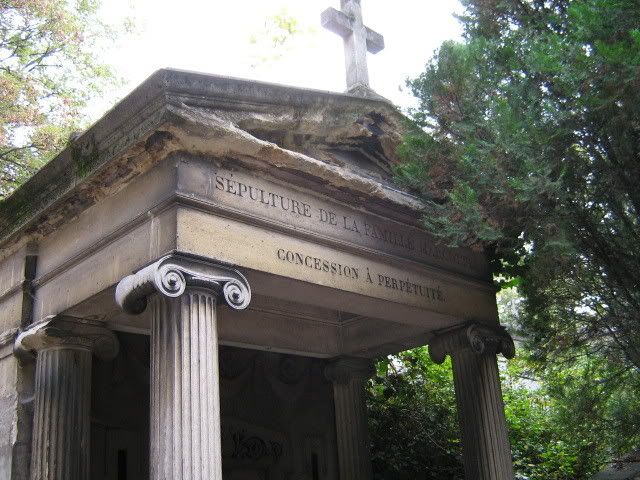
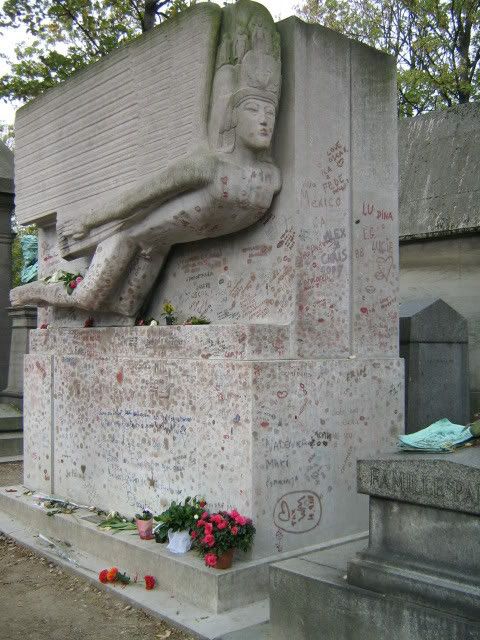
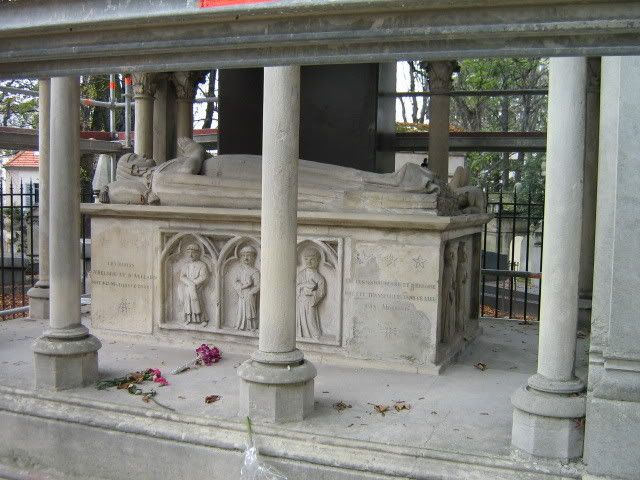
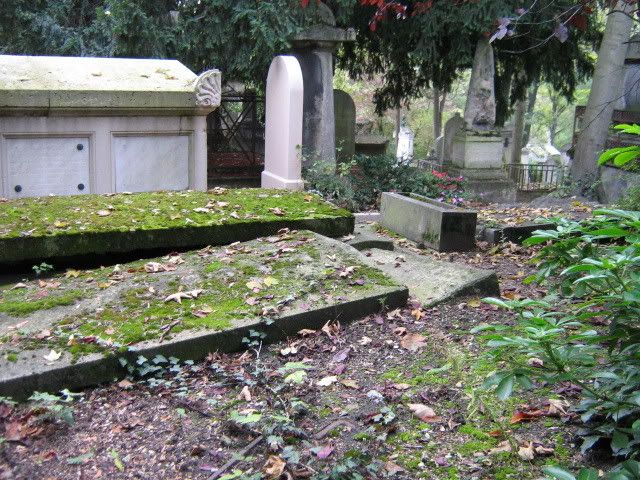
The genealogically-related pursuit of interesting or offbeat cemeteries is relentless and demanding but someone has to do it. Recently I found myself in Paris to do just that—enjoy a site I’d regretfully missed on a number of previous visits. Père Lachaise cemetery is not on everyone’s top ten Parisian landmarks. But it does hold hallowed ground (pun intended) among cemetery connaisseurs.

The old monuments are family dedicated forever. Note the concession à perpétuité. Navigating over 100 acres of hilly territory amidst small gaggles of gaping tourists and the occasional funeral procession or maintenance vehicle was a challenge. Isadora Duncan eluded me, even with my selection of drooping site maps (uh oh, I’m looking like a tourist myself). Maybe she is just there by the crematorium building which was blocked off for restoration.


And where oh where did Jane Avril go? Back and forth, up and down, weaving criss-cross between the markers on that particularly difficult hillside, I couldn’t find her. While Toulouse-Lautrec is not there, his friend Jane is, without visible epitaph.


We all know Jim Morrison has his fans, but Oscar Wilde was a clear favourite. Admonitions to respect the dignity of the deceased had no effect on this lipstick-smeared, rather ugly memorial. Victor Hugo and Chopin were accorded more appropriate homage with many flowers. Simone Signoret and Yves Montand. Modigliani, Proust, Balzac, Rothschilds. Pause for Molière, remembering Le Misanthrope in French 401!


Héloise lies beside her Abélard for eternity now, their mediaeval remains having been reinterred here. With all the activity going on within and without the gates, I feel that concession à perpétuité is assured.


My techie CDM says click on the photos to enlarge them. You probably already knew that. Magic.

24 September 2007

Ryan


One year ago today my friend Ryan Taylor took a bus from Toronto to Niagara Falls and ended his life. His body was not identified for several days, on the New York side of the river. Missing person reports caused intense distress and confusion. Ryan would never have intended to add such extra anguish to family and friends. In solitary preparation, he had tied up a number of professional loose ends. He had completed and returned the updates for his courses at the National Institute for Genealogical Studies. He spent time to sort his papers for sending to an local archive. He timed his leave when the first television season of Ancestors in the Attic was wrapped. For all I know, he may have done the same tidying up in his job as a librarian. Ryan liked things tidy.

Suspicions of alternate scenarios die hard when people are shocked. Those are the people who knew him as the bigger than life, commanding but charming presence ... the speaker who could captivate an audience, patiently explain family history to a library patron, share tea and cake or cocktails and appetizers with friends of all ages. So many friends. So much talent. He never failed to amuse with his encyclopaedic knowledge and humour. Then it was easy to induce and share his irresistible laughter. Those were the good times. He needed and loved them. In lonely times, which he couldn’t share, he was diminished and finally defeated.

Endogenous depression is very, very difficult for the afflicted person to admit, express, describe or share ... close to impossible. This is not the same as exogenous depression which results from a drastic “life event,” usually a one-time happening. Endogenous means recurring or chronic bouts of debilitating mental suffering that has physical as well as mental effects. 


Chronic depressives are almost helpless to fight the unpredictable biochemical change that plunges them into a bottomless black pool of deep anxiety, self-recrimination, self-loathing, panic attacks, agoraphobia and/or suicidal thoughts, not to mention shame at their inability to control it. Medication works for the fortunate few. Medication often means years of monitored experimentation to find something that works. And often a hard, discouraging journey in itself.

My dear friend. How we wish we could have eliminated your pain. You would have loved the last joke we never got to share. Your everlovin’ buddy, Brenda Harriman.

19 September 2007

Plus ca change ...

As the plodder moves on through book revision, finishing one chapter at a time, it is this writer's fate to learn that some source or reference has changed, something new has been added, something old was replaced. A non-fiction 'textbook' must be as up-to-date as possible. Imagine that, when the world of genealogy has embraced the Internet with mucho gusto. The seductive, sly and slightly neurotic Internet.

Keeping track of URLs is bad enough. But whoa, it's back
yet again to rewrite even less happy news. The Archives of Ontario has stopped its photocopying service in the Reading Room, replacing it with order forms for service and longer waits. Even more serious, Library and Archives Canada has made drastic reductions in its open hours and service ... after their publicly announced commitment earlier this year to the ideals of family history. Quite the catch-22. By channelling their efforts into more electronic resources, LAC shortchanges all the researchers who need their on-site material.

And my carefully revised section on adoption may be defenestrated. Ontario's long-planned new legislation to open formerly sealed records was finally implemented this month. Just days later a Superior Court judge struck it down as unconstitutional.

I'm at the mercy of these people, whoever they are. And sadder for it.

26 August 2007

Plodding and Slogging

Plod and slog does not refer to my blog. Am plodding on a revision to my Genealogy in Ontario: Searching the Records. And what a job. The last really effective revision was in 1996 and the world of genealogy has changed incredibly since then.


Equally incredible to me, by the time the 2008 edition appears, it will be almost 25 years since the first slim version was published in 1984. Originally, writing it for the Ontario Genealogical Society was a trade-off for me. I was able to weasel out of organizing their first Church Registers Project and write something for them of which I knew better.

With revisions or new editions in 1988, 1996 and 2002, I lost track (probably OGS has too) of how many copies have been sold, but it must approach 10,000 by now. I’m told that is beyond what is considered a “bestseller” in Canadian publishing terms, but what do we amateurs know. Amazing to some, but not to me, how many North Americans have Ontario roots or branches. The first two editions bore a cover designed at my vague direction by one of my artistic children, another satisfaction.

The fourth edition has the advantage of a unique friendship to steer me among the reefs and keep the jib trimmed. At last, I am learning about writing and editing. Meanwhile, the blog suffers from inattention.

04 August 2007

I Was Adopted

If ever a picture was worth a thousand words, this is it, for me (unhappily, the "original" does not reproduce well). Who do you think this gorgeous creature is? What time period? How old do you think she is? I’ll tell you something about her but I want to see if anyone guesses her age in this photograph. Since this blog is dedicated to family history interests, I have to say she belongs in a unique way.


The striking beauty evoked gypsy or exotic Mediterranean comparisons, but she was born in Winnipeg to a working mother who struggled to make ends meet. As Yvonne Mason Reynolds, she was a child entertainer on prairie and western vaudeville circuits when “acts” would travel from one theatre to another with a manager—in her case, with her mother as chaperone. Vonne was eventually paired with sister Adele, but Vonne was rapidly growing, looking older than her years, while Adele was tiny and blonde. They sang, danced, did comedy routines on their physical differences, and were a great hit. Once—Winnipeg was on a prairie circuit for imported acts—her mother managed to persuade Bill (Bojangles) Robinson to give her tap dance lessons.

Theatre life was tough, along with life in general, and sometimes she wanted to give up. She knew her unacknowledged father was a scion of an old prairie family, and she only met him when he was on his deathbed. As vaudeville waned, she became a fashion model: a natural, with her perfect figure and over six-foot height. Early experience taught her to develop a shielding persona in her adult life of elegant appearance and wisecracking humour.

Some time after marriage to Ken Sherman, they moved to Thunder Bay where they bought a local photography studio. Vonne learned and managed every aspect of the photography business; her own glamour was no small point in selling customers on having their portraits captured, and she brought out the best in them with her fussing and uninhibited remarks. Her former stage career gave her the knack for posing her subjects, perfecting the lighting, and using imaginative props. In an era before colour film, Vonne’s artistic talents were instigated by colourizing of black and white portraits. Before long she also became a devoted member of the artistic community. She befriended Norval Morrisseau during one of his detox hospitalizations in the 1950s, bringing him art supplies, and treasured the paintings he gave her.

This is when I met her as a family friend; we shared a certain love of the footlight experience. And shared a cross-country trip to the Banff School of Fine Arts, me with two chaperoning mothers. Vonne’s public persona was a magnet for men and women alike. Dinner parties at the Shermans’ always involved exquisite meals with ingredients uncommon to most Thunder Bay tables. She never had children, but became a surrogate mother to a couple of “chosen” daughters, delighting to repeat in her smoky drawl that she never had to spread her legs to get them.

Vonne never lost her enthusiasm for the stage and returned to it later in life. She and Ken retired to Victoria in the 1970s. She proceeded to become well-known in Victoria for her participation in dozens of theatrical productions; early on, she was persuaded to join the cast of “Auntie Mame” as Vera. Other major roles followed in “Gypsy” and any number of musicals. Her can-can high kicks and later character performances—which she kept up until she was 80!—endeared her to fellow performers and audiences alike. This is where she really felt alive. There was nothing better than a cast party where she could be persuaded to croon at a piano Dietrich-style. One of the most public moments was the visit to British Columbia of Vonne’s look-alike Bea Arthur (remember “Maude” on TV?). They were posed in “twin” pictures with an interview which was flashed all over newspapers up and down the west coast. No doubt in my mind who was the star.

As she lost her sight, underwent numerous cancer operations and debilitating physical humiliations, she refused to lose her imagination or the stalwart humour. In fact she regularly tortured herself to apply makeup and fix her hair just so for a photo, to prove to her distant friends she was still alive. From her original majestic height, she had shrunk to a painful five feet six inches by the end, and at the age of 93+ years her body finally succumbed. Vonne insisted on no death notice or obituary or public burial when her time came, and her wish was honoured.

I still half expect to hear that voice coming down the phone line, “What’s on your mind today, love? What can Momsie do for you?” She knew how much she was loved.

24 July 2007

Cheers and Boos

In early 2007, Library and Archives Canada (LAC)—the national repository for Canadian historical documents and heritage in Ottawa—made a public declaration of its commitment to genealogy and family historians:
“At the individual, family and community level, genealogy is an essential and primary learning tool for creating an understanding of who we are. It celebrates the social contract between the individual and society through one’s family structure, history and heritage.... Creating a focus around genealogy gives LAC a unique opportunity to reach many new audiences who are interested in genealogy and, at the same time, encourage them to go beyond a name on a family tree.” www.collectionscanada.ca/genealogy/index-e.html

The announcement of the LAC Strategy for its Genealogy Program was, in itself, a historic moment. It represents another success in a long struggle for recognition of family history as a valid study and genealogy as a legitimate discipline. Way to go, National Archivist Ian Wilson and your team!

Academia is a much harder road to hoe in terms of mutual respect. Genealogy has been considered as almost irrelevant in the halls of history. And yet our standards of proof are now higher than those employed by historians and related disciplines that rely on “secondary sources” and/or preponderance of evidence for presenting their conclusions. In the last fifty years, genealogical standards of research and evidence have reached a high level of refinement, thanks to the Board for Certification of Genealogists: www.bcgcertification.org/. Ivory towers take note: university degrees in family history will win out!

That is why it’s still discouraging to counteract ignorant or negative impressions, especially when those impressions are published in a high profile, prestigious magazine. An article in the July 2007 Smithsonian Magazine by Richard Conniff called “The Family Tree, Pruned: Its Lure is Powerful—but Genealogy is Meaningless, Relatively” raised a powerful reaction on my professional listserve. The article paints genealogists and family historians with the pathetic old brush of seeking noble or celebrity ancestors (we only want to connect ourselves to an aristocratic or famous historical figure). *Yawn.* Where did this man do his research? Are we too sensitive to a little humour? Was humour actually employed? If it was tongue in cheek it leaves quite a bad taste in the mouth. Never mind the unsuspecting readership who will take it at face value. And so old myths are perpetuated.

Some of the hurdles we continue to surmount are inherent in the dual nature of ‘genealogy.’ We have professional genealogy—those who work at it as a career, whether in client research or a wide variety of educational activities and family historians who want their end results to be as accurate as possible. We also have ‘hobby’ genealogy—a greater majority who work at their family histories as a part-time pleasure, perhaps in splendid isolation apart from the ambiguous effects of Internet searching. Those of us who live it at a professional level have an obligation to help educate the ever-expanding growth of “newbies” about acceptable standards of proof and presentation.

Ultimately, what all of us want is to honour those who went before us. We want our own ancestors to come alive. Most of us want to know what makes us tick, who and where did it come from, how did they live, what local events influenced them. We uncover connections to “lost” family members, medical history, genetics, community and religious history, migration movements, legal issues, and social context. As we age, it’s so interesting to see physical features or personality characteristics repeated in the new generations sprouting up.

Still, sometimes it seems that only commercial concerns recognize us as a large and important segment of the North American population, albeit as a driving business force. But we are more than consumers. And we aren’t going away.

04 July 2007

Cemetery Power

One of my favourite subjects again ... The New York Times 25 May 2007 had a lovely article (“Cemeteries Seek Breathing Clientele”) by Patricia Leigh Brown in Philadelphia. Hardly breaking news to family historians that cemeteries are heritage sites and deserve attention! We struggle to save abandoned cemeteries and fight municipal bureaucracies that favour development over respect for the deceased. Now, the boards of historic cemeteries have created novel fund raising ways for the necessary upkeep. I quote:

“Historic cemeteries, desperate for money to pay for badly needed restorations, are reaching out to the public in ever more unusual ways, with dog parades, bird-watching lectures, Sunday jazz concerts, brunches with star chefs, Halloween parties in the crematory and even a nudie calendar. Laurel Hill, the resting place of six Titanic victims, promotes itself as an 'underground museum.' The sold-out Titanic dinner, including a tour of mausoleums, joined the 'Dead White Republicans' tour ('the city’s power brokers, in all their glory and in all their shame'), the 'Birding Among the Buried' tour, and 'Sinners, Scandals and Suicides,' including a visit to the grave of 'a South Philly gangster who got whacked when he tried to infiltrate the Schuylkill County numbers racket.'

“Some cemeteries are betting on infotainment. At Heritage Day last weekend at the 200-year-old Congressional Cemetery in Washington, a 70-piece marching band serenaded the grave of John Philip Sousa, and dog owners held a parade for dogs dressed as historical cemetery personages, including a Union soldier.”

Great stuff. The mind boggles with rapture at the nascent possibilities. Guelph, Ontario, was a leader here with creative tours of Woodlawn Cemetery that feature the raising of the dead in period dress and their tales of miscreants, mystery or mayhem (the ideal ancestors). The old burial ground at St. James Cathedral in Toronto still contains the bones of first citizens of the historic town of York under its adjacent lawns and parking lots. I'm all for a son et lumiere spectacle at the Cathedral reenacting ancient duels, distillery building, cholera shed workers, free speech at bar-room gatherings, temperance complaints, and other tranches de vie.


Unfortunately, this is not a photo of burials at St. James, because no stones are left to mark the remaining forgotten who were never transferred to newer cemeteries. Brenda has substituted a photo from a Loyalist burial ground in Bear River, Nova Scotia.

Nevertheless, family historians, take note of fundraising and fun. GO, cemetery directors!

23 June 2007

FRASER Families Part 1

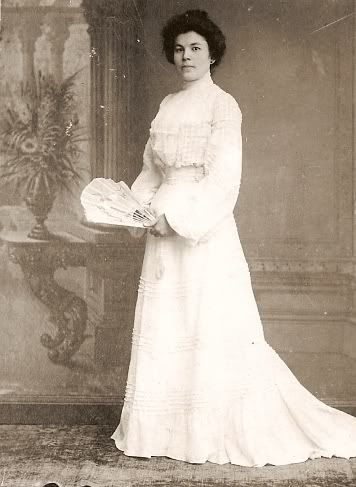
This is my lovely-looking petite great-grandmother Catherine Fraser, known as Kate to her husband. Not sure yet, but I may be facing several Fraser lines of descendancy but I do think it’s a fine name. Turns out both Catherine’s parents were Frasers who settled in Argentueil County, Quebec, around St. Andrews East. Many of her descendants through the generations have given the first (or second) name Fraser to their sons.


Catherine was born 29 December 1833, daughter of John Fraser and his wife Nancy Fraser at St. Andrews East.(1) She married Peter Dougall there in March 1852.(2) The fact that Nancy was also a Fraser was reinforced by the marriage bond of Catherine’s parents in 1832, so I had two different "lines" to deal with.(3) A local history gave some lore about many Fraser families, but even along with church registers and census returns, not enough to figure them all out.(4) The parents John and Nancy Fraser do not appear in the local burial register or St. Andrews East Protestant Cemetery, so I didn’t know when they died.


Catherine’s mother Nancy (short for the formal Ann) Fraser had a father called John Fraser, who was my Catherine’s maternal grandfather.(5) By eliminating another early John Fraser in the St. Andrews area, who came from Banffshire in Scotland, Nancy’s father John was most likely from Inverness-shire. His second marriage is documented in Montreal,(6) and his first marriage in Inverness has narrowed to two 'candidates.' The wife of one of them is yet another Fraser! The Inverness region was liberally populated with Frasers in the eighteenth century, and his ancestry is unresolved for the time being.

The man from Banff could be credibly eliminated as Catherine’s father John Fraser. All we knew about her father was that he was a blacksmith and he died some time after the 1842 census and before the 1851 census. Again, no burial information from St. Andrews Cemetery. There the research had stalled and been put aside. Then I had one of my few serendipitous discoveries thanks to volunteers who abstract newspaper notices:

"Died Jan. 31 [1892], St. Andrews River Rouge, Que., Nancy Fraser, widow of the late John Fraser, and sister-in-law of the late Dr. Wm Fraser, Montreal, and mother of Mrs. P. Dougall, Renfrew, aged 85 years."(7)

Bingo! Three relationships mentioned in one source! Nancy’s identification as the widow of John Fraser and the mother of Mrs. P. Dougall (Catherine) was happy news. Even more intriguing was the reference to a Dr. William Fraser of Montreal. By tracing this medical man, the sibling of Catherine’s father, I was able to establish their roots in Killin, Perthshire, Scotland, for another two generations. Dr. Fraser will have his moment here another day. But I still wonder what happened to his brother John, my great-great-grandfather.

(1) Photocopy from St. Andrews East Presbyterian Church register, Vol. II, p. 6. The registers 1827-1850 are also on Library and Archives Canada (LAC) microfilm C-2905.
(2) Dougall-Fraser marriage, 2 March 1852, St Andrews East Presbyterian register; extract by minister W. Harold Reid, 23 September 1970.
(3) Fraser-Fraser marriage bond, 5 January 1832, Library and Archives Canada, Upper Canada Marriage Bonds, RG 5 B9, no. 3322,; LAC microfilm C-6782.
(4) Thomas, C. History of the Counties of Argenteuil, Quebec, and Prescott, Ontario. (Belleville, Ont.: Mika Publishing, 1981 reprint of 1896 original by John Lovell & Son, Montreal).
(5) Ann Fraser baptism 14 June 1812, St. Andrews East Anglican Church register, 1812-1849; LAC microfilm C-2905.
(6) Fraser-McIntyre marriage, St. Gabriel Street Presbyterian Church, Montreal, p. 24; Archives of Ontario microfilm MS 351 reel 1.
(7) Renfrew Mercury, 8 February 1895.